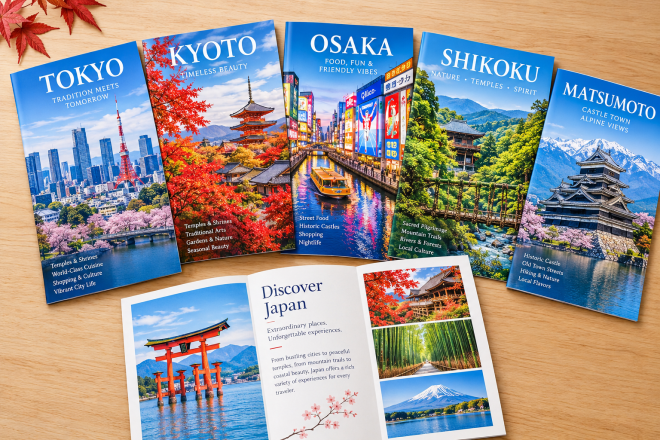
A few months ago, I knew virtually nothing about Japan. We’ve heard from many people who have been there and loved it. The food, the culture, the scenery… but what is it about those things in Japan that is so magnetic, I wondered. I’ve been to Japanese gardens in many places around the world, eaten plenty of great sushi, and seen stylistically unique Japanese art. I’ve read Memoirs of a Geisha and I know what sumo wrestling and kimonos are. But it was not until a fellow hiker on the Milford Track in New Zealand told us about the great temple-to-temple hikes he had done in Japan that I began to realize how little I really knew about the country.
Since then, we’ve taken a pretty deep dive into guidebooks, blogs, and videos, and realized that the three months we are allowed there without an extended visa will barely be enough to scratch the surface. The country consists of a curved string of mountainous islands extending about the same distance as Maine to Florida—and only around 200 miles across at its widest, or a tad wider than Massachusetts. There are four main islands and thousands of smaller ones, about 250 of which are inhabited. Sadly, we’ll probably make it to just two of the main islands during our time there.
We’ll start with the Alps – yes, Japan has Alps too, just like Europe and New Zealand. In this case, they are a long ridge of spiky peaks with active volcanoes interspersed, bisecting the main island of Honshu, where Tokyo is situated on the eastern side. Mount Fuji, the most famous and iconic volcano in the country, rises over 12,000 feet, and several others are over 10,000 feet tall. We’ll take a train and bus into the mountains from Tokyo and stay in a wide range of accommodations, from basic hostels to old-style ryokans with tatami mats on the floors, roll-out futons for beds, and hot springs to soak in. We’ll let you know how the hiking is, but we’re excited to see this region in autumn, when those famously red Japanese maples are supposed to rival (if not surpass) New England foliage.
This continues our unplanned journey around the Ring of Fire—lands of volcanic, geothermal, and seismic activity that circle the Pacific. Ecuador, Chile, New Zealand, Hawaii, and now Japan. To complete the circle, at some point we’ll have to get to Indonesia and then Alaska, but that’s a trip for another (summer) day. I just learned that somewhere around 75% of the world’s active volcanoes and 90% of the world’s earthquakes are associated with the Ring of Fire—but I swear to you, we do not have a death wish and we are not adrenaline junkies looking for the next explosion. It just kinda worked out that these are fascinating places to visit!
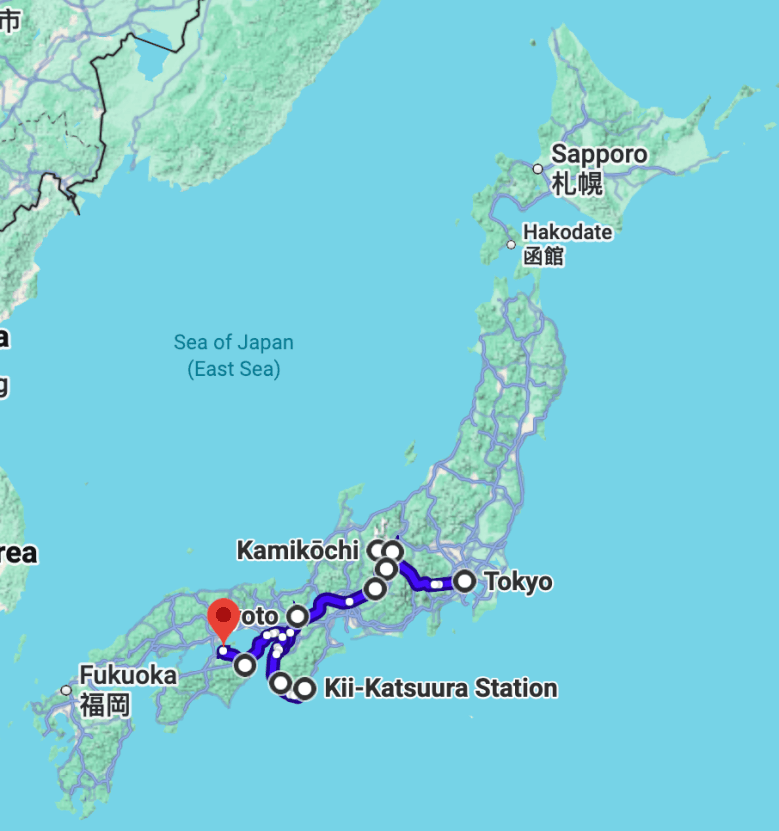
In addition to hiking in the Alps, we’ve also planned a series of multi-day walks along ancient stone roads and paths. Some of these once were the primary connections between cities; others connected temples and became the paths of pilgrims. Today, walkers along these roads are supported by villages, trains, and luggage-transport services. Because the fall foliage makes many of these walks so popular when we’re there, we found that booking lodging months in advance was essential—and even then we found ourselves shut out of some of the most highly recommended lodges. But we managed to find rooms in strategically placed locations—ranging in price from $70 to $300 per night, and we’re not entirely sure why yet!
Then we’ll settle into Kyoto, the old capital, for three weeks. Not only did we think we might need a respite from all that moving around, but from the guidebooks, there appears to be so much to see and do in Kyoto and within the range of a day trip from the city that we figured we needed at least that much time. Fun fact: Kyoto (the old capital) and Tokyo (the new capital) are anagrams of each other! Hopefully at some point we’ll find out if that was intentional or not.
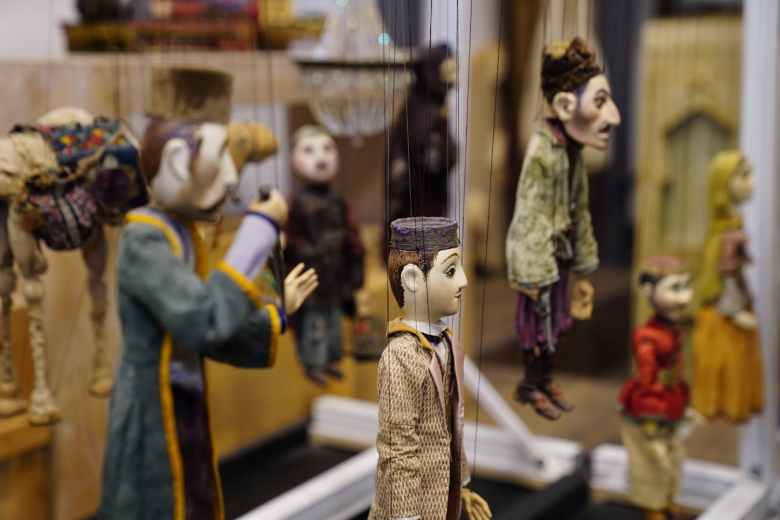
The Japanese culture is ancient—the islands have evidence of human habitation tens of thousands of years old, and recorded history there begins around 100 BC. That’s a big change from last year in New Zealand, where the first humans appeared only 800 years ago. The Japanese culture was profoundly shaped early on by connection to their closest continental neighbors in Korea and China, but due to their self-imposed isolation for centuries, it developed into its own unique variant. We really look forward to learning more about their art forms, ancient crafts, spiritual beliefs, and cultural traditions. Kabuki theater, bunraku puppetry, and woodblock printing are all on our list (not to mention some food tours and cooking classes) but undoubtedly that list will grow.
From our research, we’ve also learned how important politeness and cleanliness are in Japanese culture. The first Japanese word I learned this summer was “sumimasen”, which can be used to say “excuse me” (whether you want someone’s attention or bumped into them on a crowded street) or “sorry”. There are other words for “sorry” as well, but apparently “sumimasen” is one we’ll use a lot, just to be polite. I also bought some slip-on sneakers to wear around town, because we think we’ll be taking our shoes off and putting them back on again quite a lot. This is part of the cleanliness value: one should never bring outside dirt inside. Since we tend to take our shoes off in our house anyway, this should be an easy one.
This year is destined to be a shorter time in-country than our previous five years for two reasons. First (and most important), our daughter is expecting our first grandchild in early February. We certainly want to be back for that Big Event! Second, knowing that, we decided not to go through the bureaucratic hassle of applying for a longer-term visa in Japan, so we have only 90 days. It’s funny, for most of my life having three months to explore a country would have sounded like an excessive amount of time, an eon. Now it feels like we’re cramming too much into too little time and we will have to go back for another visit (except that there’s still so much of the world to see).
What are we likely to miss? Hokkaido, the northernmost island, which is supposed to be less touristy and more rural, with incredible skiing in winter. Okinawa and similar islands in the southern reaches of the archipelago, which are said to have gorgeous beaches, snorkeling, and a climate similar to Hawaii or the Caribbean. Kyushu, the southernmost main island, famous for hot springs, ancient castles, active volcanos, dramatic gorges, and Pacific beaches. See what I mean?
The more I’ve learned about Japan, the more I’ve realized how much I still have to learn. And so, the next adventure begins!


Al – we were in Kyoto last December. When in Kyoto, I highly recommend the moss garden. It’s exquisite. You’ll need a reservation; we went first thing. Maybe the most beautiful garden we’ve ever seen and we’ve seen a lot of gardens. Would also recommend the imperial palace, reservation required. And lastly Ryoan-ji; the most famous zen garden in the world. Along with a million other pavilions and gardens. If you go to the bamboo forest, which is mobbed with tourists, continue on a nice walk to the Adashino Nenbutsuji temple – beautiful minus the masses of visitors. It’s an amazing city! Safe travels. Laura Kirk
LikeLike
Thanks Laura! We’ll put these on our list. All recommendations welcome!
LikeLike
So excited for you! Another good tip to go with the slip on shoes: make sure you don’t have socks with holes in them!
LikeLike
Thanks for the tip, G., and all the earlier advice! Got new socks too!
LikeLike
Hot Springs, YES! Riokan, YES! It all sounds like an invigorating and enriching 3 months Wore out a pair of shoes walking around Kyoto. The bottoms just fell apart. Have a spare. Kyo means big city or capital in Kanju, so why it is in both words, according to Mika. Cant wait to go along for the ride.
LikeLiked by 1 person
Just yesterday I was wondering where you were headed this time around. I’ve got my answer! Have a blast and congrats on your upcoming grandparent experience! Best to both of you.
LikeLike
Thanks Luis! We sure aim to get back to Spain one of these days too!
LikeLike
Hello, Al and Rachel,
It looks like another great, though foreshortened adventure for you, though, as I note when I don’t have enough time, money, patience, you name it, to feel like I’ve done all the visiting I would like, it will still be there (for a return trip).
So, looking forward to hearing more as you wander, and yay for becoming grandparents early next year.
Leslie Beatty
LikeLike
Thanks Leslie!
LikeLike