It felt like a balm to reach the mountains after spending three days in Tokyo, where we had recovered from the long flight and time change and explored just one small sliver of the third most populous city on Earth. In Tokyo, everything seemed to flash and sing and clamor for our attention. Our tiny hotel room was close to Shinjuku, the busiest train station in the world, used by 3.6 million people daily. That’s like nearly the entire population of Los Angeles passing through one building every single day. The station is like a small, crowded city unto itself, with more than 200 exits, a dozen shopping malls (for real!) and mazes of passageways that would make a lab rat fall down in despair. We used it to escape to the Alps.
And while the most popular hikes in the Japanese Alps are almost as crowded as Tokyo streets, once we got beyond the easiest, most accessible trails, we were finally able to feel a sense of solitude. The Japanese have a phrase for that feeling: shinrin-yoku, or forest bathing. The idea is that spending time in the quiet woods can be like a soothing soak for the soul. After a few deep breaths in the mountain air, listening to birds and trickling streams, we were right there in the warm bath.
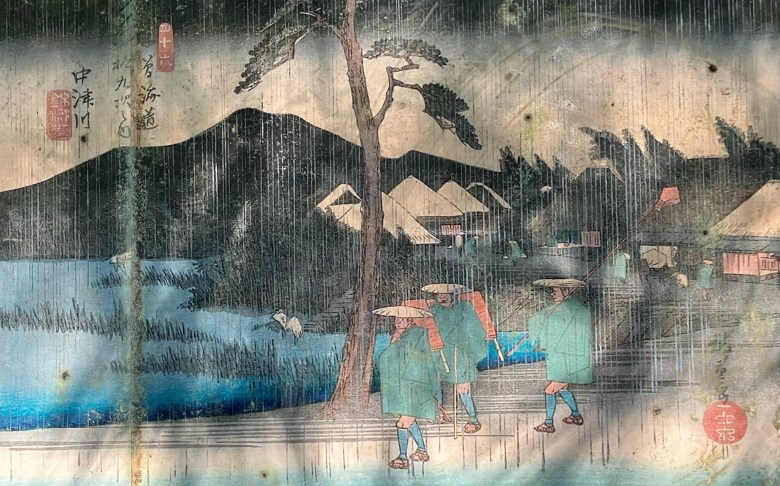
Of course, “forest bathing” is a modern invention. Long ago, people spent a lot of time walking through the woods and mountains to travel between larger cities, and it was no soothing bath. The largest Japanese island, Honshu, has a north-south spine of spiky mountains bisecting the coasts, so paths through the mountains became essential arteries for trade and connection. One of two roads connecting the imperial capital city of Kyoto with the financial and military center on the east coast, Edo (now Tokyo), was the Nakasendo Trail through the mountains.
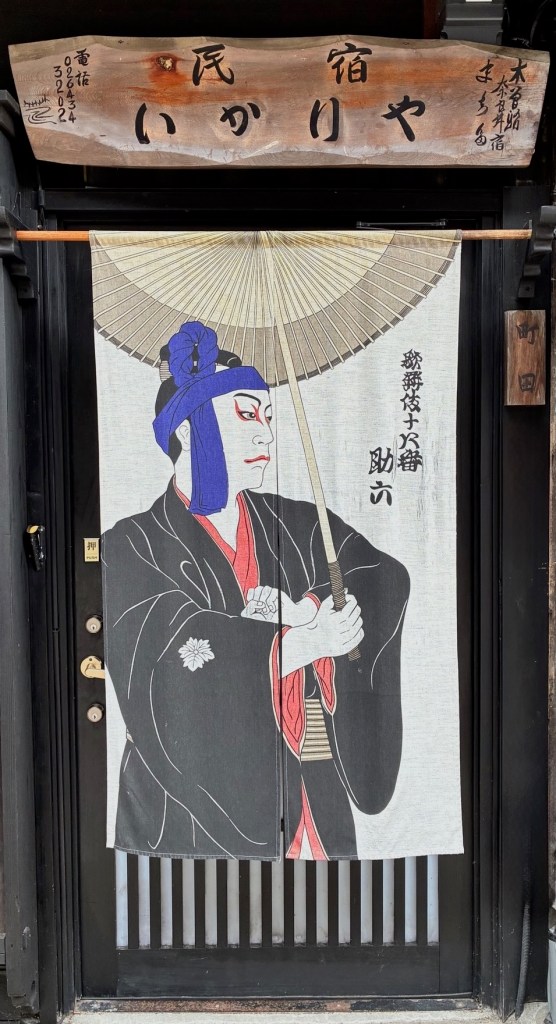
We chose the Nakasendo for our first multi-day hike in Japan. We sent our luggage ahead to the end, carried four days’ worth of clothes and lunches in our backpacks, and spent the nights at ryokans in post-road towns along the way. We had gotten our first taste of the ryokan experience in the central Alps before the Nakasendo. These are old-fashioned inns with futons on bedroom floors covered in tatami (woven straw mats). Many of the inns have natural hot springs called onsen where weary hikers can soak their sore muscles. They also serve traditional, multi-course Japanese meals, including all manner of foods we couldn’t identify—and some we could identify but might have preferred not to—but the flavors were delicious and served with such care and pride that we stuffed ourselves morning and night.
Ryokans, shops, and small villages on the Nakasendo originally popped up to serve travelers along the route, and several well-preserved examples continue to do so today. At its peak, 69 post stations broke up the journey of 330 miles—one every 5 miles or so. While people first carved out the paths that would become the Nakasendo as early as the 9th century, it was the era of the Shoguns and Samurai (around 1600–1868) when the roads connecting Kyoto and Edo became most vital. In fact, the Nakasendo is sometimes also known as the Samurai Road (though truth be told I didn’t know that until I saw it on a sign outside a souvenir shop near the end). Whether or not that’s a name for tourists, it’s true that the road was created for and used most often by samurai, feudal lords, and traders on official business between the city of the Emperor (Kyoto) and the city of the Shogun (Edo).
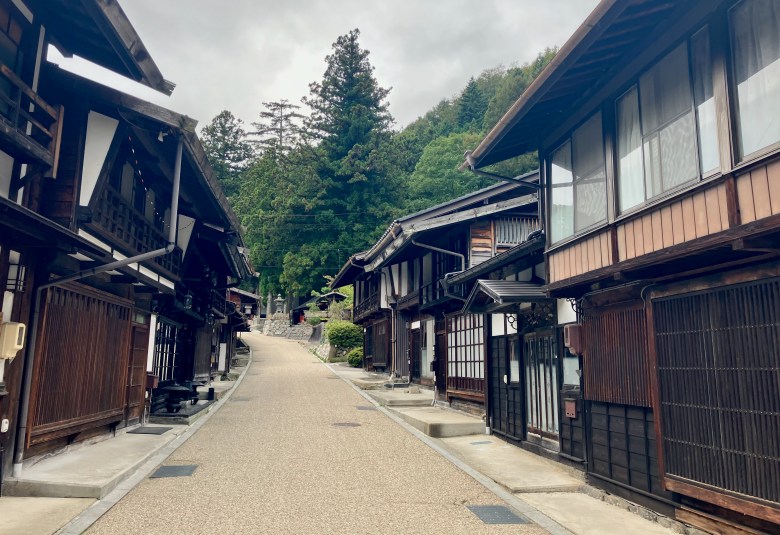
Our journey would pass through the Kiso Valley, one segment of the full Nakasendo that includes 11 post road villages and 52 miles through the mountains alongside the Kiso River. Our first stop was the hamlet of Narai-juku (juku is a suffix used along the Nakasendo that means “post road town” or “place to rest”). Well-preserved wooden houses line the narrow main street, many now selling local crafts like wooden combs and foods like grilled mochi-dough dumplings, made with sticky rice flour. It was the opposite of Tokyo—quiet, calm, uncrowded, and essentially closed for business by 4pm.
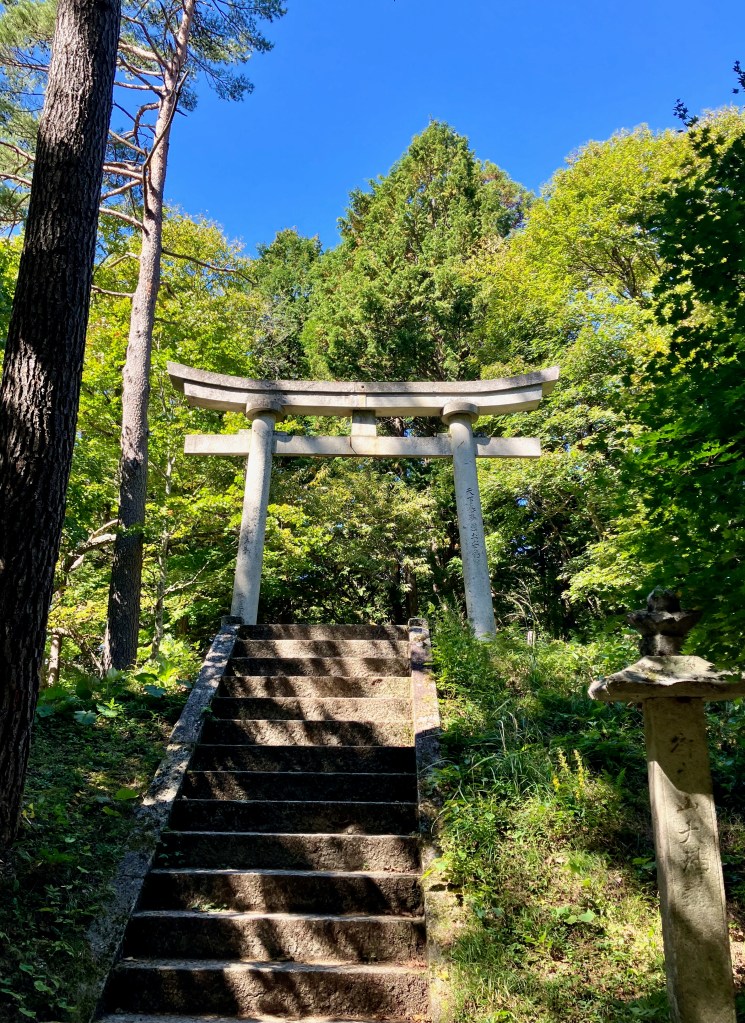
Mountains rose up at one end of Narai’s main street, where Nakasendo hikers climb up and over the Torii Pass, the highest point on the trail at about 4,000 feet. While only a few hours’ walk between villages, this section of the trail is its steepest. At the top is a large stone gate known as a torii marking the entrance to a Shinto shrine. Torii are intended to represent the transition from the mundane to the sacred, a connection to nature, and the spiritual journey of those who pass beneath them. It wasn’t hard to imagine weary travellers wearing straw sandals (many carrying heavy loads for their samurai leaders) reaching that shrine, exhausted and dusty.
In our modern version of the Nakasendo, we caught a train from the end of the Torii Pass hike to our next post town, Kiso-Fukushima, in order to avoid parts of the trail that are now busy roads. Here we visited a restored checkpoint station, one of only four that once existed to control the flow of both travelers and restricted goods. At that time, it was especially difficult for women to secure passage, as feudal lords wanted to prevent their wives from fleeing. Guns were also heavily restricted to prevent the lower classes from rising up against the lords and samurai. One signpost here told us that feudal lords were required to travel to Edo to meet with the Shogun every other year, and each time they traveled with 2,000-3,000 people to support them. The largest entourage ever recorded was that of a princess who married into the Shogun’s family. She was accompanied by some 20,000 people and 3,000 horses. The procession was 20 miles long and took 10 days to pass through the checkpoint. Our procession of two people was met with considerably less fanfare.
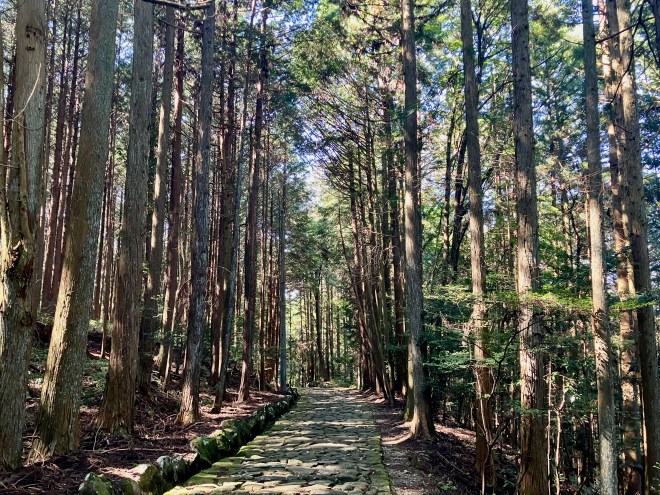
In all, we hiked only about 28 miles of the 330 over four days. Three of the four were 5-6 miles and a few hours; the second day was our only beast at about 12 miles between Nojiri and Tsumago. While we have done more challenging hikes (Milford Track anyone?) our feet sure let us know they were ready to stop and soak. These are not wilderness hikes so much as cobblestone paths, paved country roads, and some dirt and gravel trails that wind their way through cedar forests, bamboo groves, farms, and villages. The forests themselves, with light filtering through unbranched trunks, gentle streams, and quiet hills, are the primary scenery. Occasionally, the trail pops out of the woods into the valley, with views of high green mountains, looking across rice farms turning golden with autumn. Unlike the Milford, we were lucky with the weather throughout, with a string of perfect days—sunny, blue skies, high temperatures in the low 70s but starting cooler in the mornings. Perfect hiking weather.
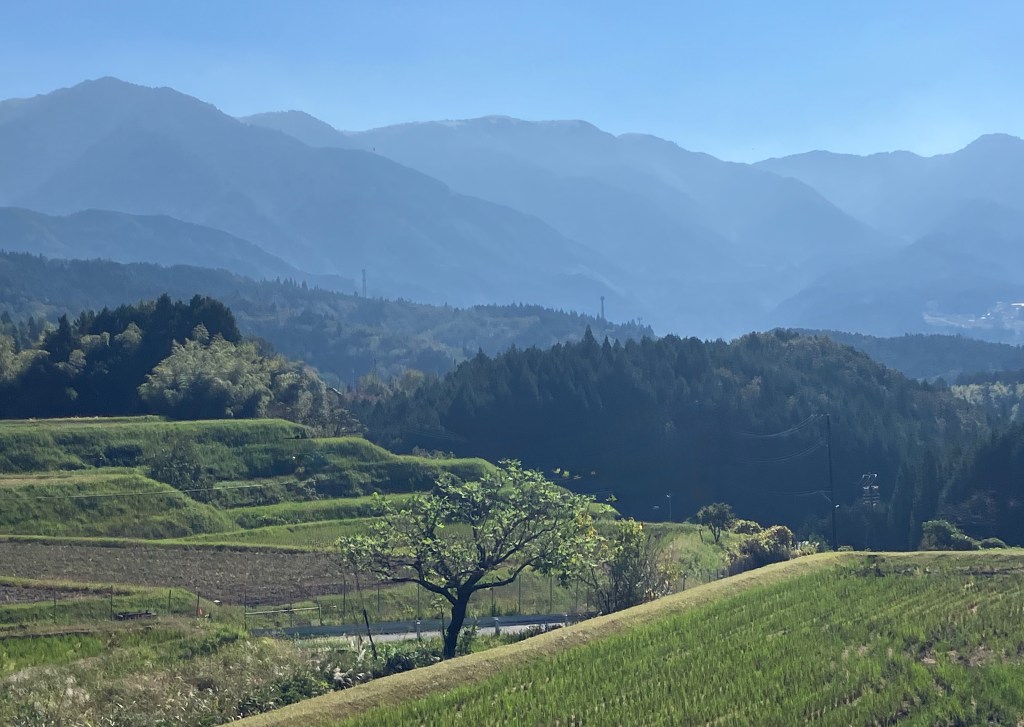
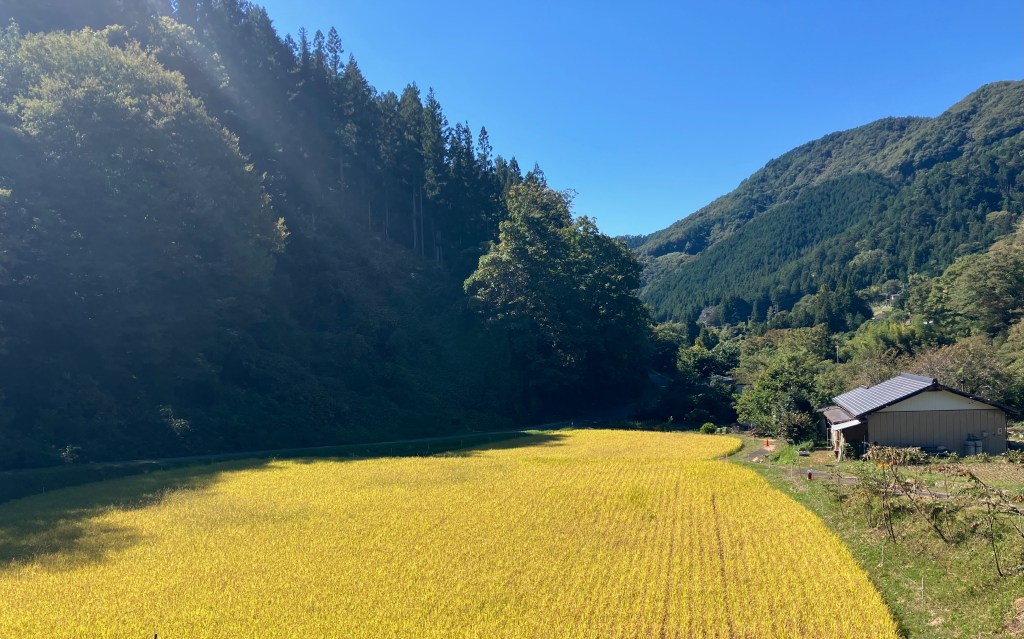
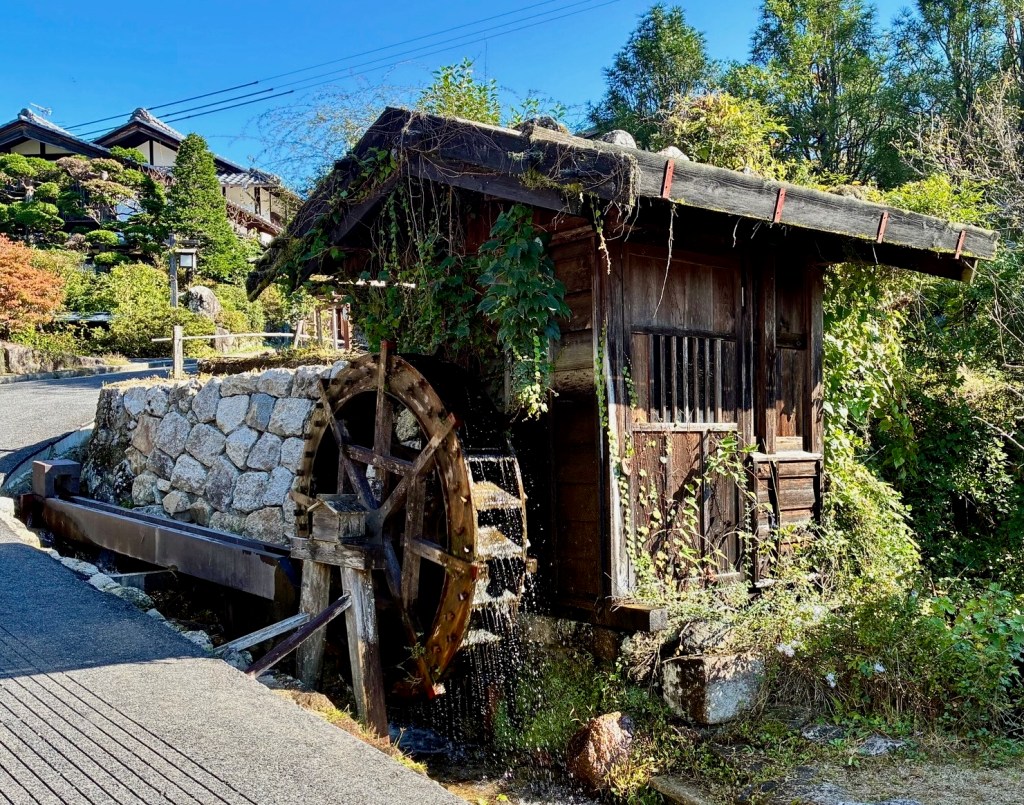
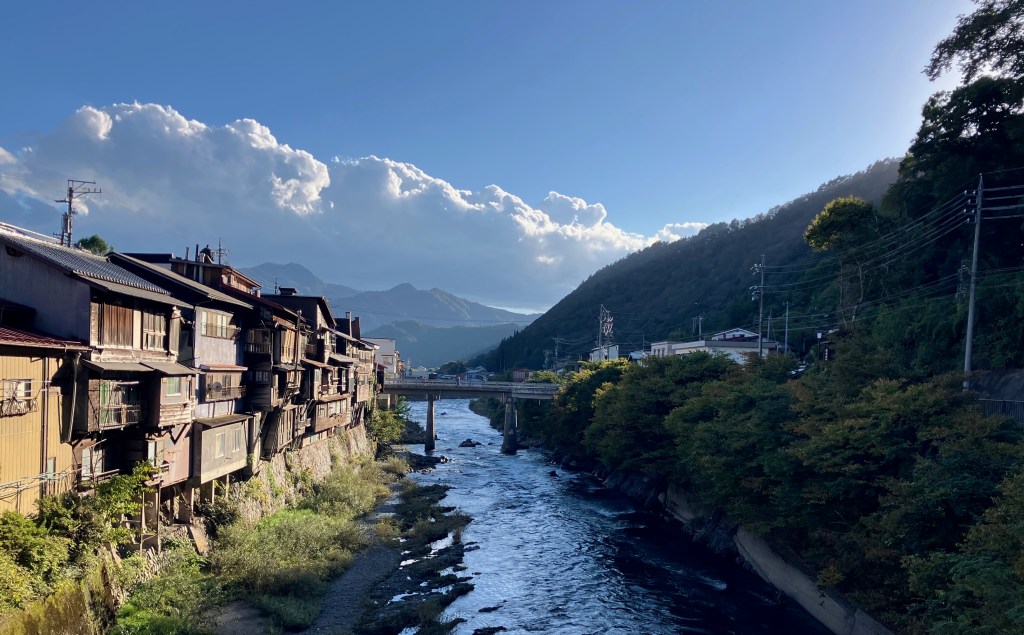
From Tsumago, a town much like Narai, with old-style brown wooden houses, quiet streets, and local crafts, we continued to Magome, a more manicured and tourist-friendly version of the post town. It still retains its old-style charm but has more restaurants and is more easily accessed—and therefore has more tourists clattering up the cobblestone main street. On our final day, we hiked two more towns southward and then caught a bus back uphill to Magome and our lodging—something that would have been inconceivable to Nakasendo travelers back in the day. Imagine that princess with her 20,000-strong entourage deciding to go back two towns before continuing on their way!
Also unimaginable 200 years ago, from Magome, we took a bus, a local train, and the high-speed Shinkansen bullet train to Kyoto, all in just a few hours. We ended with a much clearer picture of this period in Japanese history and the feeling of having bathed in the forest (not to mention several hot springs). And after a hot shower and some laundry, we’ll be ready for our next historical and cultural deep-dive: the 2,000 temples of Kyoto!