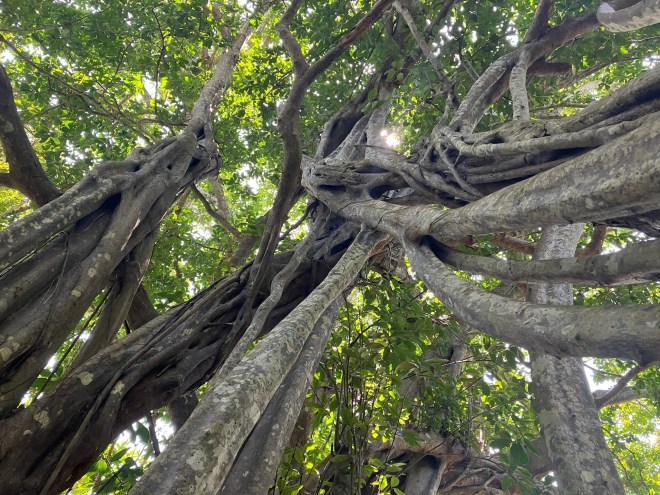
A broad smile and a melodious “Jambo” (“welcome”) greeted us as we wedged ourselves out from the back of our three-wheeled tuk-tuk. At the far end of a spine-jarring, teeth-rattling ride on a rutted dirt road, we found ourselves at the entrance to a small forest known as Kaya Kinondo in the dialect of the Digo tribe of coastal southern Kenya. Kaya translates to village and Kaya Kinondo is one of about 30 now-abandoned villages. These villages were settled in the then-vast forests by various tribes of the Mijikenda people between 400-600 years ago. Today it is the only one open to visitors.
Our friendly greeter Salim, a 23 year-old Digo man, informed us he would be our guide and invited us to join him in an open-air room under a thatched roof. I had to tamp down my knee-jerk response to doubt his sincerity, as we have been bombarded with a nearly non-stop barrage of solicitations for tours and guide services since arriving in Diani, but he was so quiet and sincere I soon set my mistrust aside. Under the welcome shade of the roof he began to share with us the history of the forest and his people.
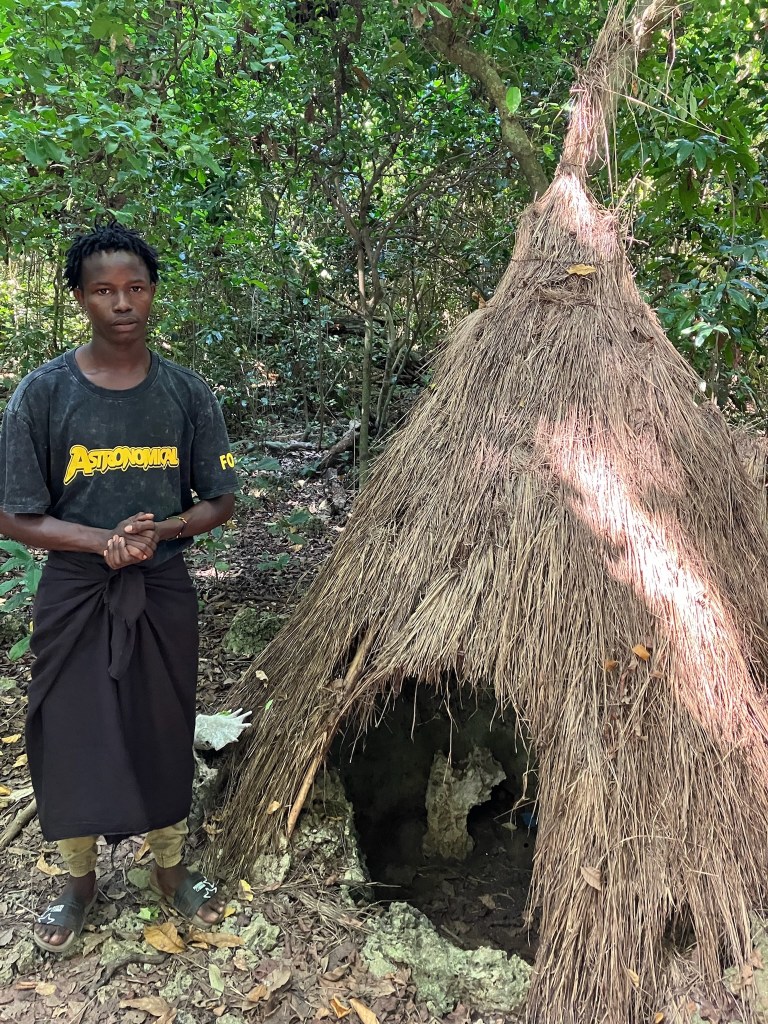
Salim told us that the Mijikenda is made up of nine tribes, including the Digo, who each speak unique variations of Bantu. He personally speaks Digo, English, Swahili, and two of the other Mijikenda languages. Each tribe is divided into clans, clans into lineage groups, and finally those into families. His ancestors originally fled to this part of the coast from Somalia hundreds of years ago when they faced persecution from their enemies. They settled along the water’s edge and lived as fishermen. During the 16th century, Arabs began arriving from the Middle East and engaged in the slave trade with the Portuguese. The beleaguered Mijikenda picked up and moved their villages deep into the forest to avoid capture. The forests, already considered sacred space, now also became their home and sanctuary for the next 300 years, until slavery was finally banned in the late 19th century. Over time, the Digo made their way back out of the forest to settle on cleared land, though they continued to worship among the trees.
Armed with this new knowledge, but before we could enter into this revered realm, we had to learn some ground rules:
- We had to wrap ourselves from the waist down in a special black cloth called a manikin (even Salim wore one)
- We had to remove our hats (much like entering a mosque or church)
- We could hug the trees but not one another—no P.D.A. allowed, except with trees.
We considered ourselves lucky when we learned that the Mijikenda people originally used a very different calendar to our Gregorian system. They didn’t have years or months. The only division of time was the week, which was four days long and every fourth day was set aside exclusively for worship. Had they still been adhering to their old time-keeping, we would have had a 75% chance of getting into the forest on this day. But lucky us, once we were appropriately attired and schooled in the rules, we were able to step onto the path and into the thick old growth.
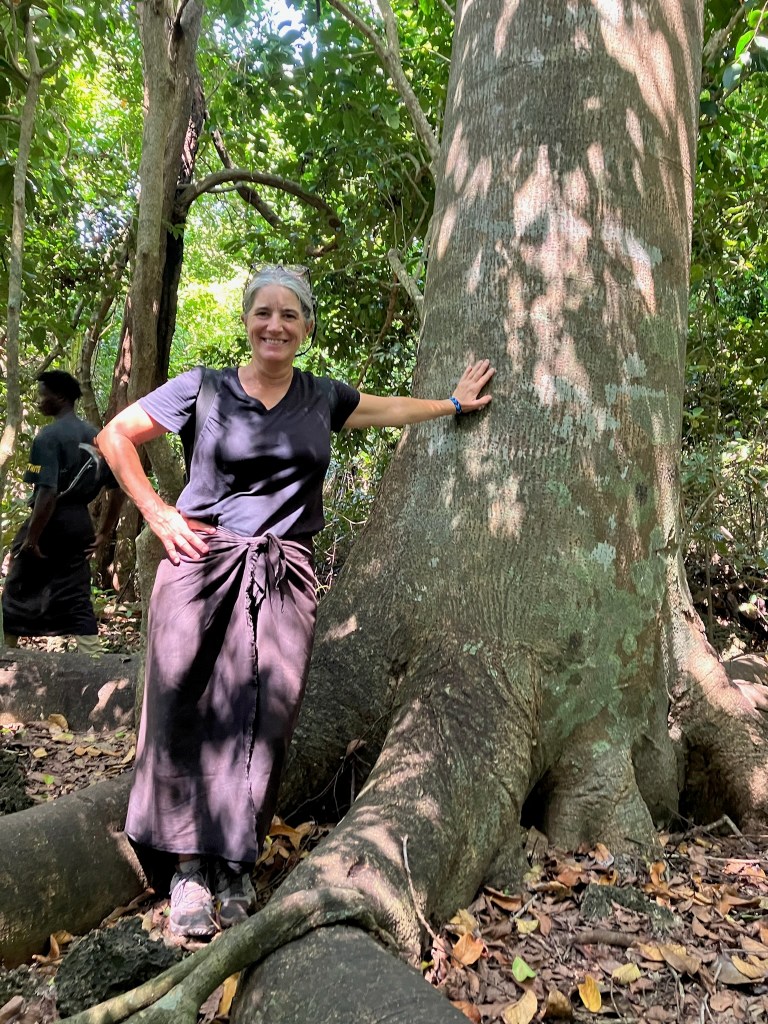
Stopping first at a structure resembling a traditional round house with a thatched roof but in miniature (think gnome size), we asked permission from the ancestors and the forest to enter their space. It brought back memories of entering the araucaria forest in Chile last year and similarly made my skin tingle with the sense of sacredness and humility. Having, I assume, gotten permission to pass, we dove deeper into the trees. Moving slowly and deliberately, in part out of respect and in part so as to avoid tripping over roots and falling flat on our faces, we began to notice the details. Here a small lizard scampering through the ground cover, there an industrious parade of ants going about their business, off to the left a dik-dik, essentially a tiny antelope, stepping lightly through the undergrowth, above us the harsh cackle of black and white hornbills discussing lunch, and monkeys silently observing us.
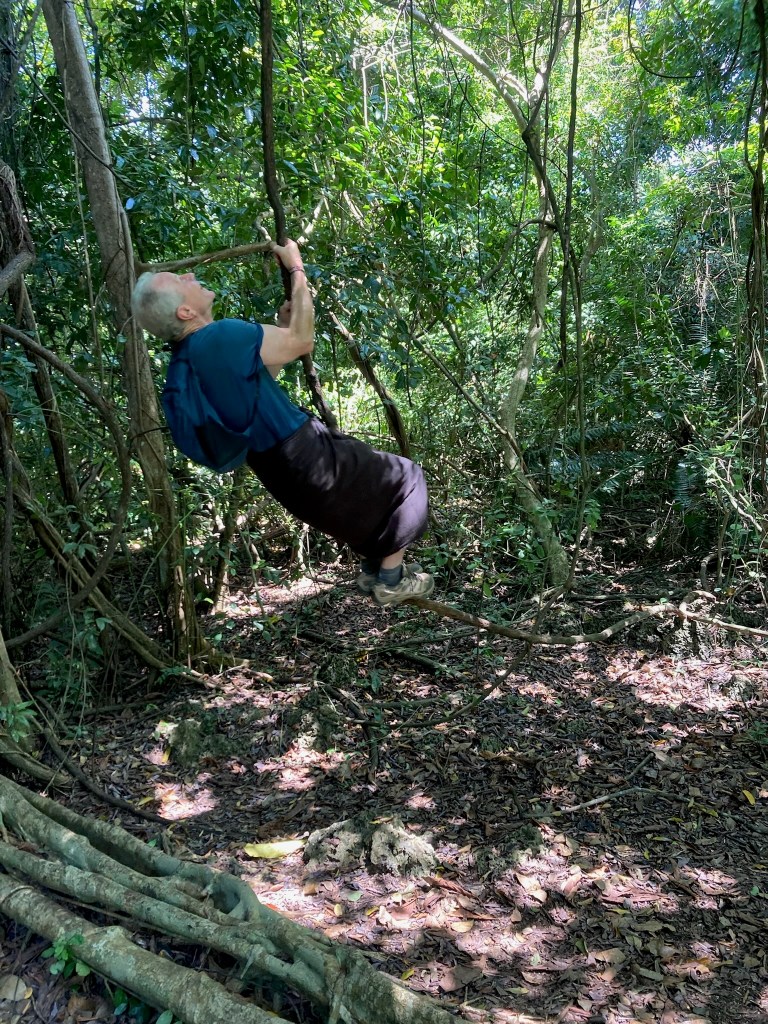
Strangler fig vines as thick as my arm hung from the tallest trees and Salim told us that the local kids enjoy using them as hammocks, swings, and climbing structures, which he proceeded to demonstrate for us, encouraging us to play too. He taught us the Digo names for some of the trees and plants and shared how they were used—some pounded into fiber to make clothing, others for traditional healing, and the only intentionally planted tree, a 300-year-old tamarind, used for culinary purposes. Farther on into the forest we stopped and met one of the largest and oldest arboreal residents, whom we were encouraged to hug and make a wish or tell it our sorrows. Again, I was reminded of another trip into a forest, this time the rainforest in Ecuador where we embraced an old soul of a tree and felt a part of the universal cosmic energy (or perhaps we had inadvertently licked a “special” tree frog or fungus. It’s hard to say.)
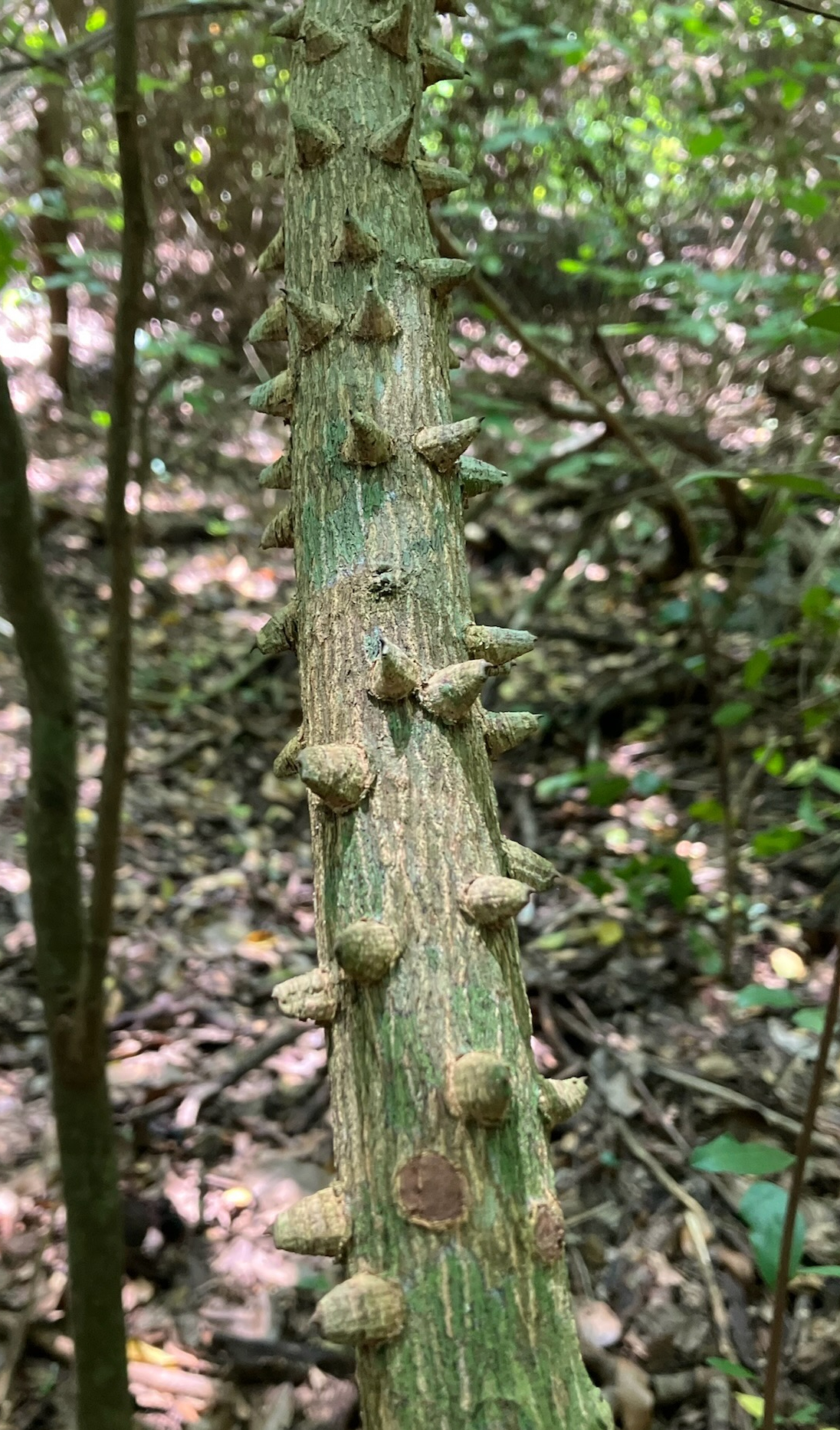
Onward we went until we came to a space that had obvious signs of having once been a clearing. Salim said it had been the site of the village when the people fled to the forest and today serves as a staging area for the worshipers. On the edge of the circle was an ash-filled hollow, which was and still is used for roasting the sacrificial animals. There is a hierarchy of animals—if an individual is having a problem, a black chicken is killed; if a clan is troubled, a black goat is slaughtered; and if the entire tribe is suffering (such as during the Covid pandemic), a black bull is sacrificed. In all three cases, the animal is then cooked and eaten (waste not, want not). Only the tribal elders are allowed into the innermost sacred space in the forest and people who are not yet married are considered children and do not attend the worship events.
The Digo people have by and large not converted to Islam or Christianity, unlike so many other groups native to East Africa. Their religion is principally a form of ancestor worship, and like the Muslims of this region they allow for polygamy (up to four wives), but you must marry outside of your own clan. Salim was clearly proud of his people, their history, culture, and spiritualism, which brought to mind the gentle and strong Mapuche people we met in Chile, the beautiful and kind Quechua in Ecuador, and the fiercely independent Catalunyans in Spain. Wherever we go in the world, we are privileged to meet people striving to live in harmony with their surroundings, honoring nature, and holding dear their ancestral traditions despite the nearly overwhelming current of modernization and globalization.
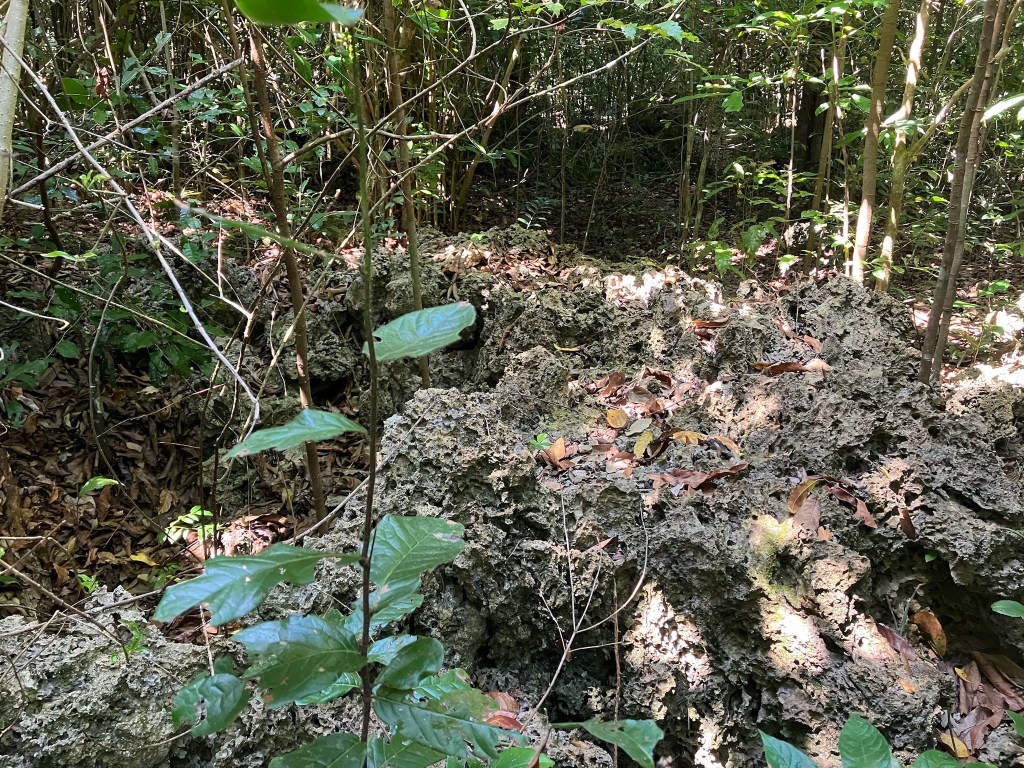
When we emerged from the forest, we saw just how close it is to the sea, yet it is so dense and maze-like that it served as protection for hundreds of years. Today a line of modern, gated resorts separate the forest from white-sand beaches on the Indian Ocean. Yet Salim had pointed out the multitude of coral remnants in the forest, a reminder that the sea once came up to that point, before his people settled there. He said they believe that the sea will rise up to meet the forest in the future, and he’s undoubtedly right. The resorts will wash away, but the forest will remain.
 Seeing the World, One Year at a Time
Fascinating and wonderful story telling! You both have such a gift for that. The contrast between what we are experiencing here in crazy land and what you two are immersed in, in an ancestral community that has its priorities straight, is incredibly stark.
Looking forward to the next chapter!
LikeLike
We are trying to minimize the crazy for ourselves by limiting how much news we read. I fear for our country. Thanks for reading and sending such a nice comment.
LikeLike
What a beautiful and moving telling…spiritual, sacred and moving. Almost hear music playing in the background.
LikeLike
What a privilege to visit this sacred forest!
LikeLike
I love the alliteration, ‘rattling rutted road.’ The piece only got better from there. The photos enhanced the verbal description so that one was transported, magically, seamlessly to an enchanted hard-to-believe it’s real, forest.
What a magnificent tutorial for you. I wish everybody would profit from it.
LikeLike