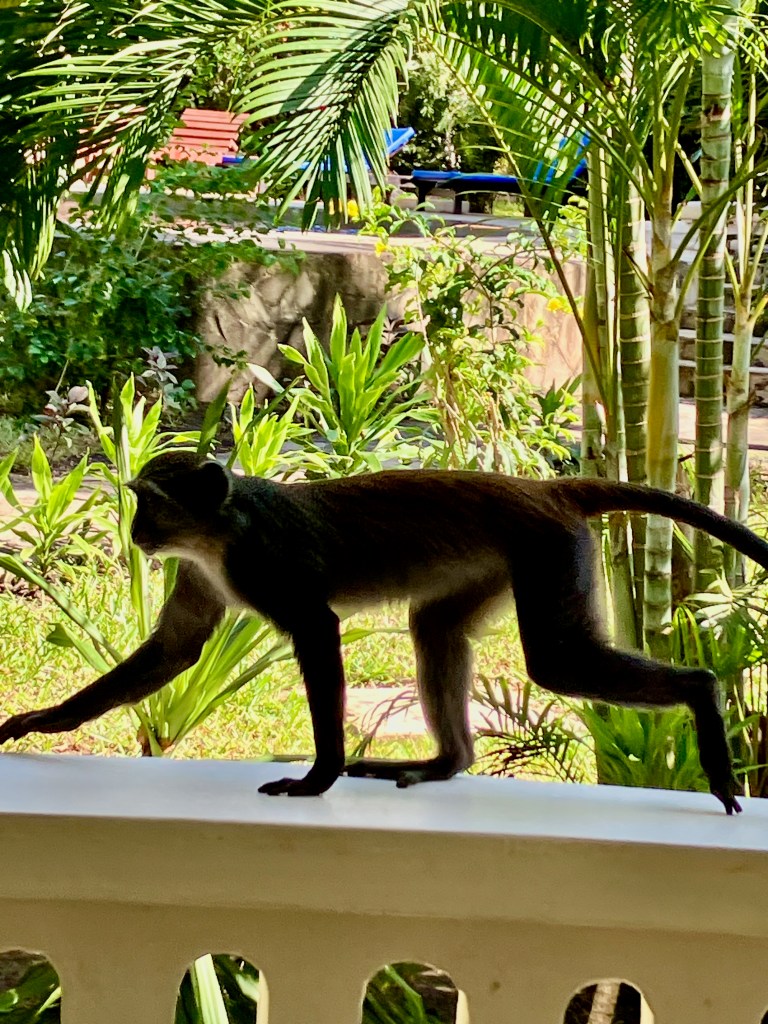
A small band of monkeys passes through our front yard every day, munching on flowers and leaves, curiously peeking through the slats of our veranda wall, and leaving their poop on the walkway to the pool. We are not in Maine anymore.
This is our first time in Africa (actually, Rachel visited Egypt long ago – not as long ago as the age of pharaohs and pyramids, but pretty close…). We know first impressions can be deceiving, and that Kenya alone has enormous variety, to say nothing of the entire, massive continent of Africa. So let’s be clear: We are not describing Africa here—that would be like describing all of North America after spending a week in Miami Beach. We are just hoping to capture some of what we’ve seen in our first week or so in Diani Beach, Kenya.
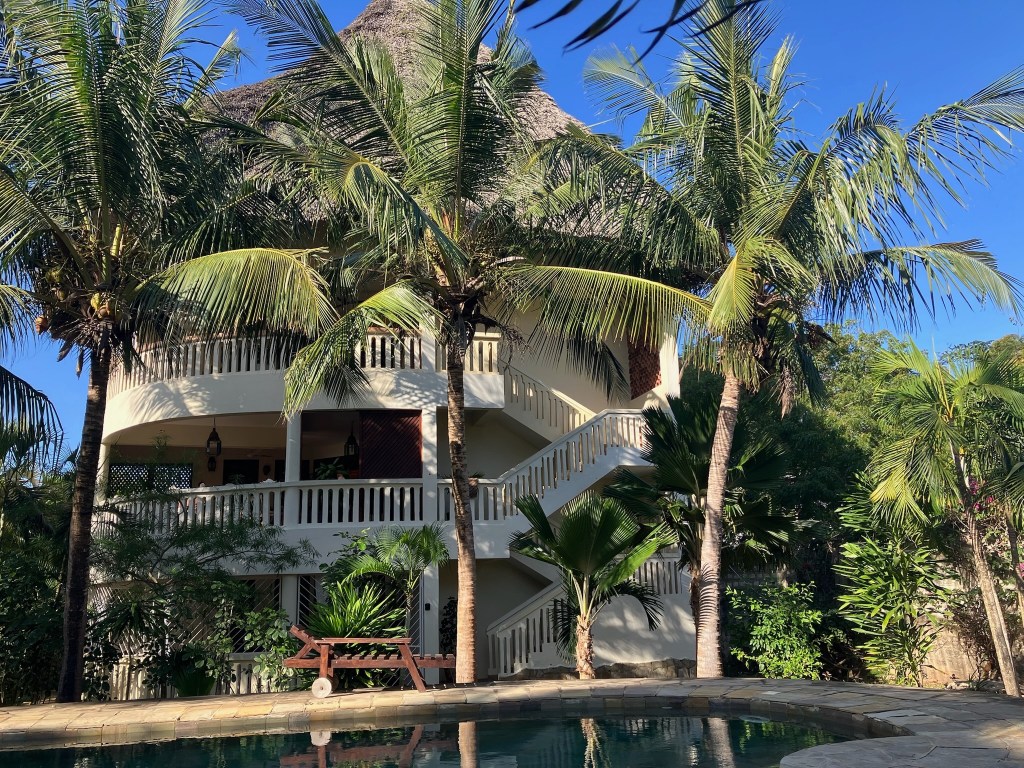
We are living in a small compound of condos in round, three-story buildings with 2-3 units in each. They are painted off-white with brown thatched roofs and open verandas, surrounding a kidney-shaped, lightly salted pool. (Having a light level of salt to keep the water clean is a revelation compared to the typical over-chlorination of U.S. pools!) There are few other guests here; those we’ve seen seem to be European condo owners who come down for a week at a time. A gate keeps the compound secure, and the daytime guard is a lovely, friendly Kenyan woman with long orange cornrows who smiles frequently and teaches us some basic Swahili, like jambo for hello, asante for thank you, and karibu for both welcome and you’re welcome.
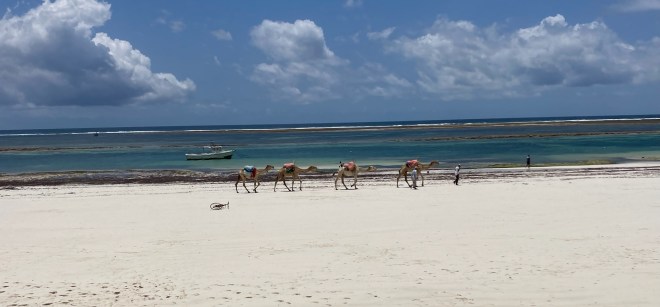
We are situated next to a Christian school (people here tend to be either Christian or Muslim) where we can hear children playing and lively soccer games into the evening. At the end of our driveway is a busy street – Diani Beach Road – that runs parallel to the beach for about 13 miles. Across the road is a dirt path that ends after 500 yards at a beautiful, secluded beach on the Indian Ocean, with sharp rocks on either end that prevent long walks in either direction at high tide. Further north and south, the beach widens and people can walk for miles. The water is the warmest ocean water I’ve ever felt; wavy, churning up sand and seaweed, and bright teal. Heading due east from here, the first land you would hit is Jakarta, Indonesia, about 4,600 miles away. About an hour’s drive due north is Mombasa, the second-largest city in Kenya, and an hour and a half south is the Tanzania border.
There is no “town center” here that we’ve found – just a few junctions teeming with markets, taxis, and tuk-tuks (3 wheeled, covered motorbikes that drive up to 3 passengers around). The beach road links these junctions to exclusive beach resorts, from a river with no bridge in the north to a peninsula in the south. We have barely begun to explore the area, mainly walking to the supermarket for groceries and taking a few small excursions. Jet lag hit us hard—we slept a lot for nearly a week. One local woman we met recently said we were being “crocodiles” because all we did was sleep, eat, and swim. Guilty as charged.
What else have we noticed?
It’s hot. We are near the equator, so the sun can be intense; it just feels more powerful and lays its weight on the body heavily. Temperatures typically run in the mid- to upper-80s, but it feels hotter between about noon and 4pm. We have avoided being out in the afternoon sun when possible, preferring to hang out on our shaded veranda with occasional dips in the pool. We’ve been told most people avoid the beach during those hours as well, unless they can be in shade. Since the beach faces east and is unprotected, the best shade comes later in the day when the sun begins to sink behind the trees. Even walking to the supermarket and back leaves us drenched in sweat. Fortunately, our pool is refreshing and there is often a cooling ocean breeze drifting through the palm trees. And we’ve also been told that this is nothing—October is considered one of the best months here because it’s not as hot as it will be! In fact, our lovely security guard was wearing a knit vest over her uniform yesterday to keep warm.
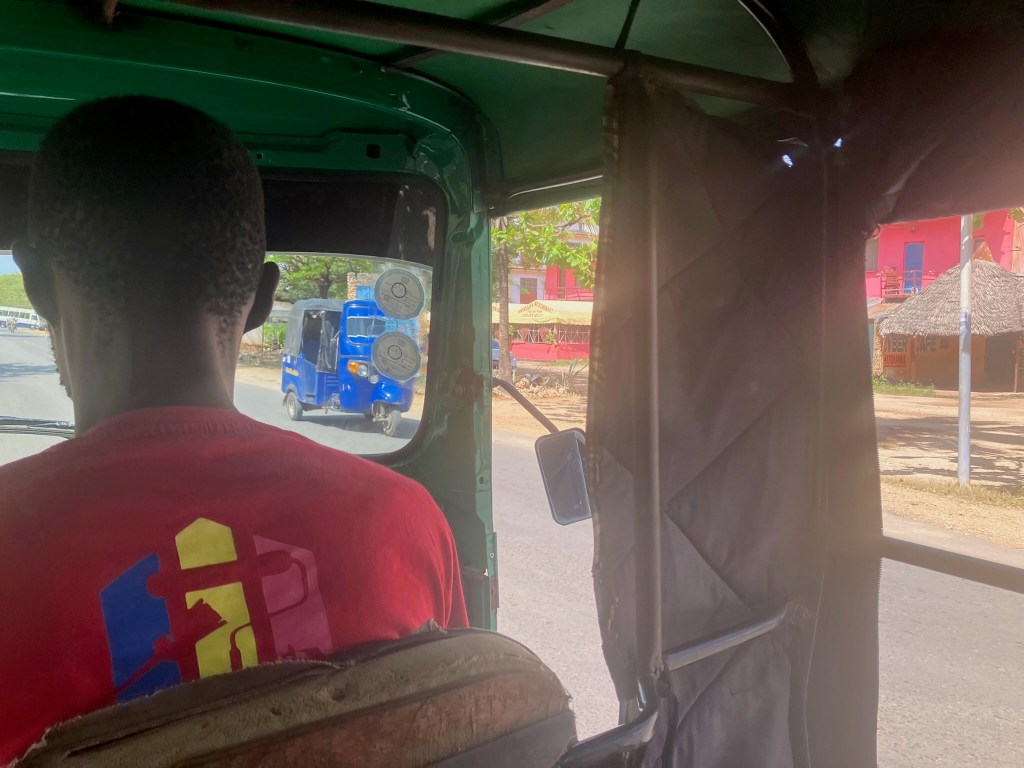
The streets are busy, dusty, and chaotic. There must be thousands of tuk-tuks on this road, each independently owned, driving past the resorts, around town, and up into the villages. When we walk out to the road, they stop and beep to inquire if we want a ride. They swerve in and out of traffic, on and off the road for pickups and dropoffs, and sometimes the driver pulls into a shady spot under a coconut tree for a rest. They share the road with motorbikes (also for hire), cars, trucks, and pedestrians. We never walk anywhere without someone offering to sell us something: a safari, a boat ride, some Maasai crafts, a camel ride on the beach, cheap beaded bracelets, or roasted peanuts scooped from a bucket. Some groups of men sit in the shade doing nothing; many other men and women are hard at work building or repairing structures and cars, touting their business, selling mangoes or grilling meat by the roadside. The fragrant smoke from these grills—as well as less appealing smoke from dumpsters and who knows what else—often permeates the air. Kenyans drive on the left (due to being colonized by England), adding to the general sense of chaos for us Americans.
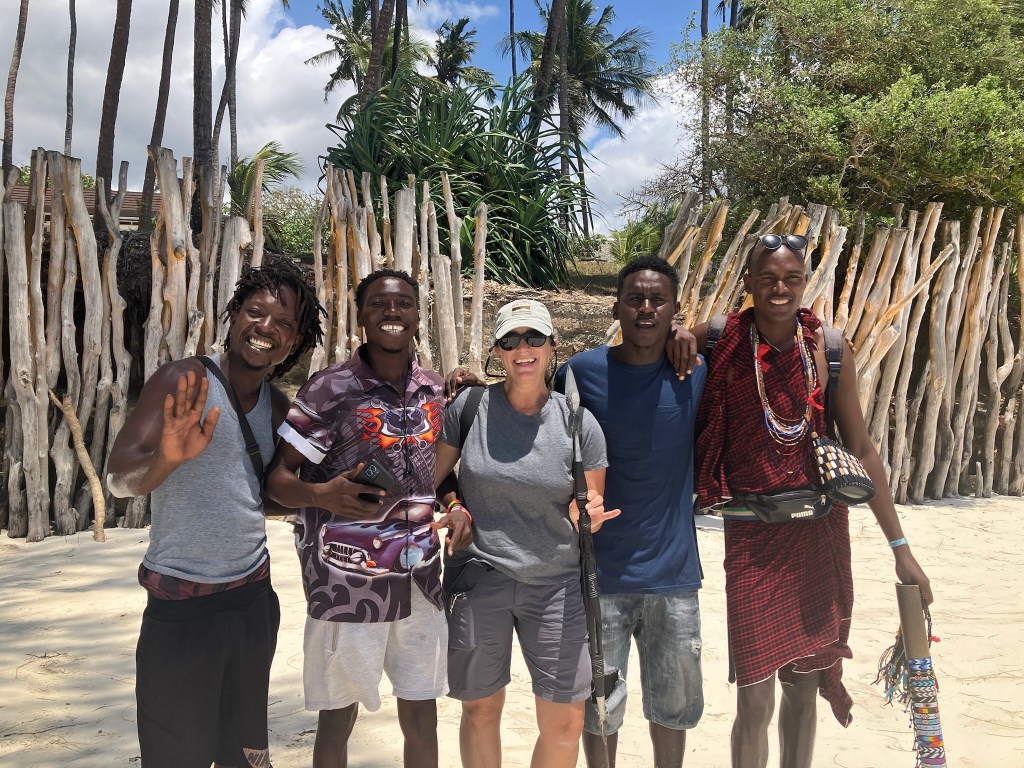
The people are friendly. Children are curious and eager to say hello, showing off the English they learn in school and from watching popular Nigerian movies. Even the people with something to sell first start off with a welcoming conversation – Where are you from? Welcome! Are you enjoying Diani? Be careful of the sun! They share their stories, walk with us, chat us up, and often don’t even bring up their pitch until we say we are leaving. People say “Jambo!” with a smile and a wave, “pole pole” (slowly slowly) to get Europeans and Americans to ease their pace in accordance with Kenyan beach life, and, yes, “hakuna matata” is alive and well here. We’ve even heard locals saying it to each other, so it’s not just for tourists and Disney movies. One day we joined a group of young people doing a beach cleanup while listening to lively music. They welcomed us, gave us gloves, smiled and took photos with us, shared their pickup bags, and made us feel like a part of the group.
Our friendliest experience so far was with a young woman named Naomy who offers cooking classes as an “AirBnB Experience.” We joined her at a local market and walked a dusty pathway among dozens of street vendors. We stopped occasionally to pick up fresh fish and produce, and then meandered to her lovely, modern home in a mixed neighborhood of houses, shacks, and mud-walled huts. There she introduced us to the 21-year-old girl she took in after the girl aged out of a local orphanage. Together we talked, cooked a meal, and shared music together. Naomy was both inspiring—she seized a serendipitous loan opportunity at age 21 to build a successful business, spent two years working in Dubai, and bought a home—and delightful to be with. Having been orphaned herself, she is now committed to helping others by housing young orphan women who have aged out of the system’s supports and financing their education. She opened up her home to us and shared herself, her cooking, and her culture with warmth, humor, and spirit.
The mangoes are sweet. We arrived during mango season, so roadside stands everywhere are selling the fruit, and they are big, sweet, and juicy. Enormous mango trees line the road, bearing fruit that isn’t yet ripe. We’ve heard that this year there will be two mango seasons due to late rains, and that when the street trees ripen, local people pick them when they are ready, but do not hoard them. Turns out, other than mangoes, bananas, and coconuts, not as much fruit as we expected is native to the sandy soil of the coast area. The large supermarket near us, which caters to European tourists, is fairly well stocked from other regions, but comparatively expensive. We’ve also found that seafood is surprisingly hard to get. One time we asked our friendly guard about finding some fish, and she promptly called a local fisherman. When he arrived a few hours later, he brought whole red snapper, caught that morning, and cleaned it in our front yard. It wasn’t cheap (about $16 for two whole fish, which I’m sure reflects the tourist price) but it was buttery and fresh. We hope we’ll find other sources of seafood as we expand our travels up and down the beach.
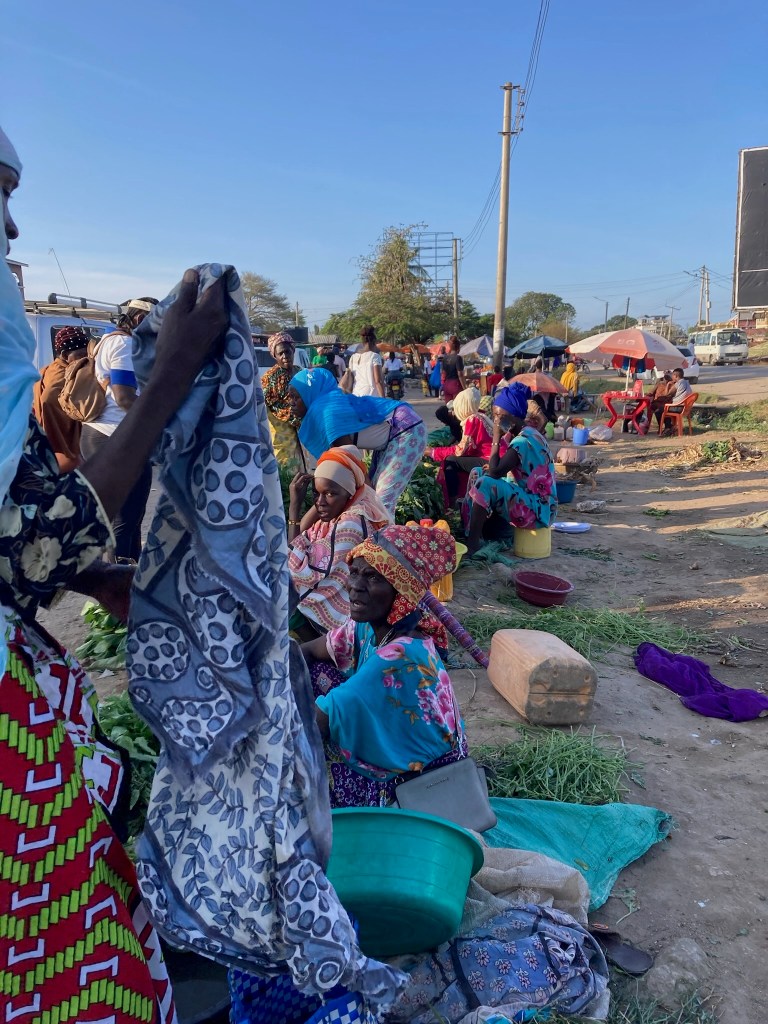
The economy is a frequent topic. Many Kenyans have come here from other parts of the country seeking work. Our cooking teacher Naomy came from Nairobi. The guide for one of our day trips came from the Rift Valley. Some people tell us there isn’t enough work to go around; the “beach boys” who sell cheap trinkets to tourists complain that they only do this because they can’t find other work. One told us the unemployment rate in Kenya is 75%! (Actually the World Bank says it’s 5.7% – which is admittedly double what it was in 2016, but still a far cry from 75. That said, youth unemployment is over 13%.) Other locals tell us that too many people don’t want to work and dismiss the beach boys as just wanting to hang out at the beach instead of working. But they all agree that opportunities are few without an education, and too many girls especially still do not complete theirs. Most seem to also agree that their current president is not doing enough to provide opportunities to Kenyans, which is the reason for recent student protests in Nairobi calling for him to resign.
Shillings are so pre-2020. So far we’ve gotten our local cash at ATMs, and running the conversion numbers in our heads is a constant accompaniment to buying anything. The Kenyan shilling is about .0077 of a dollar – not the easiest conversion rate to remember, but we have an app that helps us figure it out.. So $1 = 129KS. Or 1,000 KS = $7.75. One surprise has been the prevalence of an app called M-Pesa for exchanging money. It’s used by locals and long-term tourists alike for all kinds of transactions. We’ve been told the government mandated adoption of the app during Covid, and it stuck. People love the convenience and safety of not carrying cash, and it’s accepted virtually everywhere; even in a tuk-tuk. All you need is a Kenyan phone number and the app, and you can top up your account at any corner store. We’ve just gotten ours so we can stop carrying around thick wads of Kenyan shillings.
Mythological bugs. Nowhere else have I felt the fear of insects that I feel here. That probably says more about the mythology of insects in Africa that I’ve swallowed in my sheltered life than it does about the insects themselves. Are African fire ants a real thing? I have no idea, but when I see a red ant here I panic. Are African killer wasps real? Again, no idea, but when I see a big, creepy wasp, I run away. I should do some research on this, but while hiking to a waterfall recently, our guide cautioned us to avoid the “safari ants,” which were black and tiny but apparently will swarm your leg if you step on them and leave stinging bites. We have also been inoculated and medicated and mosquito-netted and bug-sprayed to ward off what seems like countless insect-borne diseases, warned about avoiding areas that are at high risk of malaria, and heard about parasites that live in water or the grass or who knows where. In truth, we’ve so far found very few mosquitos and, other than the occasional curious wasp, oversized spider or millipede, ever present fruit flies, and small ants, we’ve certainly not felt swarmed by bugs. Now that I read that last sentence, though, perhaps that’s enough cause for concern!
Bugs notwithstanding, we have found our apartment’s terrace to be a lovely place to sit in the shade and enjoy cool breezes while we plan our next steps. We have scheduled a three-day safari at the end of our time in this apartment and now plan to head into Kenya’s highlands after that. In the meantime, we’ll continue to explore the coast and all it has to offer. And we’ll be sure to offer up more impressions from our explorations soon.


Your best travelogue ever.
Makes me want to go to Kenya. (not!)
LikeLiked by 1 person
Aw…too bad! I didn’t mean to dis Kenya!
LikeLiked by 1 person
I was all-in until the insects. At least there aren’t any ticks.
LikeLiked by 2 people
How much do I love following along on your journey? A LOT. Thanks for giving me a brief window into the amazing.
(and I’m with you on the bug fear 😬)
LikeLiked by 1 person
Thanks, G! It’s eye-opening to be sure!
LikeLiked by 1 person
This is bound to be an especially distinctive adventure! I’m already learning so much!
LikeLiked by 2 people
Nice introduction to the new year.
The mention of “safari” ants reminds me of a chapter in “The Poisonwood Bible” wherein safari ants overran a village and actually ate everything in their path. Not hyperbole.
stay safe and happy
LikeLiked by 1 person
yikes! I had forgotten about that scene!
LikeLiked by 1 person
Nice resume. Mosquitos love me, if I were there you would see plenty of them.
LikeLiked by 1 person
I think Rachel has your blood and even she’s been safe so far!
LikeLiked by 1 person
Great to read your First Impressions and see your pics. Yay on the mangoes. Boo on the bugs. Enjoy!
LikeLiked by 2 people
Ahh the bugs! I didn’t think about that. These first weeks sound tiring, but I’m sure you’ll soon be on your way to grand adventures. It’s so fun to know what you two are experiencing. 100% living vicariously over here.
LikeLiked by 2 people
Excited to be along this journey with you. Moved by the woman who is supporting girls aged out of orphanages. What a bundle of compassion. Curious to know what jobs are available for women. Thanks for Kenya 101.
LikeLiked by 2 people
Thanks Shirley, and yes, that woman is an inspiration not only to us but to all the girls who pass through her home. Her current mentee is studying computers. Mostly what we see here are service jobs, it being a tourism center. There are definitely farms and shops of all kinds. And teaching of course. Beyond that I’m not sure, but hopefully we’ll learn more as we go. It’s definitely a patriarchal culture, which makes our cooking teacher all the more remarkable.
LikeLiked by 1 person
Reminds me of how grateful I am to get to be born here.
LikeLiked by 1 person