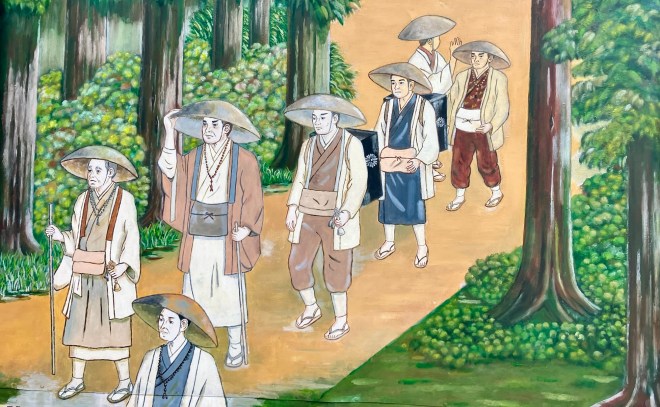
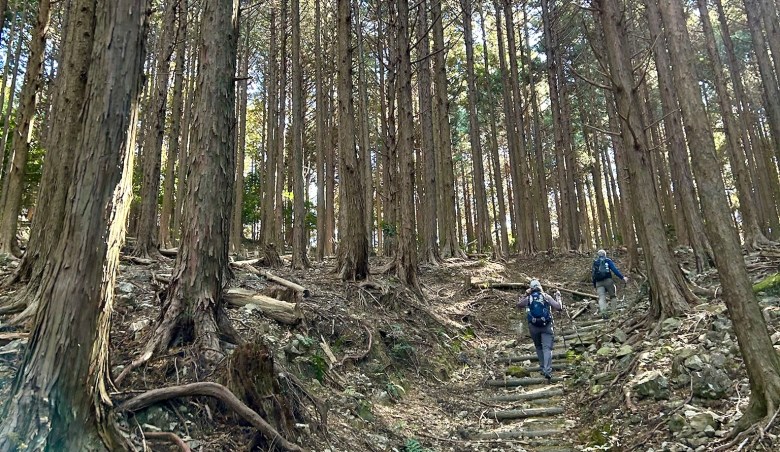
Tip, step, tap, step, tip, step, tap, step, the metronomic cadence of my hiking poles and shoes move in rhythm over rough stones, loose gravel, and packed dirt, up and down mountains, hour after hour, allowing my thoughts to drift. Images flip randomly through my mind like photographs gathered haphazardly in an old shoe box. With a robin’s-egg blue sky peeking through the cedar tree canopy above and the steady burble of a stream somewhere just out of sight, I catch one of the mental images before it can flit away. Spain. Year Two. Late spring. We are standing in front of the cathedral in Santiago, the terminus of the famous pilgrimage route known as the Camino de Santiago de Compostela.
Fast forward: We recently discovered that the Camino’s sister pilgrimage route exists in Japan. In Spain, the Camino is identified on paths by a yellow scallop shell; in Japan the Kumano Kodo is marked by a three-footed black crow, a symbol of good luck. These are the only two recognized UNESCO World Heritage pilgrim routes. To date, approximately 20,000 people have completed both, earning the distinction of being “Dual Pilgrims”. In order to qualify, a person must walk at least 100 kilometers (62 miles) of one of the Caminos in Europe and at least 38 kilometers (23 miles) of the Kumano Kodo in Japan. Why such a big difference? Well, I can now tell you from personal experience: The Japanese kilometer feels like at least three kilometers in effort. While the Spanish Camino (we’ve heard) is mostly flat with some rolling hills, the route in Japan is challenging, steep, and uneven with lots of elevation changes. Hiking days average 18 exhausting kilometers (11 miles) in distance.
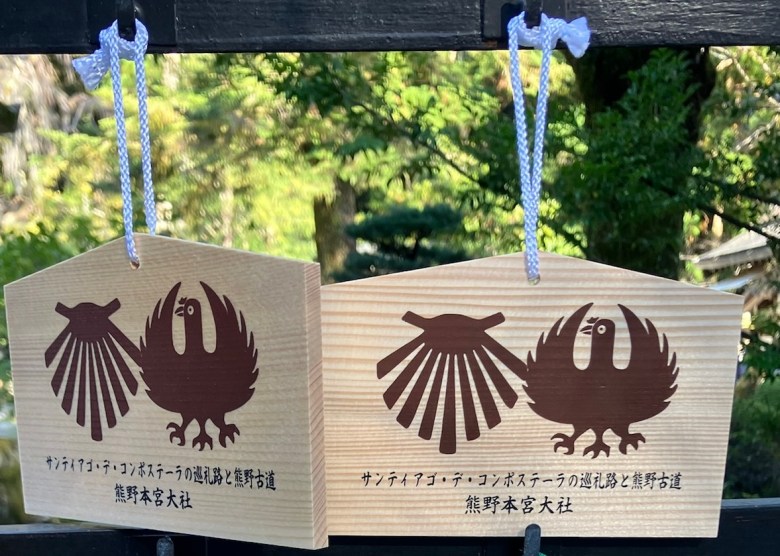
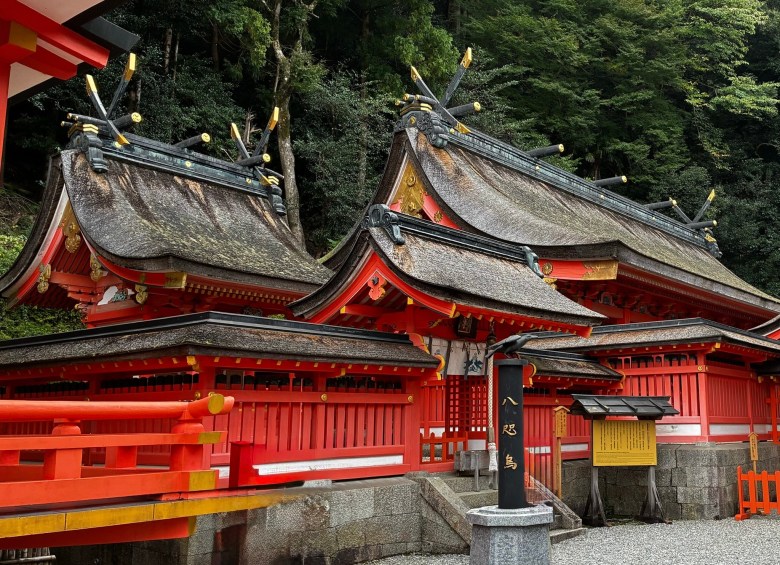
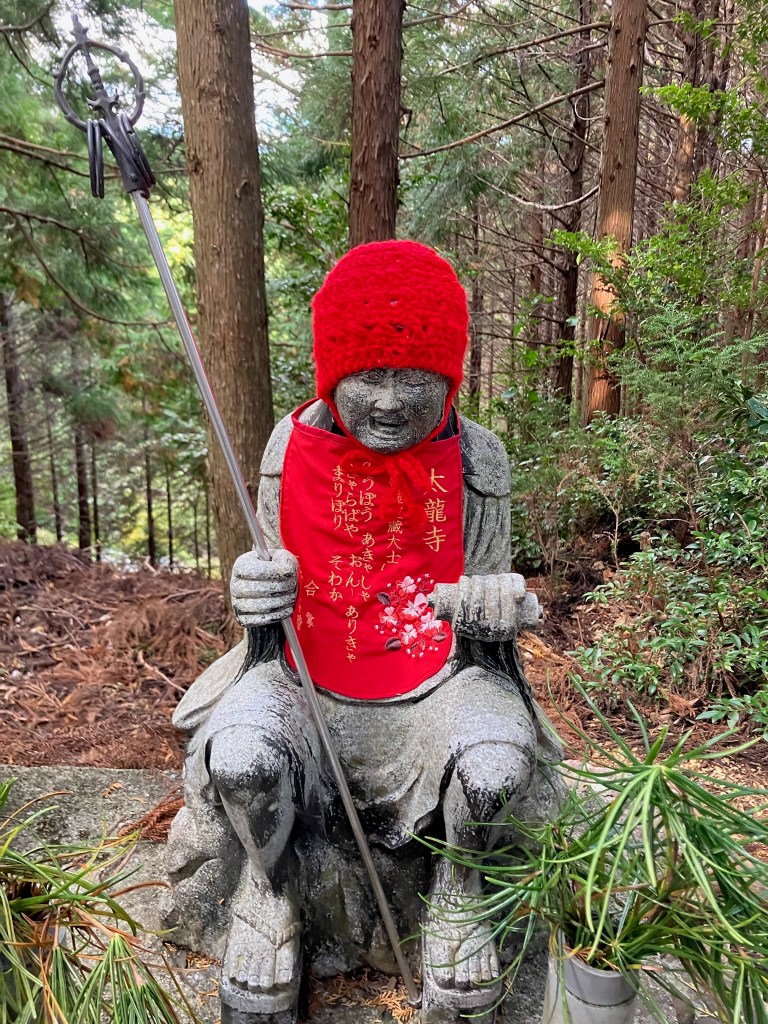
The Kumano Kodo is located in the rugged mountains of the Kii Peninsula in the southern part of Japan’s main island, Honshu. We decided to tackle the entire Nakahechi route, one of four established paths, and the most popular, which covers about 70 kilometers (43 miles) from end to end. It connects the three main shrines of the region and has been in use for over 1,000 years. We gave ourselves four days to complete it. I guess the Buddhist gods were pleased with our choice, as we had perfect hiking weather the entire time, bookended with a day of rain on either side, giving us the excuse to relax and soak our weary bodies in the hot mineral spring baths in our lodging.
On the day prior to starting the hike, we bade farewell to Kyoto and traveled by train down the coast of the Kii Peninsula to Kii-Tanabe, accurately described by their own official tourism bureau as “a sleepy coastal city”. There we met two Canadian men who were also planning to hike the length of the pilgrim route. One of them had recently completed the Camino de Santiago and was looking forward to becoming a Dual Pilgrim. He explained how one can collect ink stamps in a special booklet at various stops on the way as proof of having been there. I eagerly picked up a blank stamp book at the tourist office and stamped, in bright red ink, the Kii-Tanabe image in the first empty square. I was officially a pilgrim.
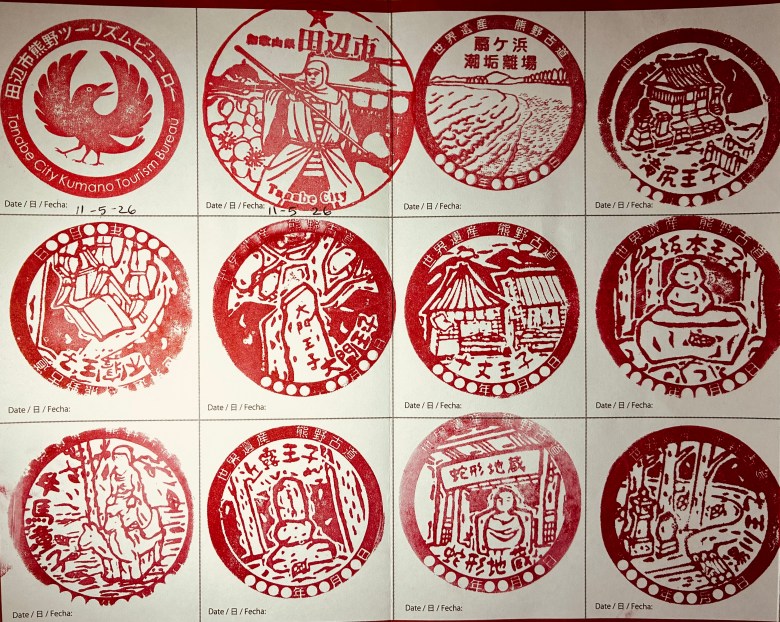
Over the next four days we would play leap-frog with these friendly Canadians, enjoying conversations, sharing travel stories, commiserating about aching knees and feet, and confirming that we had found the mailbox-size, wooden boxes at strategic points along the way with stamps and ink pads inside them. We ended up being booked at the same hotel on the final night and by then we felt like old friends (or maybe we just felt old and had become friends). We shared contact information and pledged to reconnect.

Just two weeks later, we tackled part of another pilgrimage route in Japan. This time we were on the island of Shikoku, with one of our daughters, walking for two days on the ancient paths connecting four temples on the Henro 88 Temple route. That’s right, this walk connects 88 temples and circumnavigates Shikoku, which is accessed from the main island by one of the world’s longest suspension bridges. The trail is about 1,038 kilometers (645 miles) long. For comparison, the Camino de Santiago’s most popular trail is 772 kilometers (480 miles).
On the Henro, pilgrims wear distinctive white smocks and flattened cone -shaped hats. They carry a book or scroll to collect stamps at each temple. Despite only hiking for two days, we were welcomed as fellow travelers by the “real” pilgrims. The locals embrace pilgrims, giving out snacks, hand-made gifts, and bags of sweet, juicy mandarins from their trees. One night we stayed at a guesthouse owned by an older man who has completed the circuit three times! He and his wife treated us like family, eating dinner with us alongside two Japanese guests and a semi-retired Australian. We met other pilgrims who spoke of having a transformational life experience, combining relentless walking with a sense of spirituality. Before coming to Japan, we had no idea that there are so many places to take long hikes that connect sacred spaces.
They also connect people. Whether we are on a pilgrimage or just traveling, one of the best things to come out of these years has been meeting people of many ages and nationalities and forming new friendships. For the most part, the travelers we have gotten to know have been a self-selecting group of curious, adventurous people who are open to new experiences and with whom we happen to be sharing a time and place. Because we are all traveling, we automatically have something in common and conversations start easily. “Where are you from? Where have you been? Where are you going? What do you recommend?” easily morphs into, “Let’s stay in touch. Here’s my email address.”
In November, we met up with some friends we first encountered in Chile, when our ferry boat got stopped by bad weather on the way to Patagonia, and all the passengers had ample idle time to chit chat in the lounge. This fall they were doing a driving/camping trip through Japan and our paths crossed in Osaka. What fun to get a meal with them and be regaled with tales of their travel adventures from the past few years! We found that they are even more adventurous than we are: The next trip they’ve planned is motorcycling through the Himalayas!
While we may not always be so lucky to meet up in person, we take advantage of social media and modern technology to keep in touch. Our amazing group of African overland adventurers has continued to connect from time to time over the past two years, sharing pictures of travels and updates on life’s happenings. One intrepid young German woman from our group has since been around the globe twice, visiting more than 40 countries and, lucky us, we might get to see her in Tokyo when she comes to Japan to be a ski instructor in far northern Hokkaido.
Not everyone we meet is a traveler. We also have formed wonderful friendships with locals and long-term residents. In Spain we stayed in one place long enough to create strong connections with a few people with whom we still stay in touch. We keep threatening to go back to see them and—who knows?—maybe this spring the call of becoming dual pilgrims ourselves will push us over the edge.
Making new friends has been wonderful and enriches the travel experience. At the same time, I am reminded of how much I treasure and value the friends and family we have “back home”. Our lives are woven together with fibers hand-spun into strong yarn from years of shared moments: laughter, tears, meals, walks, celebrations, and quotidian tasks. Being able to return to a familiar place, visit with loved ones, and share our stories and hear theirs, all combine to create an invisible mantle I wear like a hug when I am far away.
And so, this pilgrim hopes to continue adding to my metaphorical shoe box of photos—snapshots of people encountered on my travels, places ordinary and exquisite, grand festivals and intimate moments, landscapes and tiny flowers, so that when the time comes to stop moving about the world there will be a veritable truckload of images in my mind to flip through. Until then, a big shout-out to all of you friends, old and new, who follow along with us in this blog. Leave us a comment – we’d love to hear from you!


Usually,, when people travel, they focus on the visual, historical, structural,and gustatorial offerings of the place they’re in. Not so for you, in addition to those things you’ve also found an abundance of humanity whether of like or dissimilar type. They all impact you and inform who you are and who you are becoming. Who you are becoming is revealed in this blog in a beautiful way, and I, as your dad, could not be prouder.
LikeLike
Thanks Dad. I love your comments. You always enrich the posts with your perspective.
LikeLike
Meeting people is one of the best parts of traveling. We gain so much perspective! And I’m glad you remember that the yarn from home binds us in our history and knits our lives together in love.
LikeLiked by 1 person
I was channeling you with that metaphor. I love seeing your amazing creations on social media. Grandma Tybe lives on through your hands and knitting needles.
LikeLike
I’m so enriched by getting to travel along with you and share your experiences and observations. Your exquisite prose and the accompanying photos are a gift. Mundane question. What shoes do you wear for these long treks?
LikeLike
Thanks for being such a constant supporter of our blog Shirley. I know you can picture Japan clearly, having been here yourself. This past week we found candied ginger and I thought of you (of course). In response to your question: We wear what Al calls “low hikers”, basically hiking shoes that are shaped like sneakers but are much more durable and have good tread for rough terrain.
LikeLike