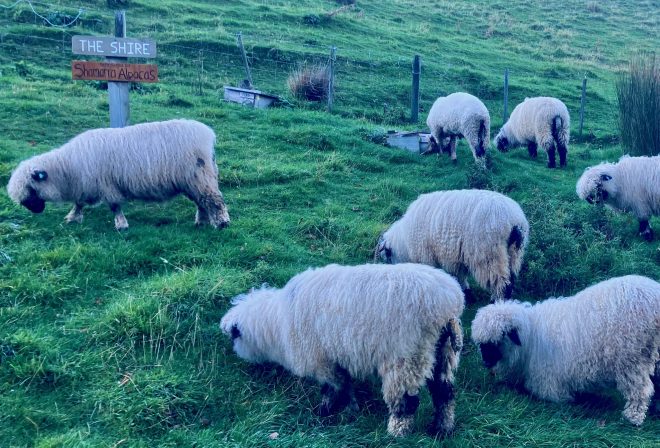
As an English major in college, I was required to memorize the opening stanzas of Chaucer’s Canterbury Tales in Middle English—a task that has proven incredibly useful over the years as I’ve applied it to my everyday life in countless ways. Um, not. But now, it’s impossible for me to visit Canterbury—even in New Zealand—without thinking of Chaucer’s 14th Century collection of morality tales, as told by a set of fictional travellers from diverse backgrounds. And it’s not just the name! I’ll spare you the Middle English, but here’s an excerpt of the prologue that seems relevant to where we are even now:
When April with its sweet showers
Has pierced the drought of March to the root,
And bathed every vine in a liqueur
Whose virtue creates the flowers …
Then folk long to go on pilgrimages,
To seek foreign shores,
Far-off shrines known in sundry lands;
And especially from every shire’s end
Of England to Canterbury they wend.
Seven centuries later, here we are in Canterbury in April, having longed to travel from (New) England to distant shores, watching the rain fall on what’s left of the summer flowers. Eerie coincidence, isn’t it? (Kidding…)
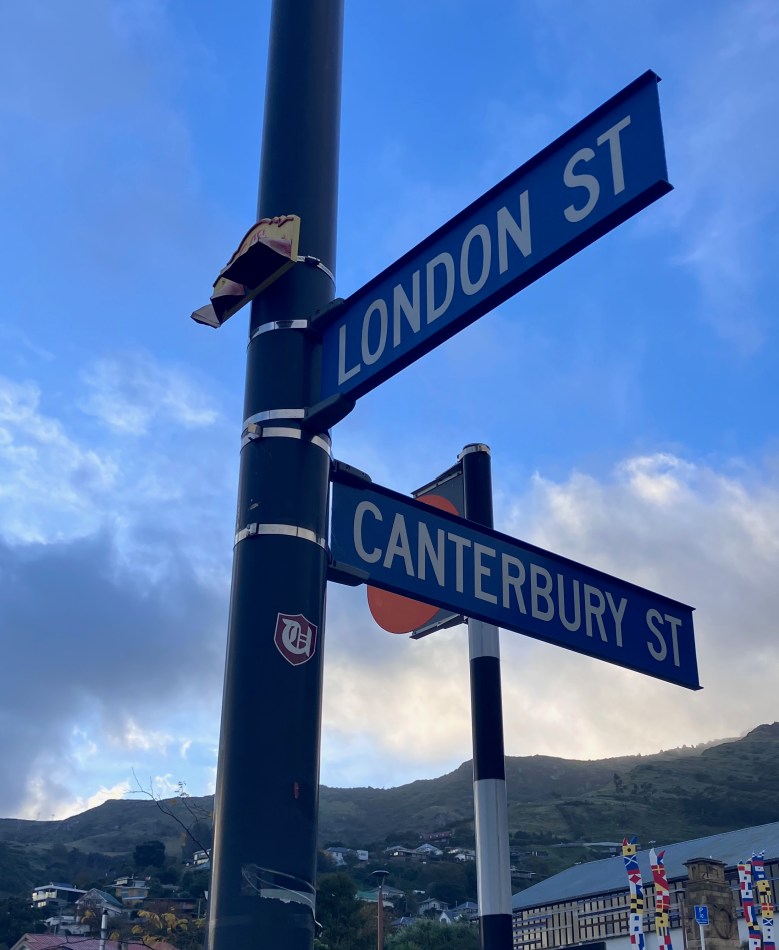
In New Zealand, Canterbury is a region surrounding the city of Christchurch, the South Island’s largest city. English settlers first arrived around 1850, exploiting a land ideal for sheep farming and trading with Maori tribes. Despite a devastating earthquake in 2011 that demolished more than 10,000 buildings, Christchurch still displays its English roots proudly: Edwardian-era architecture where it survived, street names (Hereford, Gloucester, Worcester), cricket, rugby, and pubs. There is even punting on the Avon, a river that winds through the city and draws visitors from every shire’s end.
In that spirit, I’ll introduce our own abbreviated collection of tales about our experiences here in Canterbury. And so, pilgrimes, telle thy tales!
The Stonemason’s Tale: The 2011 earthquake was devastating to Christchurch, and evidence of it pops up all around. In addition to iconic buildings (like the central cathedral) that are still under construction 15 years later, reminders appear around every corner. There’s a somber memorial cutting into the banks rising from the Avon that names 185 people who lost their lives. There’s a wide array of beautiful street murals, cleverly disguising deconstructed buildings, that have all been commissioned since the earthquake. There’s an entire museum dedicated to the earthquake and its aftermath. But perhaps the broadest evidence is the overall cityscape that exists today. Nearly everything is new, some in a good way, like the stylish curves of the new convention center and the sturdy bastions of the skyline-dominating rugby stadium (opening this month!). But some of the new builds are simply modern, cookie-cutter townhouses, reflecting the need for a lot of housing quickly.
One guide told us that city leaders took the opportunity of a fresh start post-earthquake and actually asked residents what kind of city they wanted Christchurch to be. They wanted a city that was residential, human in scale, with green spaces and good public transport. As a result, there are now no buildings over four stories high except those that miraculously survived the earthquake. The bus system is smooth, inexpensive, and mostly electric. Parks, bike paths, and walking tracks are sprinkled throughout. And everything has been retrofitted or designed from the ground up with the latest earthquake-resistent architectural techniques and technologies. Even the old brick and stone buildings are rescued facades on modern shock-absorbing structures. Imagine that: leaders who actually ask residents what they want and listen.

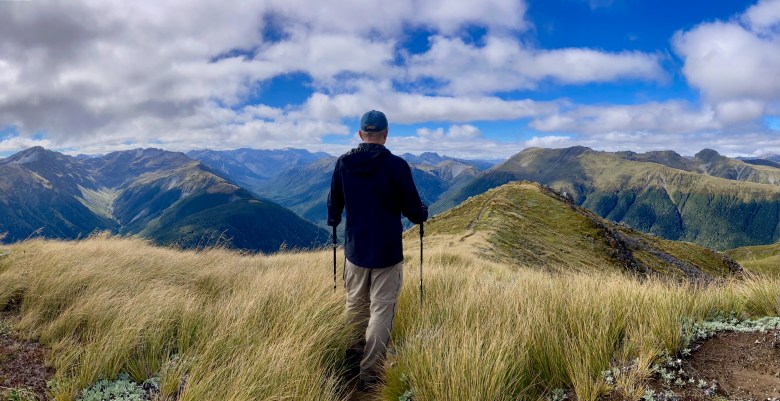
The Traveler’s Tale: Christchurch grew up at an economic crossroads, connecting the ocean to the agricultural plains, and then to the Southern Alps and West Coast, where gold was found in the 1860s. It has also been a hub for us (and many others) to rent campers and see the region. We started our time here with seven days in a camper van, exploring the coast north of Christchurch and then heading inland to mountains and lakes. Given the twisty, narrow, steep roads there, we found it difficult to imagine traveling in Canterbury in the late 1800s: a multi-day, tooth-rattling stagecoach journey on rutted gravel roads through cavernous mountain passes along raging rivers just to reach a spartan, uninsulated wood-frame inn. All that to cover the ground we drove in just a few hours, with our comfy bed, fridge, and stove along for the ride. If we pass for “adventurous” people now, they must surely have been a different breed of adventurous altogether.
Since we’re now coming into fall here, some of the state-run camping areas were closed—but apparently that only means there’s no one monitoring the entrance. The gates were all still wide open and a few hardy campers were spread out among the sites. Even the paid campgrounds, which seem to serve as summer homes for many people with large trailers or RVs, were sparsely populated—except for one where we stumbled onto a couple singing and playing songs on guitar. We gladly brought out our folding chairs and joined in the singing with assorted other pilgrims from around the world. We also found the hiking trails mostly empty, as this is one of the lesser-traveled regions of New Zealand. But honestly the scenery would be a featured attraction in most any other place.
The Birdwatcher’s Tale: In many spots on the coast of New Zealand, we have seen signs warning us not to disturb the “Little Blue” penguins that come ashore at night. Not a problem for us: The closest we’ve come to the actual birds is seeing tracks they left in the sand. On this road trip, we did see a pondful of black swans and a massive colony of sea lions resting on rocks. While the parents napped, their pups—as cute as a basketful of puppies—played in kiddie pools. Safe tidal pools in the rocks were just big enough for groups of playful pups to practice their swimming, play-fight with each other, and even play tug-of-war with strands of kelp. If that image doesn’t make you smile, you might need to check your “cuteness” sensors.
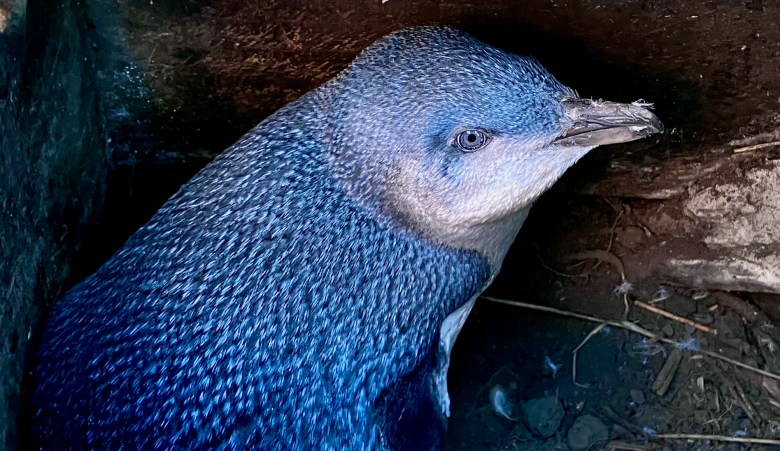
Rounding out our road trip, we made it south of Christchurch to the Banks Peninsula, a mountainous spit with rocky bays and turquoise waters. We first stopped at Birdlings Beach, where we saw the usual terns, gulls, and oystercatchers, but no penguins. The next day, we optimistically booked a guided kayak tour in Flea Bay, so named because Captain Cook first saw it during molting season and the colony of little naked penguins looked, to him, flea-bitten. For us, persistence paid off, despite it not being the season for molting or mating. At the end of the paddle, our guide told us that a few penguins that had raised chicks there in the summer had come home to rest after being out to sea for a month. It’s like that post-exam homecoming when college students disappear into their childhood bedrooms to sleep for entire days. In this case, the prodigal sleepers are white-flippered penguins—a variation of the Little Blue. They are only found on the Banks Peninsula, thanks to a heroic habitat restoration effort by the sheep farmers who own land at Flea Bay. The birds readily take shelter in cozy penguin boudoirs thoughtfully built for them by the farmers, so our guide gave us a peek inside one tiny house while she documented the endangered penguin’s vital statistics for research. Finally! A Little Blue penguin, and a rare sub-species at that! It had taken us nearly six months, but we finally met this elusive creature.
The Dog’s Tail: Sorry—I couldn’t resist the pun. This tale takes its name from a two-year-old black lab named Licorice (Licky for short). After finishing our camper van trip around Christchurch, we settled into a neighborhood near the city center for the last of the seven house- and pet-sits we did in New Zealand. This one featured a 14-year-old chocolate lab who was mostly content to sleep all day and her companion, Licky, who would get so excited to see us that her full-body wiggles seemed entirely driven by her tail. She wagged and wriggled and spun and bumped up against everything around her until someone agreed to throw her a ball to chase. So Licky’s tail wagged us, too, I suppose.

We have (mostly) loved these house sits and (mostly) loved all the sweet, loving pups. We were reminded why we have both treasured the dogs we’ve owned at one point or another. And we were reminded why we don’t own one now. I think it was toward the end of the week when Licky excitedly thumped on our door and whined at quarter to six in the morning, 45 minutes before daybreak, that we said to each other, “I think it’ll be okay to not take care of other people’s pets for a while…” Don’t get me wrong: Dogs are great, and they spread their joy palpably. I guess we’ve just gotten to a point where we prefer choosing when to get out of bed and when to come home on our own terms, rather than when a dog needs us to. So Licky (and Cody and Jack and…), if you’re reading this, we will miss your joy, but not your wake-up calls.
The Scribe’s Retraction: Thus concludes our Canterbury Tales. As Chaucer did at the end of his, I wish to apologize for any offense I have given, any unworthiness in connecting this lowly blog to a world-changing historical text, and any sins my tales may lead others to commit. And please note that, while our time here in New Zealand now draws to a close, our blog posts will not. We have a few more insights stored up about our travels, and will continue to share them as long as you, dear reader, care to see them.
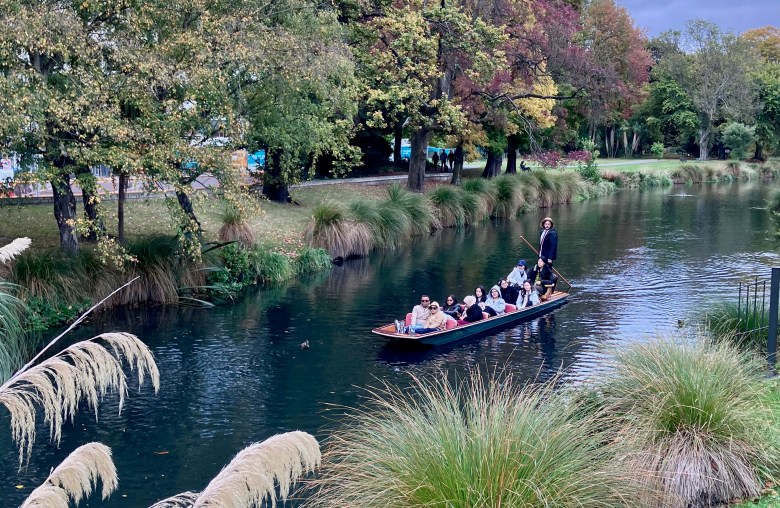


The final photo, punting on the Avon. I hope you drank lots of beer. We had wine and needed a grassy bed siesta after disembarking from the punt.
thank you Al for this beautiful blog
LikeLiked by 1 person
Egads! A city built to the needs and desires of it’s citizens. Love knowing that.
LikeLiked by 1 person