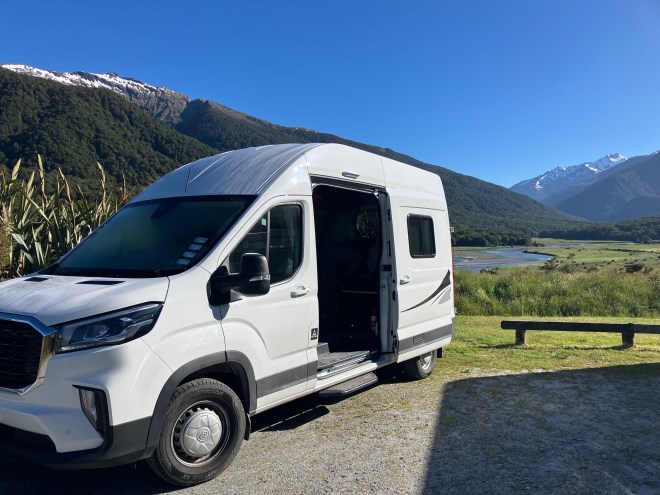
Small, well-organized living spaces have always fascinated me. Think sailboats, motor homes, campervans, and more recently the trend of tiny homes. I love the way they make the most efficient use of space, how clutter is simply unacceptable, and, for the mobile ones, how they can take you to a different beautiful place every day. I’m not the only one who’s fascinated by this: whole channels on Instagram and YouTube are dedicated to #vanlife.
So I wondered how it would be to live in one for two weeks in New Zealand. Would the efficient use of space start to feel limiting? Would the lack of creature comforts found in a home become annoying? Could Al and I manage to live in a 50-square-foot camper van without constantly bumping into one another or filing for divorce by day ten?
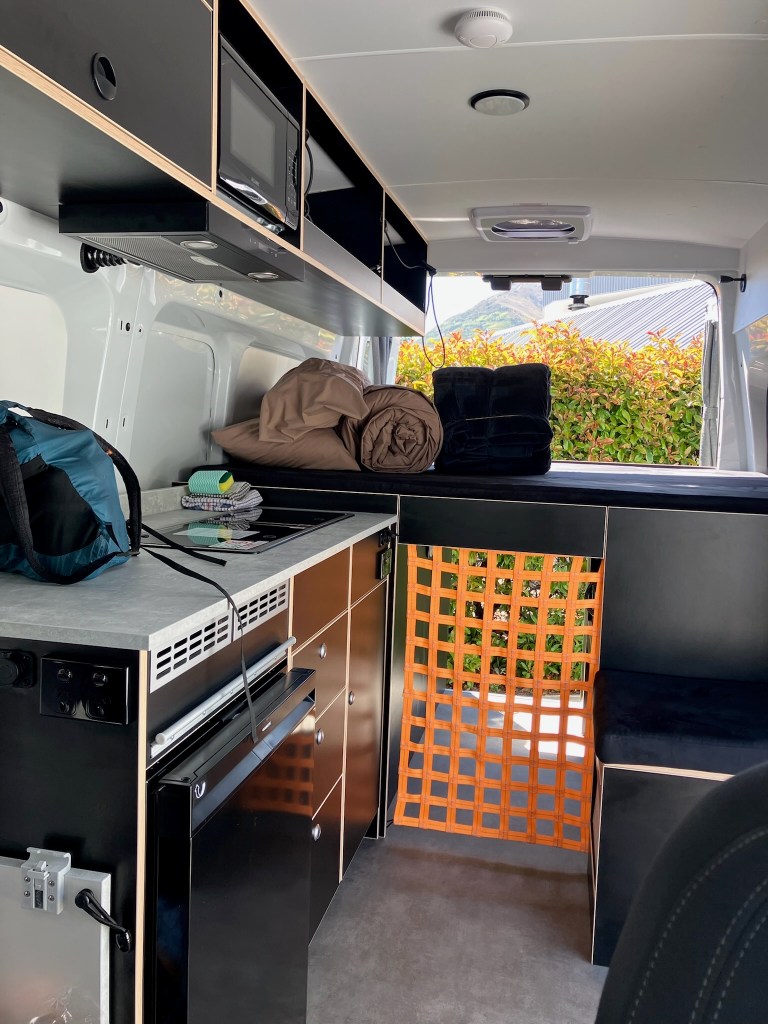
Our home-on-wheels came with a double bed elevated above a storage space and just enough clearance to sit up without knocking out our brains, a galley “kitchen” with a sink, two-burner stove, dorm-size fridge, and some drawers with cooking equipment. Perhaps most importantly, there was a toilet, which was basically a built-in seat that, when closed, acted as a step to get into the bed, and when open revealed a commode with a removable waste-storage jerry can below. Privacy be damned, the seat/step/toilet had pride of place in the middle of the living space. We moved in, made the bed, unpacked, and nervously giggled at the prospect of sharing such tight quarters.
Fast forward 14 days and a winding, 2500 kilometer figure-eight tour of the South Island, we proved it can be done. We amused ourselves by naming the interior spaces as if they were grand. “My mom always said not to brush my hair in the kitchen,” I recalled. “You’re not, you’re in the foyer,” Al replied as I stood an arm’s length from the sink. “I’m going to read in the office,” I’d announce, plopping myself in the driver’s seat. “Fine, I’ll be upstairs taking a nap,” Al responded. By the end we learned that we don’t need a lot of space to accomplish our daily home activities, with one significant exception—doing yoga indoors, for which there really just wasn’t enough room. (“I am in the exercise room” wasn’t part of our vocabulary.) We had thought maybe we’d use the Great Outdoors Yoga Studio, but it always seemed either too wet, too buggy, or too cold so in the end, we set aside our “om” for a couple of weeks.
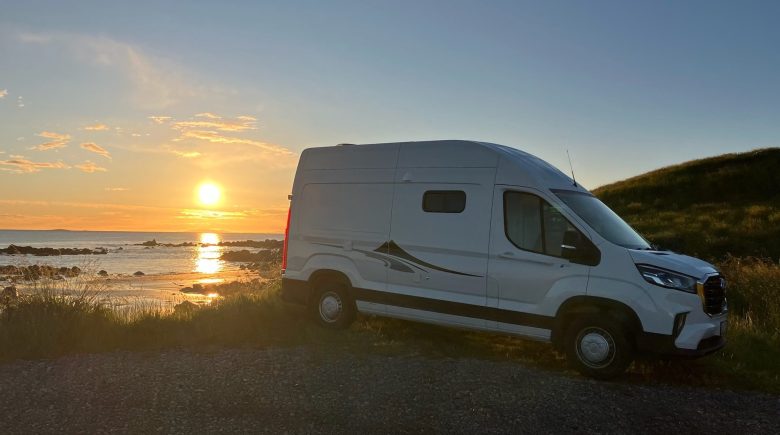
The concept of freedom camping was new to me before planning our camper trip, but it is a well-supported mode of travel in New Zealand. Many locals have customized their SUVs and mini-vans for sleeping and cooking. Essentially, if you are “self-contained”, meaning you have a toilet and water in your vehicle, you can camp on the side of the road or on land set aside for that purpose and not pay a dime. There are a couple of very useful phone apps that provide information about camping locations and amenities (toilets, trash bins, picnic tables, etc.), with reviews by other travelers that can alert you to issues of mud, sandflies, road noise, and the best time to show up to get a spot. In the two weeks we were on the road we only paid for three nights—once when we were craving a hot shower and twice in busier areas where no designated freedom camping exists. We also exercised our scarcity mentality—using excess hot water after making coffee to wash our dishes, bathing at the sink (“I’m in the shower, love”) and adjusting our definition of clean as we pulled a shirt from the laundry bag to wear yet again.
With so much moving about, we quickly got adept at going through the checklist of tasks that had to be completed in order to safely turn our turtle-shell home back into our vehicle. Propane tank closed? Check. Drawers locked? Check. Water pump off? Check. Throughout the country there are free “dumping stations” where travelers can empty their toilet tank, dispose of garbage, dump gray water (basically dish-washing water from the sink), and fill the drinking water tank. Once again the useful app directs campers to the locations. We quickly got into a routine with one of us taking care of the water while the other handled the trash and toilet. Together we could be in and out of a dumping station in about five minutes, refreshed and ready to roll.
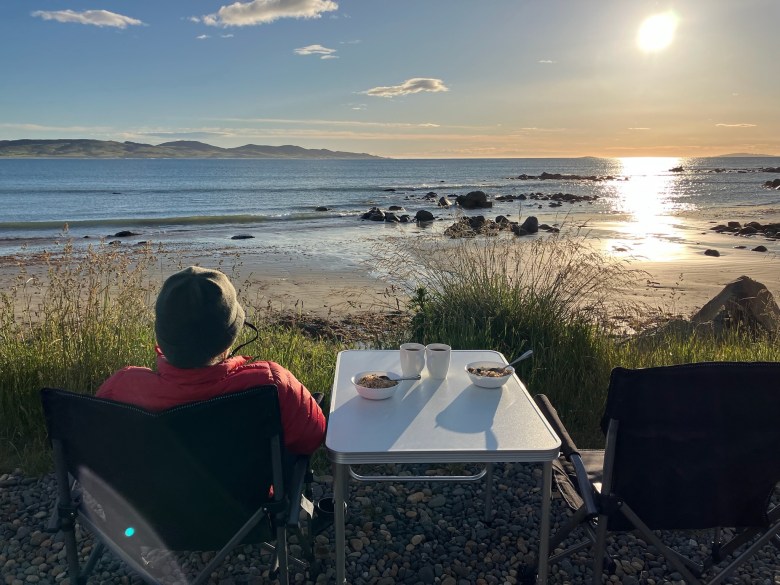
Campervan camping is about more than having food and shelter with you on the road. There is also a strong connection to nature while still having some indoor space. When we return to our cabin in Maine each summer, we are reminded of the impact of the weather on our daily lives. We notice nature more acutely in the deep woods, with our front-row view to the lake, where we watch the storms build and break, hear the wind rattling the glass, and know the temperature outside because it is the same as inside. In the van it was similar. Weather was a big factor in our enjoyment of a place, but even in a storm it was nice to be able to sit, eat, and sleep in our shelter. Still, without a heat source in the van’s “cabin”, the cold nights were, well, cold. In the Southern Alps, we took to wearing our wool hats and socks in bed. And when an unexpected wind storm struck, the van was buffeted about to the point that an alarm repeatedly sounded on the dash with a message suggesting the driver might be experiencing “excessive drowsiness” and perhaps it was a good time to take a break from driving. Not helpful!
One of the challenges many Americans face when coming to New Zealand and renting a car or camper is that here the driving is on the left and the steering wheel is on the right. We were both a bit anxious about adjusting to driving on the opposite side of the road and in a bigger vehicle than our diminutive Honda Fit. It turns out that you get used to it quickly and even the round-abouts (aka rotaries) make sense. Perhaps the biggest challenge was adjusting to the reversal of the wiper and directional signal controls. Pretty much every time we wanted to make a turn we’d turn on the wipers, swear a little, turn off the wipers, and then flick the correct stick. Fortunately, most of the time there are so few people on the roads outside the cities, nobody is around to see you turning with your wipers on.
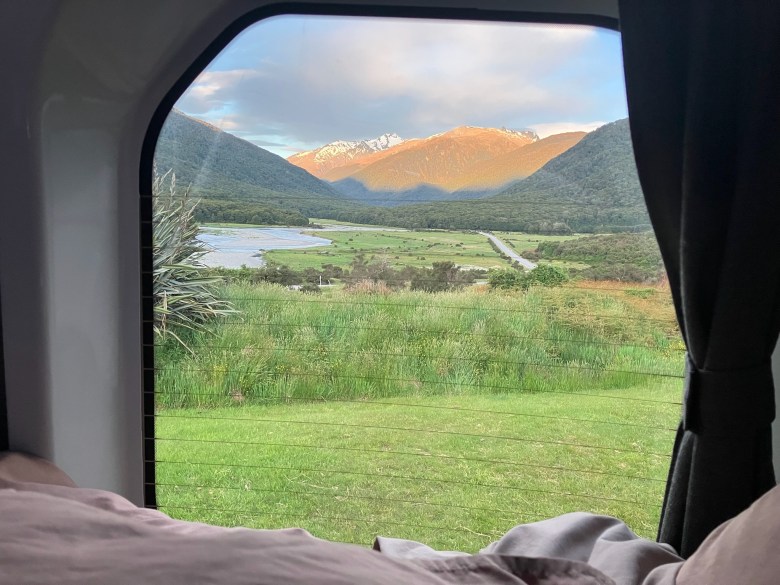
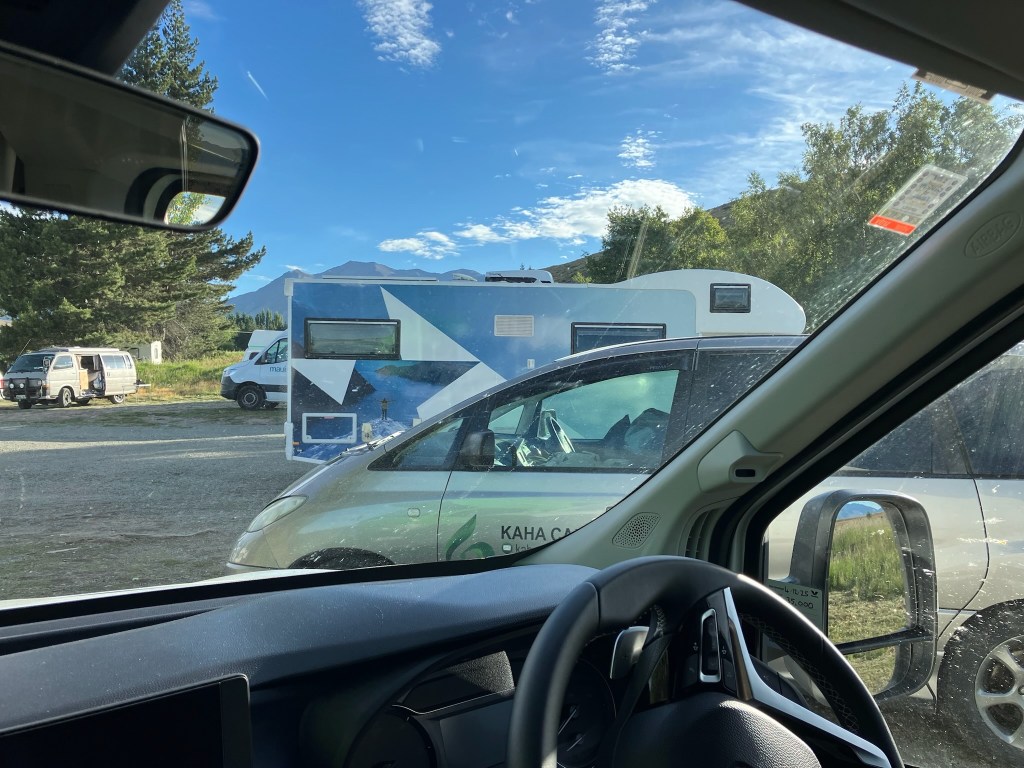
Perhaps the very best thing about taking a trip in a camper is having the flexibility to adjust plans on the fly. Since we had our bedroom, kitchen, and bathroom neatly packed inside our vehicle we could let whim, whimsy, and weather be our guide. Looks like rain on the coast tomorrow; how about we drive into the mountains? Prior to starting the trip, we created an itinerary outlining our expected route but even before we left the rental agency we had changed the plan. Mostly we chased the sun, avoided congested areas, and took our time to explore. Some of our best “finds” were the spontaneous kind, leaving our plans by the wayside to check out a campsite, lookout, or walk that seemed interesting. Almost all our camping spots had amazing views out the “bedroom” windows and easy access to nature and hiking. We were rarely completely alone but typically quiet blanketed the evenings. If we only looked out the back (the social media photos), we might never have known that behind us (reality) were quite a few other vans!

The western side of the Southern Alps are famous for rain and, since we had just spent days soaked to the skin hiking the Milford Track, we knew we preferred to see some sunshine. So with rain in the forecast, we scuttled our plan to start there and instead headed to the alpine lakes north of Queenstown. There we found some great views of Mt. Cook/Aoraki, the tallest of all the Alps in New Zealand, and the glacier fields that surround it. We saw raging rivers of milky blue water cascading down from the heights and a sea of spring flowers in bloom. From there we decided to cross the Alps over Arthur’s Pass, where we observed the Kea parrot, which is endemic to New Zealand and loves to steal shoes, wallets, and food from unsuspecting tourists.
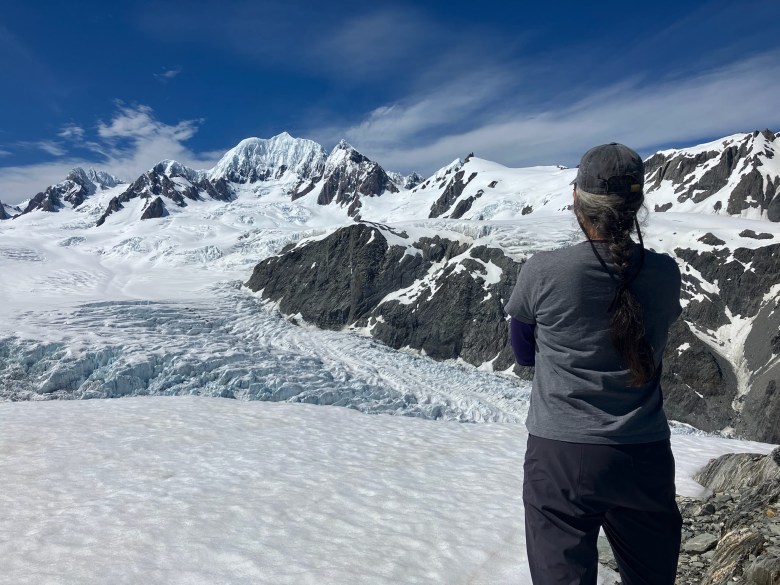
Checking the forecast again, we saw that the glacier region was looking especially good two days later. So, knowing one of our highest priorities was a helicopter ride over the glaciers, we hightailed it down the west side of the mountains to the coast. Luck was with us at the Franz Josef glacier. We awoke to a robin’s-egg blue sky and no wind and eagerly boarded the six-seater helicopter (co-pilot seats for us!). We had a spectacular flight over both Fox and Franz Josef glaciers, landing for a photo op on Fox. That was on my must-do-someday list, and I am now a huge fan of helicopter flying.
From there we drove further south than expected to find a free campsite, and were rewarded with a nearly-empty spot by a lobstering harbor that reminded us of Maine, were it not for the Caribbean-color waters and the chance of seeing penguins. Then we headed back across the Alps to get a view of Mt. Cook from the other side and on to the eastern edge of the Fjordlands for some day hikes.

To round things out, we drove the Southern Scenic Coast to the very tip of the mainland looking towards the wild and windy Southern Ocean and finally back to our starting point on the shores of Lake Wakatipu. One of the beauties of New Zealand is that all that distance can be connected by a series of two-hour drives. Along the way we found our rhythm—balancing moving and being still, attending to chores and taking hikes, and sharing the small space with grace and humor.
Even better than learning that we could stay happily married in tight quarters and scratch my itch to live in a small space, we discovered that traveling with a miniature home on wheels gives us a wonderful blend of freedom and comfort with which to explore. In fact, I’m already thinking about the perfect small-space design for our dream campervan…one of these years.

 Seeing the World, One Year at a Time
Thanks for the fabulous update. You certainly are ab
LikeLiked by 1 person
Living vicariously through your adventures. Each so different and wonderful .
LikeLiked by 1 person
I am in awe of you two extraordinary and intrepid travelers. You continue to enrich me with your discoveries and adventures. I look forward to hearing about a multitude of memorable moments in 2026. Buckets of love, Shirley
LikeLiked by 1 person
Rachel, you were raised to live in small spaces. Remember our tent weeks in New Hampshire and/or Martha’s Vinyard and/or Jamala Beach. When mom and I lived in our first bungalow at 1234 1/2 5th Ave. in SFO, we set up our ‘study’ in the tight, comfy confines of a crawl space attic, with one small window at the far [10 ft.] end.
yes we Kleins are indeed claustrophilic. Consider where Russ lives.
Before you were born, mom and I took a cross-country [ir y vuelta] trip in a station wagon fitted with a foam rubber mattress. We too, found camp sites and used a Coleman stove, no fridge.
oh, how I wish my body could tolerate a small space once more.
LikeLiked by 1 person
stunning photos and wonderful stories..thank you so much and Meery Christmas!!
LikeLiked by 1 person
Yay! Welcome to our world of the last 22 years! 🙂 I’m glad you tried the vanlife and had mostly good experiences. Doing this full time makes you realize it is a lifestyle, what with the challenges of keeping life going and the fun in between.
Mark and I actually did the same you two did in 2014, also in the South Island of NZ, to try living in a van and see how we would like it. Before then, we only had experiences of living and traveling in sailboats and truck campers. Each has their ups and downs.
So, there might be a camper in your future???
LikeLiked by 1 person
You two are an inspiration!! What an experience! Thank you!
LikeLiked by 1 person
Thanks for providing a front row seat to your travels in New Zealand. We, too, took to the road in a rented car with friends, but stayed in modest inns–not a van. We must have been in our late 70’s, and a car provided access to many of the gorgeous natural settings. The Maori village was fascinating. Stay well as you explore!
LikeLiked by 1 person