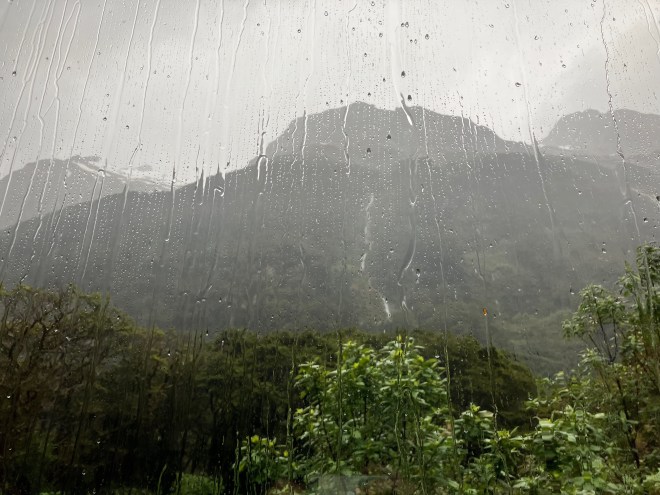
Over 22 feet of rain falls every year in Milford Sound, on the southwest coast of New Zealand’s South Island. That is the height of an average 2-story house. There’s no particular “rainy season”—somewhere between 13 and 20 days each month are typically rainy, so when you book a trip on the Milford Track (New Zealand’s most famous multi-day hike), about all you can do is hope for the best and prepare to get wet. We did both, and in the end, we got the best and the wettest of MIlford’s weather.
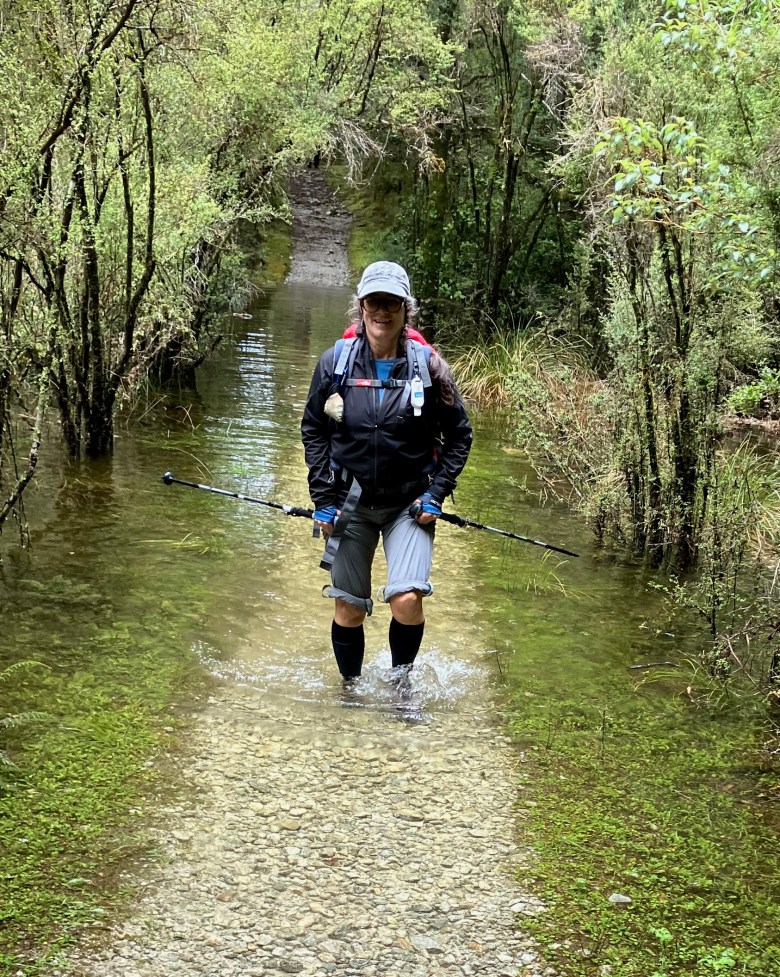
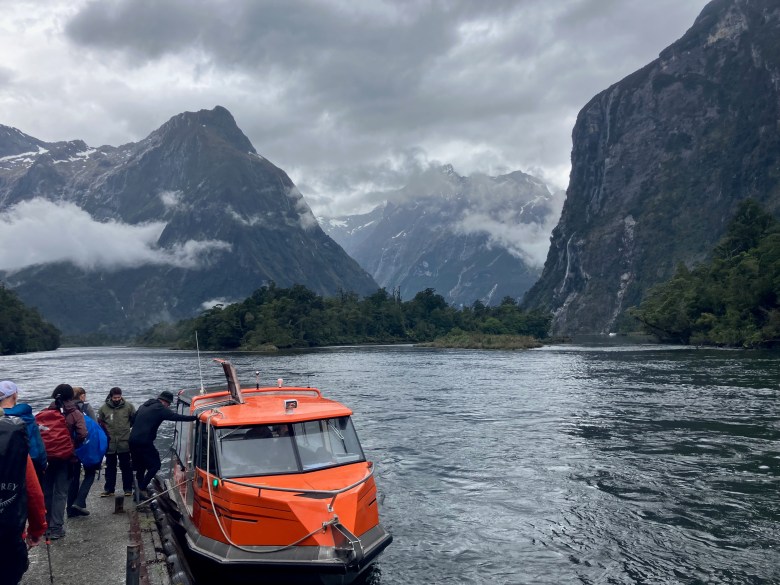
At our pre-trek briefing, our guides told us to expect to get our boots wet. But they did not warn us that literally our first step off the boat that delivered us to the trail would be in shin-deep water! The dock our group of 50 hikers disembarked onto was below the level of the lake. Many of us wondered whether to take off our boots to keep them dry, but as it turned out that dryness would have lasted about 20 steps, until we had to wade through our first stream. One of the passengers asked the boat captain about the dock, and he wryly said, “Yeah they shouldn’t have built that dock below the surface. Must have been an Aussie design company…” (Apparently there’s a friendly rivalry between New Zealand and Australia, sort of like Boston vs. New York.)
In truth, the level of the lake and nearby rivers was high due to an especially wet spring, not bad dock design (though I might suggest they install a floating dock in the future!). We later learned that the group one day ahead of us on the trail had been turned back by an overflowing river that had risen chest-high (apparently only strong water above the waist is considered unsafe). When we arrived at our first lodge, we watched as the group was shuttled by helicopter, six at a time, beyond the impasse to the next stage of their hike. By the next day—when we crossed—it was down to ankle depth, but we could see the flattened trees and washed-out ground that remained as evidence.
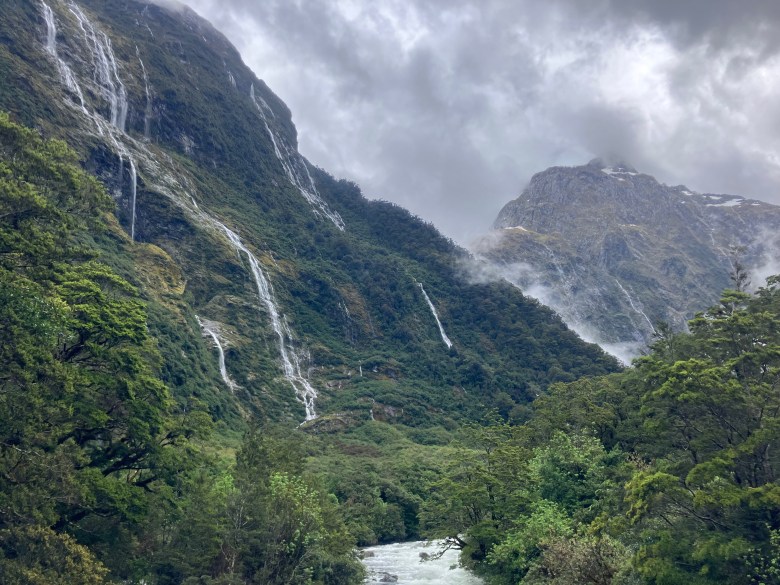
The Milford Track is just one of New Zealand’s 11 “Great Walks.” Guided hikes like ours typically involve a day of bus and ferry travel to arrive at the trailhead, three full days of hiking, and then a boat ride on Milford Sound followed by the return to Queenstown by bus. It is often cited as “the finest walk in the world” (so called by a British poet in 1908) and while that may be debatable, for sure the Milford is justifiably renowned for its alpine vistas, soaring waterfalls, and beautiful trails. It traverses 33½ miles through two stunning valleys and up nearly 4,000 feet across MacKinnon Pass, all surrounded by jagged 6,000-foot peaks that jut sharply up from sea level. Rivers gush through the valleys from inland lakes, fed by many hundreds of snow-melt cascades, to Milford Sound, one of the famed fjords in southwestern New Zealand that connect to the Tasman Sea.
Maori travelers first trod the route of the Milford Track as early as the 14th century, seeking the sacred pounamu (greenstone), which is a type of jade and was valued for tools, weapons, and jewelry. European hikers have been coming to the track since the 1880s—imagine the time it took to sail from England to New Zealand, then row across Milford Sound or take a train from Christchurch and horse-drawn wagon to Te Anau (now eight hours by car). And all that before even hiking the trail, which women did in long, heavy skirts and no one did in water-resistant shoes. I guess stepping into ankle-deep water after a comfy bus ride and one-hour ferry doesn’t seem so horrible.
Of course, getting our feet wet that first day was just the opening act—in fact, we joked that our guides planned it as a test of whether we could handle what was to come. During our five days, we had about five hours of sun. Luckily, the sun came out on our first full day of hiking, just as we emerged from moss-covered forest into an open valley framed by towering peaks on both sides, streaming with waterfalls and capped with snow. The world positively glittered with sun-sparkled drops of water.
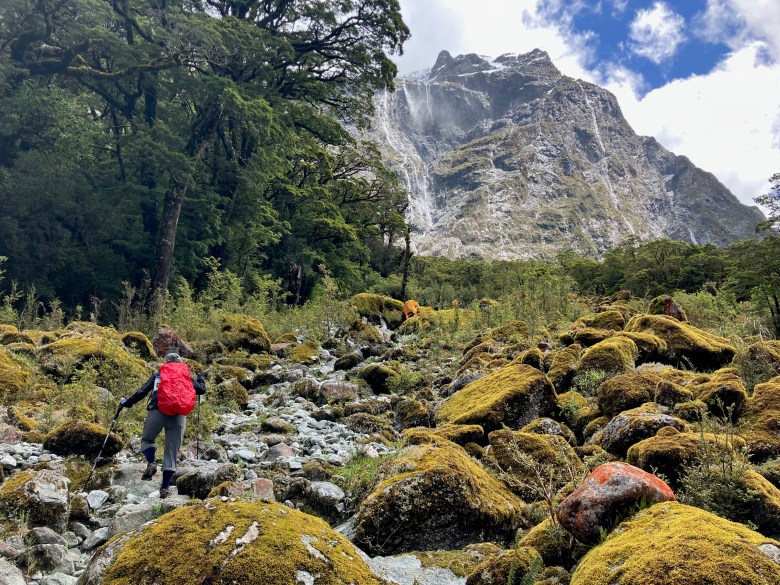
After that, it rained. And rained. And rained some more. Amazingly, the rain did not dampen our enthusiasm, nor that of our fellow hikers (well, maybe a few of them…). We found that, once your boots have been thoroughly submerged, your attitude changes. You stop worrying about getting your feet wet, and just tromp through puddles and streams without a care. When I swim, it’s similar—I hesitate before jumping in the water, but then once I’m in, I wonder why I waited so long. It’s actually very freeing, to stop worrying about what you can’t change and carry on.
You begin to see beauty in the abundance of water. Every rock face was lined with the creases of cataracts, branching and spraying like firehoses when they hit jutting crags. Inevitably they combined into rivulets that flowed along, past, under, and over the trail on their way to rivers at the bottom of each ravine. The rivers themselves roared like thunder, pouring past us in undulating rollers. Smaller streams twisted down through boulders and under swaying, narrow bridges, bringing water so clear and clean we filled our bottles with it. Trickles dripped down the “old man’s beard” lichen hanging from trees. Droplets clung to the deep green moss that blankets every tree and branch, dead or alive.
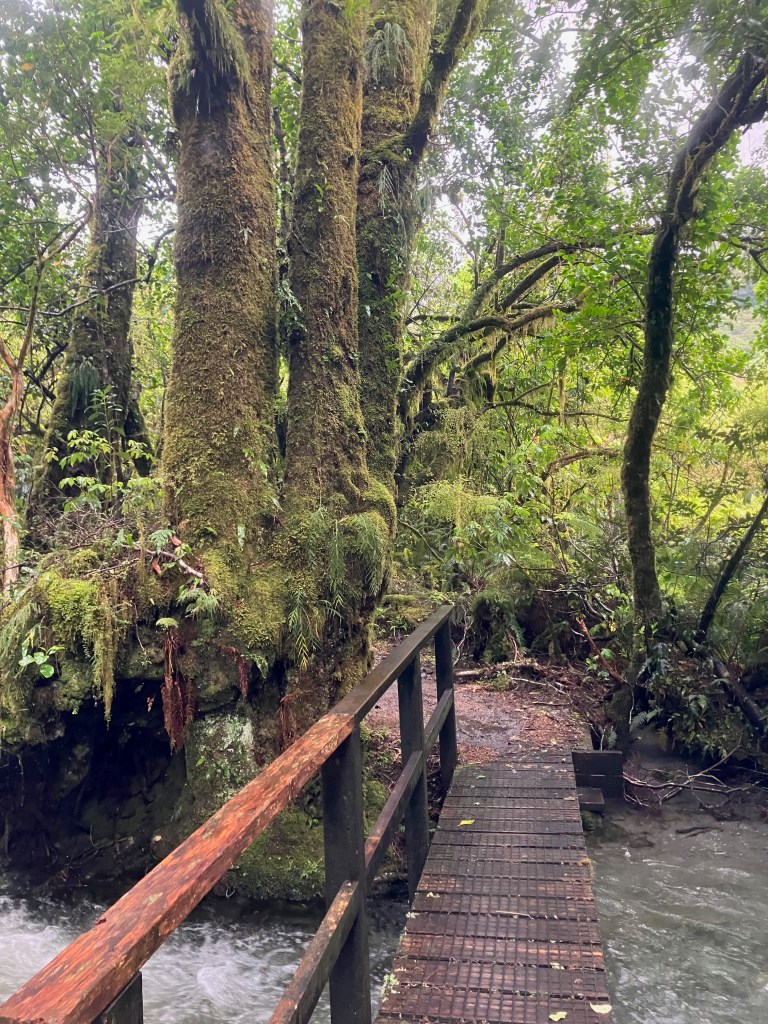
The highest waterfall in New Zealand—Sutherland Falls, named for one of the first British settlers who pioneered the Track—drops almost 2,000 feet, more than 10 times the height of Niagara Falls and 5 times the height of Victoria Falls (which was nearly dry when we saw it last year!). At its base, the falls sound like a jet engine and soak bystanders with a never-ending hurricane of water and wind.
I can’t say we enjoyed every minute of the rain. For one thing, we only saw glimpses of the gorgeous views we knew were there but were otherwise blocked by clouds. For another, Rachel’s rain jacket turned out to be not as waterproof as it claimed—we learned that even rain jackets can be “flooded” when they’re exposed to drenching rainfall for hours on end. On day three, she was soaked to the bone and the Smartwool top she thought would wick away water was just a heavy rain-soaked mat clinging to her. When we arrived above the treeline at MacKinnon Pass, which was fully exposed to powerful winds gusting at 50 mph, the rain turned to sleet. That was not fun. As hikers crowded into the small warming hut for a break, our bodies steamed and everything dripped into puddles that spread across the floor. The lone (unheated) outhouse required a sprint through sleet from the warming hut, so I suspect many hikers just held out for a dryer place.
In contrast, the four lodges along the route are amply fitted for drying out. Clearly, the needs of hikers in this climate are not new to them. Each lodge offers specially designed drying rooms outfitted with heaters and fans. For our group, the drying rooms were stacked with boots and covered with clothing like the moss hanging from trees. Given the abundance of water in the region, the showers at the lodges were powerful and blissfully hot, so at day’s end we were able to thaw deeply and emerge warm, dry, and flushed from the day’s workout. Conversation flowed like the rivers while hikers recounted their day, enjoyed fine food and their beverages of choice, and admired the dramatic views from the sheltered comfort of the cozy lodges.

On our last day of hiking, the rain eased a bit as we neared the finish line. Thoroughly soaked already, we kept up a steady pace, enjoying the last few miles of flat, well-maintained track, stopping occasionally to take photos when the mountains peeked through parting clouds. We knew the first boat from the trailhead across the Sound to our dry, warm lodge was leaving at 3pm, so we checked our watches and picked up our pace a bit to see if we could catch it. We would either be on that boat or waiting a half-hour at the aptly named “Sandfly Point”, where tiny, biting flies swarm hikers as soon as they stop moving.
Along the way, a couple of hikers ahead of us also stopped to take some photos and we slipped by, having no idea that would make us the final two on that first boat. When we arrived at Sandfly Point, we were met by hearty cheers and high-fives from the group that had been waiting for the passengers that would fill the final seats and therefore allow the boat to leave. Dripping wet, swatting flies, and radiating joy, their glowing faces showed that the accomplishment of having finished 33 miles together was what we would remember most of all. (But we sure felt badly for the two hikers we lapped on the trail who ended up being sandfly bait while waiting for the next boat!)
Having been to a desert where the annual rainfall is two-tenths of an inch, and having experienced a drought in Maine this summer where our own mountain spring dried up, it seems unfathomable that this much water could fall so abundantly here and not be able to be used to alleviate scarcity anywhere else. But that is the way of things—nature’s abundance is rarely transferable, but simply needs to be appreciated where it’s found. Milford Track would not flourish and thrive, sparkle and shine, splash and spray, or thunder and roar without all that water.
 Seeing the World, One Year at a Time
What a stunning hike that must have been—despite the rain. And it’s common among bicyclists to say once you’re wet you’re wet—sounds like you two invoked that positive outlook as well. Thank you for the history and the details to understand what a trek this really was. I might have to put it on the “bucket” list. 🪣💧💧💧
LikeLike
Lots of great biking here too, Sarah!
LikeLike
Con vosotros siempre hay una aventura nueva. ¡Me encanta!
LikeLiked by 1 person
Multi thanks, Al, for capturing the sights, sounds, and senses of your watery trek. Loved every second of the vicarious experience…and those photos were an added bonus . Really grateful that you guys take the time to share these wondrous adventures.
LikeLiked by 1 person
Hiking for hours in the rain, day after day…I’m wondering whether anyone was hearing those special waterproof boots with neoprene socks? I rented a pair at Zion to hike in the Narrows and they were amazing. This is similar: https://thefirestore.com/search-results?query=NRS%20Workboot%20Wetshoes.
LikeLike
there were some people with truly waterproof boots and they seemed to be very effective until the water got up over the shin level. Then it only mattered that you have good socks. One woman swore by her lightweight Salomon shoes that looked like sneakers but just allowed the water to flow through. The guides all wore shorts and short boots or those kinds of sneakers. Honestly, you just stop worrying about wet feet after the first shock!
LikeLike