
“Kia ora,” the tattooed man with a wide smile greets us as we step up to the coffee counter. Kia ora (pronounced kee-oh-ra) is Te Reo Māori (Māori language) for hello, though can also mean goodbye, thank you, and I see and respect you—and you don’t need to be a native New Zealander to use it. In fact, Māori words pepper the English spoken here so, while we feel confident that we will be able to communicate easily in our mother tongue for the first time in our Ten Year Travels, in fact the English spoken here is quite different from our familiar dialect. And that is just the start of the little culture shocks we have experienced so far.
That smiling barista wasn’t just treating us nicely because he wanted to sell us one of Wellington’s famous cheese scones. People here are super friendly and kind across the board. Nobody seems to be in a huge hurry, drivers don’t honk in frustration at other drivers, and random people have chimed in with their helpful suggestions and knowledge wherever we are. Just yesterday, we were riding a city bus and when it came to a stop, a lively gang of five teenage boys who were stepping off each took a moment to thank the driver. Everyone is just so darn nice.
There is one exception to the culture of Nice and that is the attitude towards pedestrians. Here cars rule the roads. You risk your life when you venture into the street to cross. Even at what appear to be crosswalks you had better look and look again to be certain there isn’t a car in sight before you step off the curb. In the cities where there are stoplights, pedestrians are given about ten seconds to get to where they are going before the light changes. But I have to hand it to Wellingtonians: their crosswalk signals are fun. The green and red “walk/don’t walk” figures honor local heroes and Māori dancers.


But while we might not feel safe crossing the streets, I have never felt safer anywhere else in the world. Case in point, we took a walking tour of Wellington (the capital city mind you) during which we visited the National Library housing the most important founding document of New Zealand, the Treaty of Waitangi (te Tiriti o Waitangi). We couldn’t take our water bottles and bags into the room, so everyone in our little group just abandoned whatever they were carrying outside the entrance without any thought of theft. Even more culturally shocking to us was when we went to the airport in Auckland to catch a flight to the South Island (Te Waipounamu) and there was absolutely no security–none! We walked into the airport and boarded our flight. We never showed a boarding pass, didn’t go through a metal detector, our bags weren’t x-rayed or otherwise examined, and only as we were walking up the outside stairs to enter the plane was an airline employee stationed to kindly confirm verbally that Nelson was our intended destination. It reminded me of the “good old days” of travel.
That is not the only way we feel safe. If you have been following our blog you know that we love to hike wherever we go and in New Zealand we are spoiled for hiking options. In prior years we have had some unpleasant encounters, from kneeling on a nest of stinging ants to being mugged in Cape Town. From the first moment we entered the natural spaces here we noticed something different. As a hiker I am keenly aware of the sounds around me—the scurry of chipmunk feet in the underbrush, the swish of a garter snake through dry leaves, the chatter of a squirrel on an overhead branch—and I generally try to avoid grabbing at a tree for stability or scrambling hand over foot on rocks without first checking for critters (I don’t need to touch a Daddy long legs!). But in New Zealand, through an intensive, ongoing effort to eradicate invasive mammal species such as weasels, rats, and possums, which had decimated the endemic bird population, the only animals you might hear in the woods are birds.
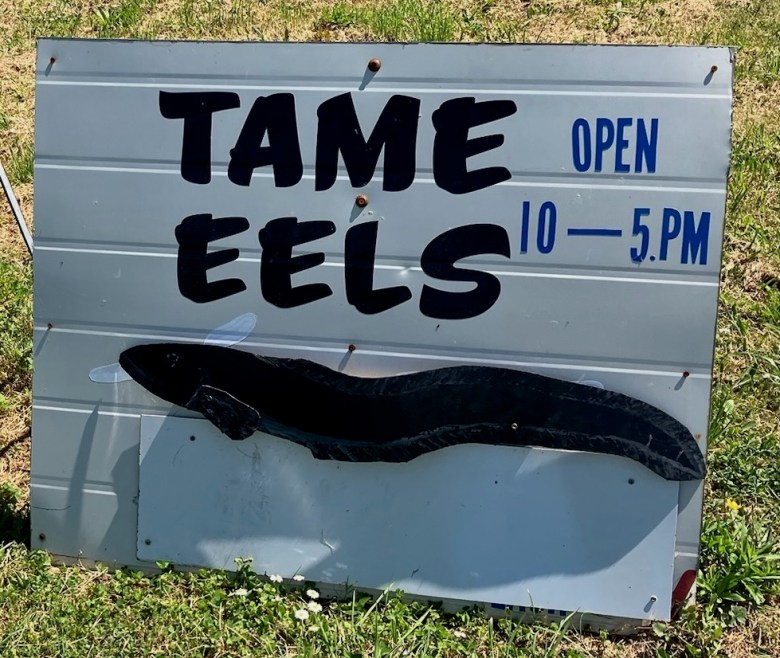
As for insects, while they exist, for the most part they aren’t scary (that said, I am no fan of the pesky sandflies that leave itchy bites around your ankles when encountered—annoying yes, but far from deadly). And then there are the animals they accept as normal but we find pretty creepy—like, eels, ugh!
That is not the only way that nature is flipping our expectations. New Zealand is a small country, running about 1,000 miles from north to south and just 280 miles east to west at its widest part. That makes it about ⅔ the area of California with a population of only five million to California’s 37 million (although there are nearly as many sheep as Californians). But what New Zealand lacks in size, it more than makes up for with diversity.

We spent a couple weeks hiking and kayaking the north end of the South Island, in Abel Tasman, the most visited of the country’s national parks, and Queen Charlotte Sound, which claims to have 20% of the total coastline of the country due to its countless coves and bays. Here the clear saltwater shines like the Caribbean in colors reminiscent of my Crayola crayons – seafoam green, aquamarine, cerulean, turquoise, cornflower and more. Small Dusky dolphins frolicked and circled our kayak playfully. Eagle rays floated over the sand and under our kayaks in a shallow-water inlet. Yet while the colors and wildlife reminded us of the Caribbean, the water is not at all tropical, despite appearances and the hardy-but-few swimmers braving the chill.
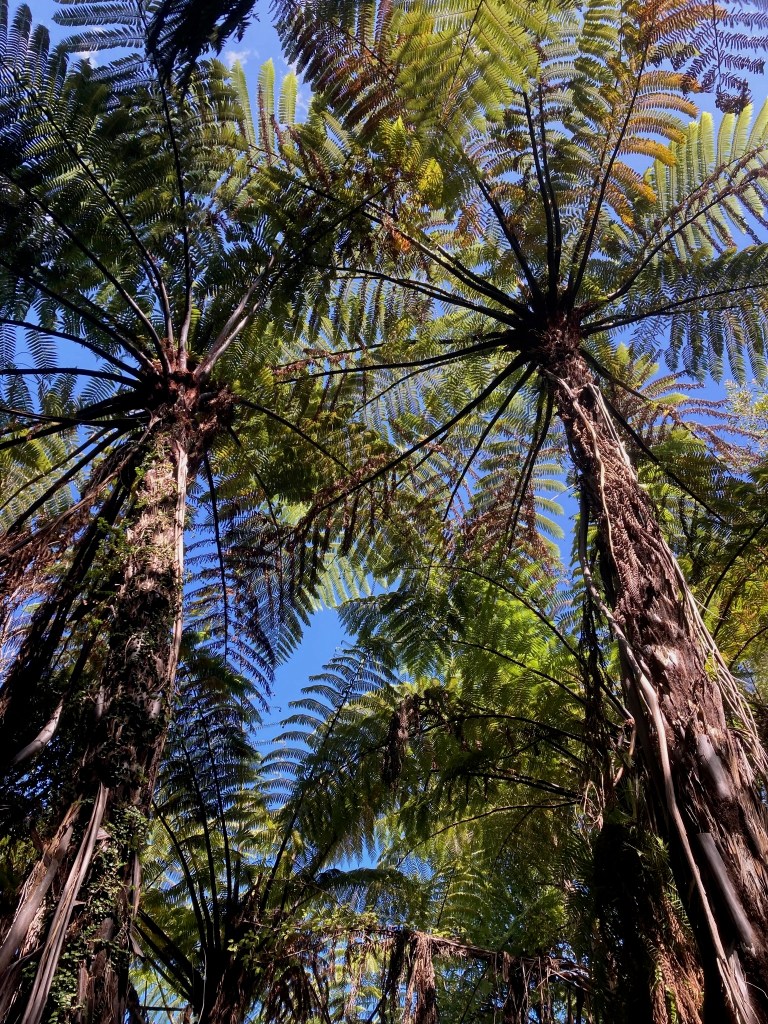
In Abel Tasman we found coastal cliffs like Ireland’s, rock arches that would be at home in Utah, and sweeping dunes like those on Cape Cod. We hiked among palms and tree ferns, which as the name suggests are prehistoric-looking ferns that tower overhead, with thick trunks and fiddleheads the size of an outstretched arm. The air was thick with the scent of humid, tropical life, flowers abounded, and yet, just beyond the hills we were hiking on we could see snow-covered peaks. Later, we took a ferry through Queen Charlotte Sound—quite similar to the rugged, mountainous fjords in Chile—to reach Cook Strait, a wind-blasted tunnel of a waterway between the two islands.

Once in Wellington, we walked past beautiful sandy beaches within the wide, busy harbor, then simply turned right to hike up a steep trail so deeply wooded it stood in as “the Shire” in the Lord of the Rings movies. We took a city bus to an expansive nature preserve, where brown parrots the size of falcons swooped by our heads on the trail and then perched on trees an arms-length away to peer one eye at us. We stopped to smell the many colorful roses in full bloom at the botanical garden, then strolled past the national Parliament and Supreme Court buildings (free and open to the public) and back into the city center to find some world-class sushi. And all that is in one tiny corner of New Zealand’s landscape, with so much more yet to explore. It feels like this small country is trying to pack everything into the limited space it has available.
Kia ora, indeed, New Zealand. Hello, we see you, respect you, and are thankful for the generous welcome.

 Seeing the World, One Year at a Time
Another wonderful write up and, for us, a lovely reminder of our time around NZ. A very special memory for us was waiting around Holmes Wharf in Oamaru at night to watch the blue penguins return from their day’s feeding. The world’s smallest penguins, they are unbelievably cute as they walk and stumble about over the road, along the path, under cars, into the campsite etc. One almost walked over Kristina’s foot. We went for 2 nights and stayed for 5 as this was such a wonderful sight, plus Oamaru just had a nice feel in the old part, steam punk central, and, actually mentioned on Google maps, a little mobile trailer selling real fruit ice cream, all around the steam punk park near the rowing club. Happy travels, Mike and Kristina 🤗🤗
LikeLike
Wow! Amazing country, elegantly told. Words fail me…I am so proud of you for what you are doing and how you convey your appreciation for it. Dad
LikeLike
This experience sounds unbelievably magical. I am so happy you two get a year of safety and majestic hikes. Keep writing, please, I am living vicariously!
LikeLike
Beautiful description of what seems to be an idyllic destination. Keep them coming.And signing off with the Maya greeting that covers almost as much as Kia Ora. InLakesh- and love.
Rosian🌹
LikeLike
Fantastic, Rachel! What an extraordinary experience!
Thank you so much for sharing it with us.
steve and helen
stevecrosby11@gmail.com
LikeLike
Rachel, I’m hanging on every word. What a marvelous description of what is obviously a magnificent country. Will savor the thought of the boys leaving the bus with a thank you for a long while. You sure know how to capture the spirit of a place and it’s people. Now to hear more about the food. With love, Shirley
LikeLike