
Morocco. This is the ninth African nation we have visited this year, and it’s a welcome shock to the system. By the time we leave the continent we will have spent six weeks in the east, six in the south, six in the west and six in the north. We didn’t plan it that way; it just worked out. We knew that we would be moving around a lot this year and it would be challenging and tiring. So finishing up in Morocco feels like submerging ourselves in the ocean on a hot day. Refreshing. Cool. Familiar in some ways, but also different and full of unknowns just below the surface. The country straddles the cultures of its neighbors to the north, France and Spain, while still being firmly rooted in Africa and the Muslim/Arab culture.
So far, we have spent three weeks traveling around the country, with a mix of self-guided, city-based tours and private tours in and beyond the cities with a guide/driver. Morocco is roughly the size of California and in many ways reminds me of that state. It has similar terrain, with high, snow-topped mountains like the Sierras, rounded, green mountains reminiscent of Napa and Sonoma, lush valleys where much of the same produce is grown (oranges, almonds, figs, dates, artichokes…), a long coastline with sandy beaches and rugged, rocky shores, and modern cities, the largest of which is Casablanca with a population of five million. And just like in Los Angeles, in Morocco…
M is for Movies
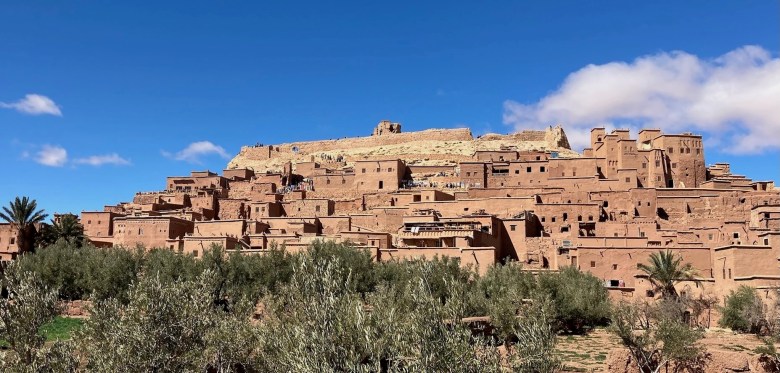
On the edge of the Sahara desert and not far from the border of Algeria is the town of Ouarzazate. Built up by the film industry and known as the Hollywood of Africa, films such as Gladiator, Lawrence of Arabia, Black Hawk Down, Babel, Cleopatra, and The Mummy have been filmed on location here. Nearby Atlas Studios is one of the largest film studios in the world. We enjoyed an afternoon wandering around Ait Ben Haddou, a former Kasbah (fortified village), which was built into the hillside long ago and is now exclusively used for tourism and filming. If you are a fan of Game of Thrones you will certainly recognize it as Yunkai, from season three—fun for two of our trio of travelers, but lost on me as I never watched Game of Thrones (gasp!). But even if you’re not a film buff, when you stop here, you’re en route to discovering that…
M is for Merzouga
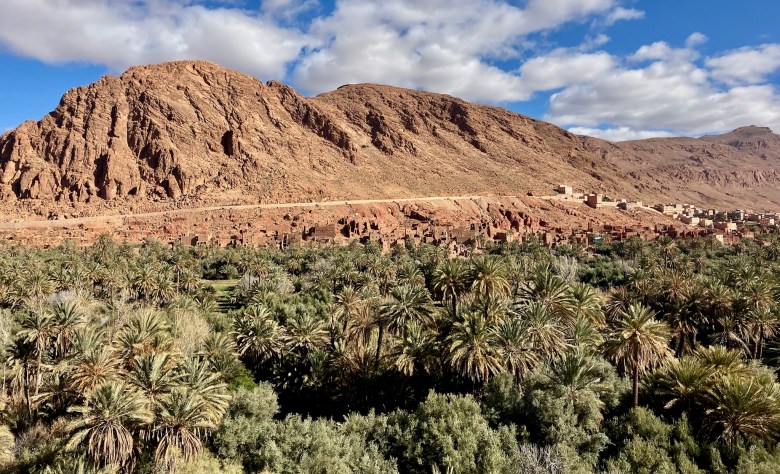
This town is at the crossroads of the vast Sahara desert to the east and the cities on the coast. It was built as a rest stop for caravans of traders who crossed the desert to and from Timbuktu on camelback with their goods. The town is kept oasis-green with the largest natural, underground body of water in Morocco that provides nourishment to the expansive palm groves considered by some to grow the tastiest dates in the world. Nearby, in the Todra Gorge we were able to walk between narrow canyon walls alongside a stream, to a source of the fresh water coursing out from the rocks that is pure, cold, and drinkable. And while Merzouga is fascinating, one of the best things about it is that…
M is for Magic under the stars
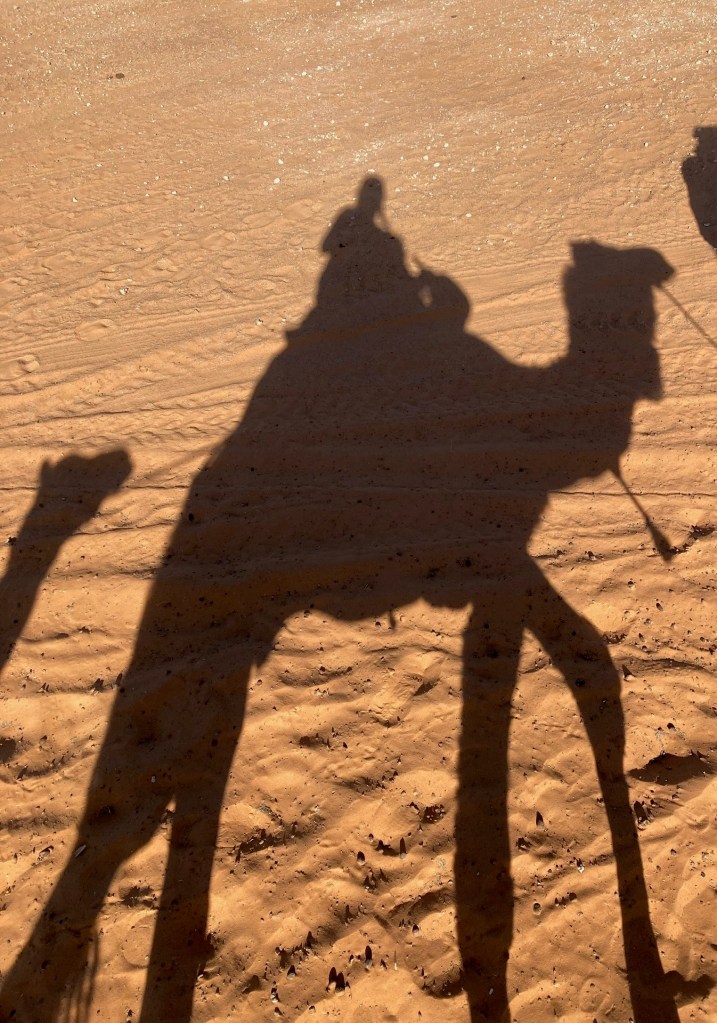

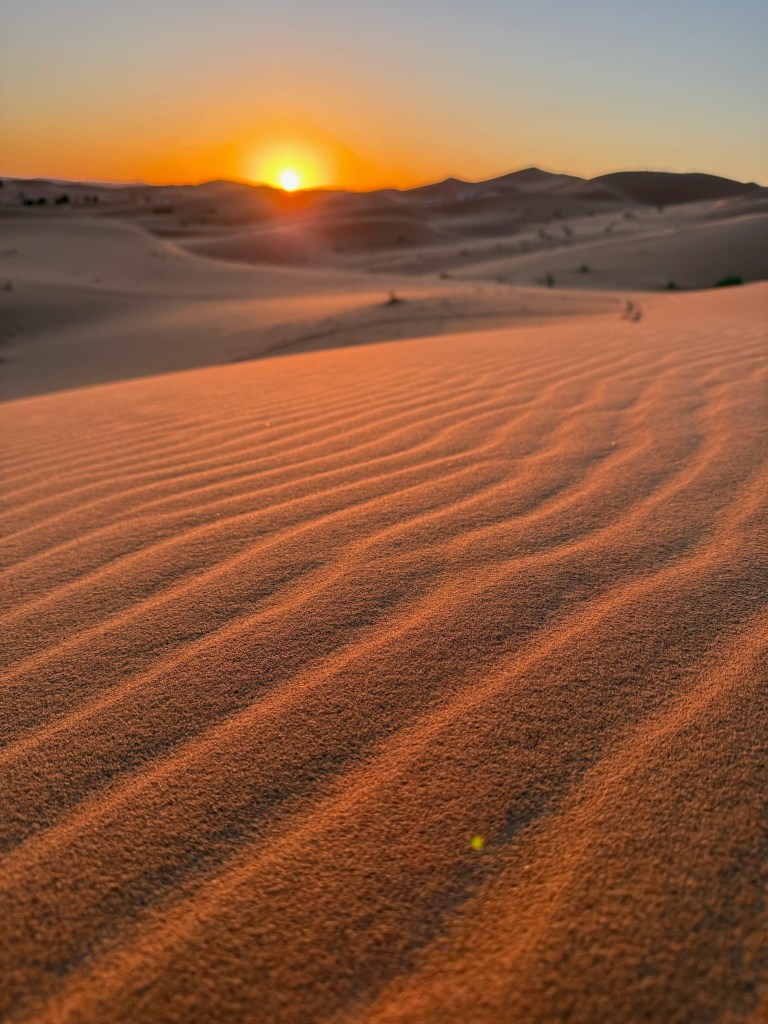
We left our 4×4 where the pavement ended and the sand started. There we ungracefully straddled single-hump dromedaries for a 90-minute humpety-bumpety ride into the dunes. The town quickly disappeared behind us and the seemingly endless rolling hills of dun-colored sand spread out before us. Channeling my inner Lawrence of Arabia, I allowed my body to sway and roll with the cadence of the camel, imagining myself as a nomadic Amazigh (the name the native Berber people call themselves) enroute with my goods to trade in far Timbuktu. Fortunately for my backside, we were only going as far as a luxurious desert camp. There we were treated to a Moroccan dinner inside a large tent and entertained by young Amazigh men singing along with their traditional drums. We watched the stars come out after the sun set behind the dunes, and slept in a private tent surrounded by the silence of the desert. And while I love a quiet night in the desert, there is nothing like the hustle and bustle of a city, so…
M is for Medina

Pretty much every city in Morocco has a medina—the old part of town, typically within a gated wall and housing a densely packed warren of shops and stalls. Marrakech’s medina, for example, is surrounded by a 12th-century wall 19 kilometers in circumference, 19 feet high, with 20 gates and 200 towers. Marrakech’s souks (markets) inside the medina are a full-body experience. There are approximately 9,000 streets and alleys that turn and wind and dead end—and guarantee that you will get lost without a guide. Souks are divided somewhat haphazardly by products. You will find areas specializing in tanning animal skins, wool dying, metal working, ceramics, leather goods, jewelry, clothing, spices, beauty products, rugs, and food of all kinds. Expect to bargain. We were told that you can pay about 20% of the starting price if you are skilled in the fine art of negotiating.
You will be tempted to gaze into shops, pause to admire some crafts, and soak up the scents and sounds, but here, chaos reigns! Vendors urge you to buy from them, beggars ask for change, and children kick soccer balls in your path. Donkeys, carts, bikes, and motorcycles careen through the narrow streets, already crammed with pedestrians. Fortunately, every city’s medina has a different personality, and not every one is like taking a spin on Mr. Toad’s Wild Ride. We had some fun getting lost in the quiet alleys of Meknés’ small medina, enjoyed a wonderful guided tour in the sprawling medina of Fes, and strolled through the more modern and spacious medinas of Rabat and Casablanca, all without fearing for our lives. And in every city there is also some respite, which brings us to…
M is for Madrasa

Inside practically all of Morocco’s medinas you will find at least one madrasa (school), often attached to a mosque, as it traditionally served as the place of learning for students of the Koran, the holy book of Islam. In the hectic medina of Marrakech we stepped out of the teeming streets, through ornately carved cedar doors, and into the courtyard of the Ben Youssef madrasa. Built in 1564 and attached to the Ben Youssef mosque, until 1960 it housed up to 800 students at a time in a hive of small, dark dorm rooms. Magnificent wood, plaster, and tilework cover every surface in intricate designs and patterns. The calm and quiet belies the chaos just beyond its walls. Students of the Koran are expected to memorize and write in calligraphic form the entire book by the time they graduate. Often these students become imams in a mosque, much like a priest in a church. And while we are on the subject of religion…
M is for Mosque
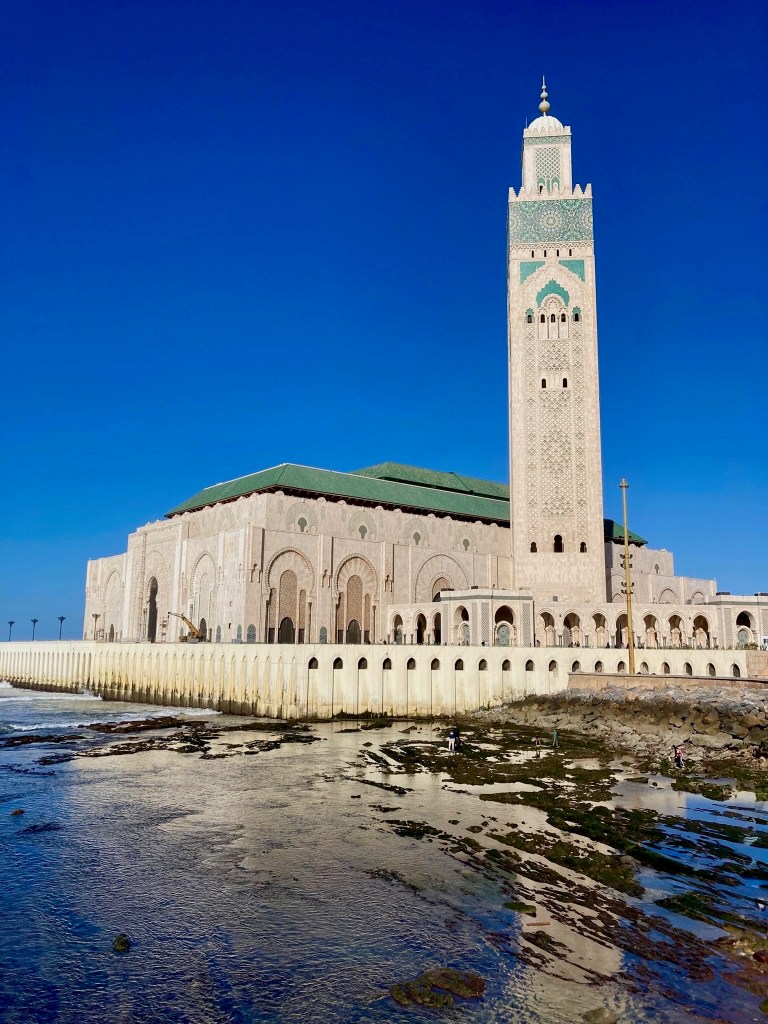
You can’t visit Morocco without encountering mosques. That said, non-Muslims are not allowed inside most mosques. One notable exception is the Hassan II mosque in Casablanca, which at the time of completion was the largest mosque in the world. Built in just six years by a crew of 35,000 workers, between 1987 and 1993, its domed prayer hall and minaret tower dominate the Casablanca skyline. The mosque can hold 25,000 worshippers inside with space for an additional 80,000 in the plaza just outside. Every square inch has been hand-decorated by the best artists and craftsmen. We were awed by the beauty and size of the space as we padded around in our socks, following our guide’s lead, while he pointed out the preparations being made in advance of the crowds expected during Ramadan (the month of fasting, beginning on March 2nd this year). No expense was spared by the king when he had this mosque built in his name and honor (and asked his subjects to pay for it!). And in case you are wondering if all this sightseeing helped us work up an appetite…
M is for Meals

Of the nine countries we have visited in Africa, the cuisine of Morocco is by far my favorite. Influenced by their years as a French protectorate in the 20th century, the bounties of food from land and sea, their geographic position at the crossroads of trade from Asia, Africa, and Europe, and you get a culinary richness virtually unsurpassed anywhere else in the world. The tagine, a ceramic, conical cooking vessel, is present in every kitchen and is filled with everything from goat to fish, eggplant to chickpeas, preserved lemons to dried figs and almonds, and isn’t complete without a handful of olives. Couscous is a national dish, most often painstakingly prepared for hours on Friday, the Muslim sabbath. And don’t even get me started on the pastries. Moroccans clearly love honey. They add orange blossom essence and rose water to most sweets. They liberally use sesame seeds, almonds, walnuts, and coconut. But my favorite dessert is chebakia, which is dough, rolled thin and cut into strips, folded into a lattice, smothered in honey and sesame seeds, and fried. They are sold on just about every street and cost a few pennies.
Good thing we are doing so much walking! When you sit down for a meal you are immediately brought fresh bread, a dish of olives and usually some combination of small plates with an assortment of cooked vegetables such as cumin-laced carrots, roasted sweet peppers, puréed fava beans with olive oil, diced beets in a yogurt dressing, and so much more. It is always colorful and always tasty. Alcohol is hard to come by in this Muslim country but that doesn’t bother us since we have become addicted to the sweet, minty gunpowder green tea that you are plied with at every turn. Ordering tea in a restaurant or café guarantees you a special experience as tea service has its own rituals that are as fun to watch as the tea is delicious to drink. I could imagine spending a lifetime eating Moroccan food and never getting tired of it. Thankfully we are only halfway through our stay in this amazing country and hopefully…
M is for More good things to come.

 Seeing the World, One Year at a Time
M is for memorable, mouth-watering musings. Multi thanks. Love, Shirley
LikeLike
MMMM…makes my mouth water.
Nicely told resume of Morocco. Wish we had visited it back in the day.
LikeLike
I know you would have loved it. M is for missing you and Mom.
LikeLike
So full of color, enthusiasm, full descriptions. I have long wanted to travel to Morrocco, but at this point my goal seems elusive. Thanks for the “next/best”- fly on the wall-secondary experience.
Stay well!
LikeLiked by 1 person
Fun blog! I can’t wait to return to Morocco in my own camper, one day. I was just asking my husband, Mark, who is watching Game of Thrones for the second time (!) – yes, it’s that good – where it would have been filmed. So thanks for answering that. Partly.
I’ve been thinking about you two as we are currently driving to the Lakes District in Chile and looking forward to seeing those beautiful images you posted of Pucon and the volcano. 🙂
LikeLike
M is for marvelous musings and making memories! Thank you for letting us ride side-car with you on this Magnificent journey 🚙.
LikeLiked by 1 person