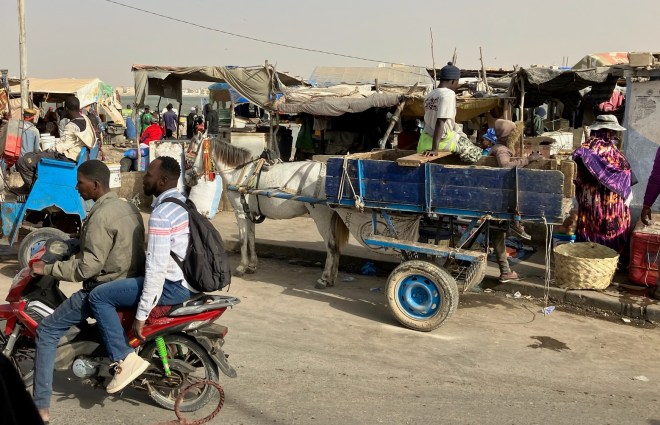
Senegal, like the other countries we visited in West Africa, is a swirling mass of contradictions: beautiful beaches strewn with trash, traffic jams and horse carts clogging paved thoroughfares, deep poverty and waves of new construction. Most people seem to have a love-hate relationship with their country. They love their homeland and hate the corruption that holds them back. When the police set up random checkpoints that seem more about harassment than law enforcement, they shake their heads, tsk their tongues, and say, “That’s my country!”
There is so much unrealized potential for tourism in Senegal, similar to Cape Verde and Sierra Leone, with its own twist. The beaches we saw were beautiful sandy strands, often filled with locals playing soccer, exercising, making music, and working on fishing boats.

We stayed on one island that is home to a few thousand people, and is only accessible by the long wooden boats typical of the region. It’s quiet, breezy, and sun-dazzled. The primary mode of transportation is simple horse-drawn carts, clop-clopping along dusty dirt roads into a sleepy town square lined by simple stone and thatch houses.
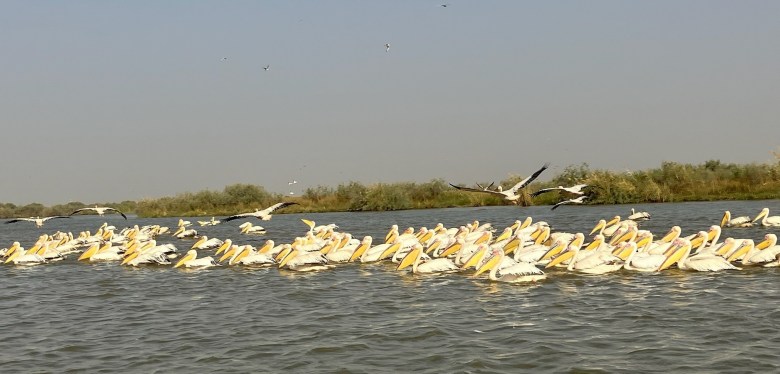
In the cities and small towns, the arts are alive and well, from simple sand-art paintings you can watch artists create in front of you to colorful tapestries and woven baskets. At Dakar’s gleaming art and history museum, cultural artifacts share the same space with modern art that builds on the traditional. We visited a vast, teeming bird sanctuary north of Dakar that has hundreds of species, most notably soaring pelicans, fish eagles, and more types of herons than I knew existed.
And yet…
The beaches we visited in Senegal also have the most trash I’ve ever seen on any beach anywhere. This goes way beyond ocean-borne plastics drifting ashore; it’s a cultural disaster. In Saint Louis (pronounced san loo-ee, as French is still one of two official languages in Senegal), there’s a potentially spectacular beach covered with piles of trash that have just been dumped there. There are few systems in place to remove trash from homes or clean up the beaches. Trash lines roadways, gets stuck in trees, clogs drainage ditches. Plastic is a particular problem, and yet every street vendor, every shopkeeper puts any little thing you buy in a plastic bag that is used for 10 minutes and then discarded. Drinking water comes in single-serving plastic bags wrapped in bigger plastic bags or packets of plastic bottles shrink-wrapped in, you guessed it, plastic.
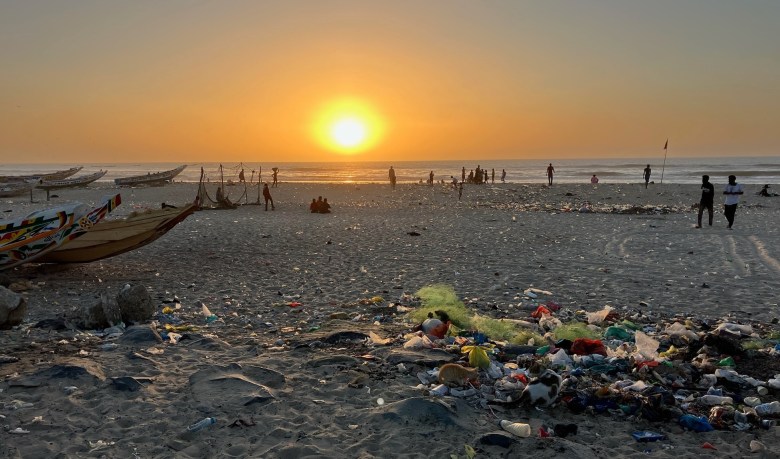
We saw the trash problem in Sierra Leone as well: People create piles of trash almost anywhere and then burn them when they get big enough. All this burning affects air quality too, as the smoke from burning trash is trapped by the Harmattan—dry desert winds carrying dust from the Sahara. In January, the Harmattan blows across all of West Africa—we first saw it hundreds of miles off the coast, in Cape Verde, as a low, dark haze blocking views of the nearby islands across the water. In Sierra Leone, we woke every morning to the smell of smoke and felt a constant veneer of dust on everything. In northern Senegal, closest to the desert, it took the form of powerful dust storms, at times almost like a white-out blizzard.
Confronting History
Saint Louis, the former capital of Senegal during the early colonial period, is a good example of unrealized potential for tourism. It could be a charming island city, with some buildings dating to the 1600s. Wrought-iron balconies hang over cobblestone streets, reminiscent of New Orleans’ French Quarter. But most of the historical buildings are crumbling. The streets are crowded with fishermen’s families, many living in tin-roof shacks. Children frequently approach cars and tourists asking for money. Of course, making the city more palatable to tourists would likely displace these long-time residents, many of whom are the descendents of those who served the aristocracy when the city was built.
Gorée Island is one of the most-visted historical sites in West Africa. It lies just off the coast of Dakar and is where captured Africans were held until they were sold into slavery and taken to the Americas and Caribbean, if they survived the journey. Senegal has done a good job of preserving this horrific history, and can finally draw some profit from its legacy in the form of tourism. It’s a short ferry ride from Dakar to see the deep scars of the island’s past.
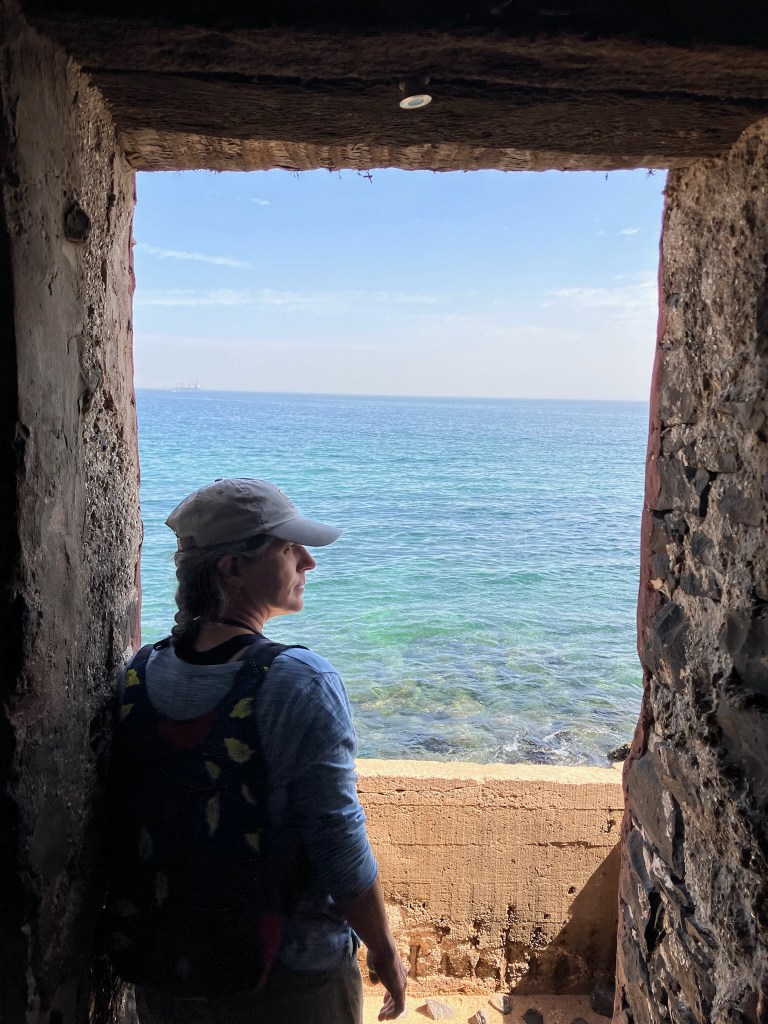
The cold evidence of humanity’s cruelty to each other still shocks the senses: tiny rock-walled cells where 40 or 50 captives were crowded for days and forced to drink water out of a trough like animals; pillory posts where they were whipped; tiny, dank, windowless punishment cells tucked beneath the stairways climbed by the white gentry. At the “door of no return,” men, women, and children were loaded onto boats, chained to one another, stripped of their identities, never to see their families or homelands again.
When we toured Gorée Island, we were joined by two Black American women in their 20s. They said they had come to connect with their ancestors after doing a 23-and-Me genetic analysis. They loved Senegal, its nightlife, the friendliness of the people. (They definitely attracted attention—I counted three marriage proposals from island men in the two hours we were with them.) But when they entered the slave house museum, they wept deep, shuddering sobs, feeling a trauma so powerful that it spans centuries. I thought of my own ancestors, several of whom were sailing-ship captains in 19th century Maine. While not directly involved in the slave trade, undoubtedly they profited in some way from goods that were created with slave labor. Besides the distant shame that realization sparked, I felt a burning anger against those who would try to hide this history. How can we understand today’s world without understanding the forces that shaped it?
West Africa Wins Again
I made up the title of this post, TWA (That’s West Africa), as an expanded version of something we kept hearing throughout the region when things don’t work as they should: “that’s my country,” with a shrug of chagrin and resignation. But it’s also based on a real acronym used by NGO workers and first shared with me by my well-traveled friend Jim—WAWA (West Africa Wins Again). Often said like a wa-wa horn in a cartoon when something disappointing happens, it means that when something breaks down, you can’t fight it, so just accept it. There’s also a sense of “we’re all in this together” [shrug, wry smile].
The primary source of WA-WAs seems to be when things are delayed, broken, or frustrating. We had several of our own minor encounters with this, starting with the convoluted routes we had to travel just to get to West Africa (see our posts on Cape Verde and Sierra Leone). Then when we were leaving, we had a late flight change made worse when the airline’s online support, telephone customer service, and in-person office were unable to work together or even talk to each other. When all was said and done, we did manage to escape West Africa, $600 lighter in the wallet, and having spent an entire day trying to fix the problem. WA-WA…
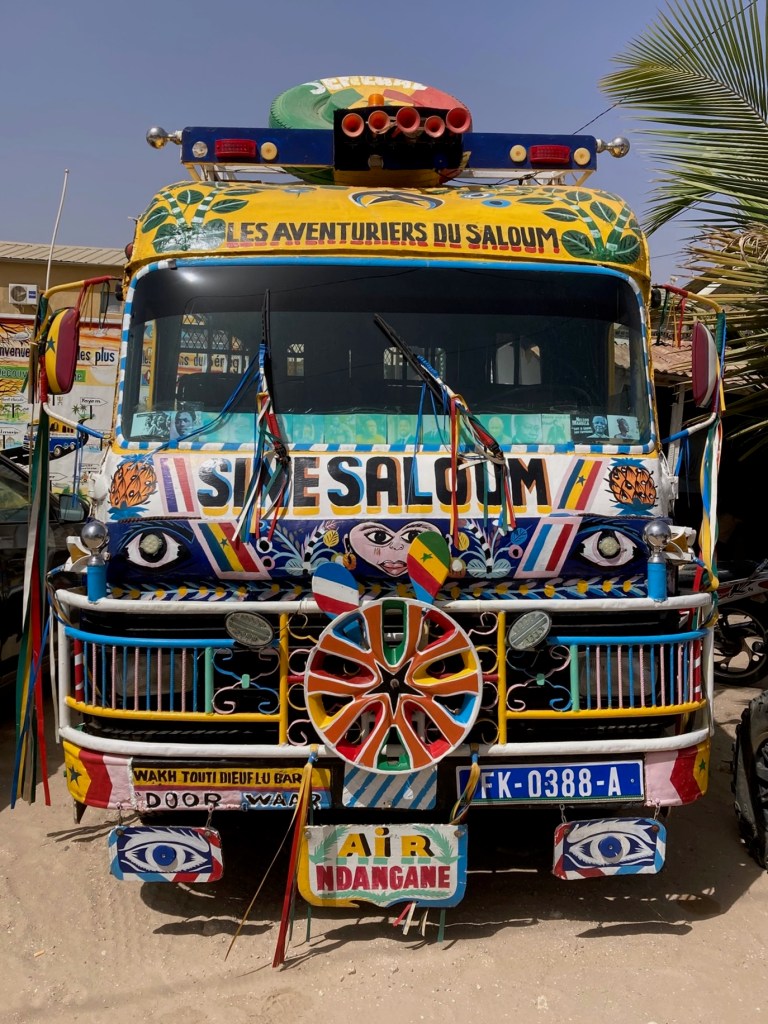
But infrastructure and government take the prize for TWAs. For example, road quality can vary wildly, and nearly all major roads pass through chokepoints: tiny towns with teeming, chaotic street markets, crossroads and roundabouts with daredevil-driven motorbikes darting in and out of traffic, construction zones with dusty gravel tire-track lanes. Tap water, when it’s available, is undrinkable (to Westerners at least) so bottled and bagged water is the norm and in smaller towns, people still carry buckets and jerry cans to a central well or river (if they have one). There’s a sense that anything involving the government is likely to be derailed by corruption, incompetence, or interference by outside entities. That’s my country! [shrug]
Of course, it’s easy for a Westerner like me to complain about inconveniences and discomforts in West Africa compared to home. It takes more effort to see how the history of colonial powers exploiting, dominating, and subjugating Africans set the stage for today’s problems. The 500-year legacy of deliberate strategies to divide, conquer, and systematically loot West Africa in particular still continues today, as governments from developed nations across the globe (not to mention private companies) continue to exploit the region. If we ignore that history, we look at West Africa through a very narrow lens.
Despite it all, nearly every West African we spoke with truly wanted to show us what they love about where they live. In Cape Verde, everyone from taxi drivers to passengers on a crowded bus welcomed us warmly. In Sierra Leone, we saw an enormous store of resilience that frequently erupted into joy. In Senegal, people seemed proud of their country’s efforts to protect wildlife, starting as recently as the 1970s, soon after they gained independence. Each country has its own distinct culture, musical traditions, cuisine, and natural beauty of which locals are justifiably proud. We were privileged to sample three of them.
 Seeing the World, One Year at a Time
we are so grateful for your “eyes on the world”. Stay safe in your travels & May all of your upcoming adventures be happy ones!
Love & Blessings,
Marti
LikeLike
Thanks Marti! Hope you and family are all well too.
LikeLike
Igual que tuve que hacer con los blogs de Chile, con los de Africa, saco el mapa y aprendo un montón. ¡Sois profesores de geografía! ¡Gracias!
LikeLike
¡Muchas gracias Luis! Nos encanta saber de ti y nos encantaría verte pronto. Planeamos pasar por el suroeste de España a finales de marzo, pero lamentablemente no por Barcelona. Haznos saber si tienes planes de viajar allí o a Madrid.
LikeLike
¿Tenéis fechas para Madrid?
LikeLike
Great experiences! The trash problem sounds similar to our experiences in Peru. Especially along the super long coastline – more tourism potential lost.
LikeLike
Yes, sadly, too much plastic and trash is a global problem. I was just reading about how U.S. trash and recycling are basically exported to developing countries.
LikeLiked by 1 person
Yeah, I believe China used to buy a lot of the recyclables from the US, but they pulled out a couple of years ago. So, who knows what happens to it all now…
LikeLike
Always enriched by your narrative and wonderful photos. Appreciate the perspective and understanding you provide of places and cultures I regretfully had no inkling. Sharing your journeys has been a priceless gift.
LikeLiked by 1 person