
At the beginning of this travel year through nine African nations, we knew Sierra Leone had to be one of them. My brother Russ moved here seven years ago and has been raving about the beauty of the place ever since. We knew it was tough to get in and out of Sierra Leone, in part because we rarely see Russ. Little did we know. In order to get here from Cape Verde—a distance of 850 miles as the sea eagle flies—we would have to fly 2800 miles via Senegal, Togo, and Ghana, overshooting our destination by more than 1000 miles only to boomerang 1000 miles back to the Atlantic coast and Sierra Leone’s Lungi airport. To make a comparison for our American friends and family, that would be like flying from San Diego to Denver via Tucson, Washington D.C, and Pittsburgh.
Bureh Beach, where Russ lives, is a small community near the end point of a peninsula bordered by the Atlantic on its west side and Yawri Bay on the east side. Having already been in Africa for four months, we were not shocked by the scenes of poverty and chaos on the three-hour drive south from the airport, but it can still be a bit overwhelming. As we crept through stop and go traffic in one busy market town, our driver warned us to put up our windows to avoid eager, desperate hands from reaching into the car—something a man actually attempted at one point.
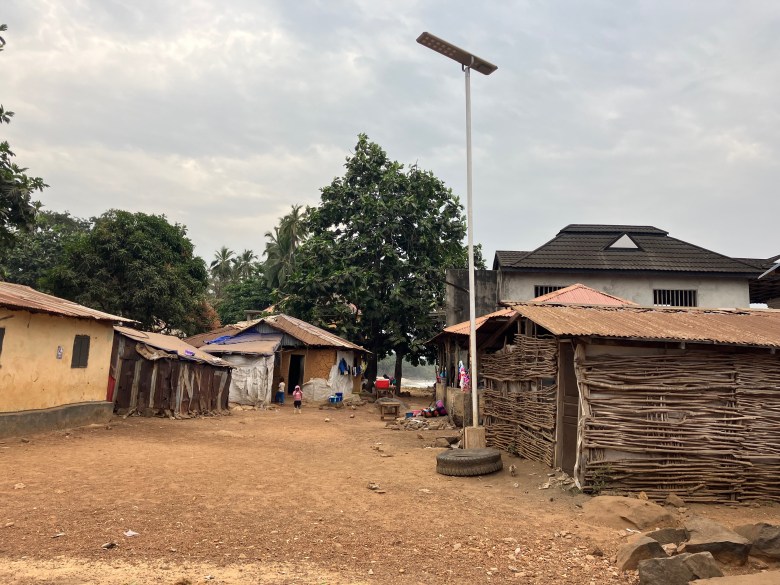
Bureh is rapidly growing; attracting tourists, developers, and speculators as word of its beautiful white-sand beach spreads globally and access improves with a new mostly-paved road connecting it to Freetown, the capital, about 90 minutes to the north. But it is not yet thriving economically. Currently there is a small but steady flow of tourists during the seven-month dry season. They are served by a few simple guest houses and open-air restaurants, a few people selling hand-made clothing and jewelry on the beach, and young men trying to sell coconuts they pick by shinnying up to the top of the tall trees. Otherwise there are no amenities—not even hot running water—and dozens of half-built cinder-block buildings languish beside the red-dust paths that serve as roads in the village.
In our three weeks in Bureh we learned a bit about what Russ’s life is like. We met his friends and community members, cooked delicious fresh-from-the-ocean meals together in his basic kitchen, enjoyed the beach, and talked about his experiences and future plans in Sierra Leone. For this blog post we decided to interview Russ so you can hear directly from him what it’s all about.
*******************
One of the first questions we get when people know that we’re visiting you in Sierra Leone is, why does he live there? So, Russ, why do you live here? What is it about this place?
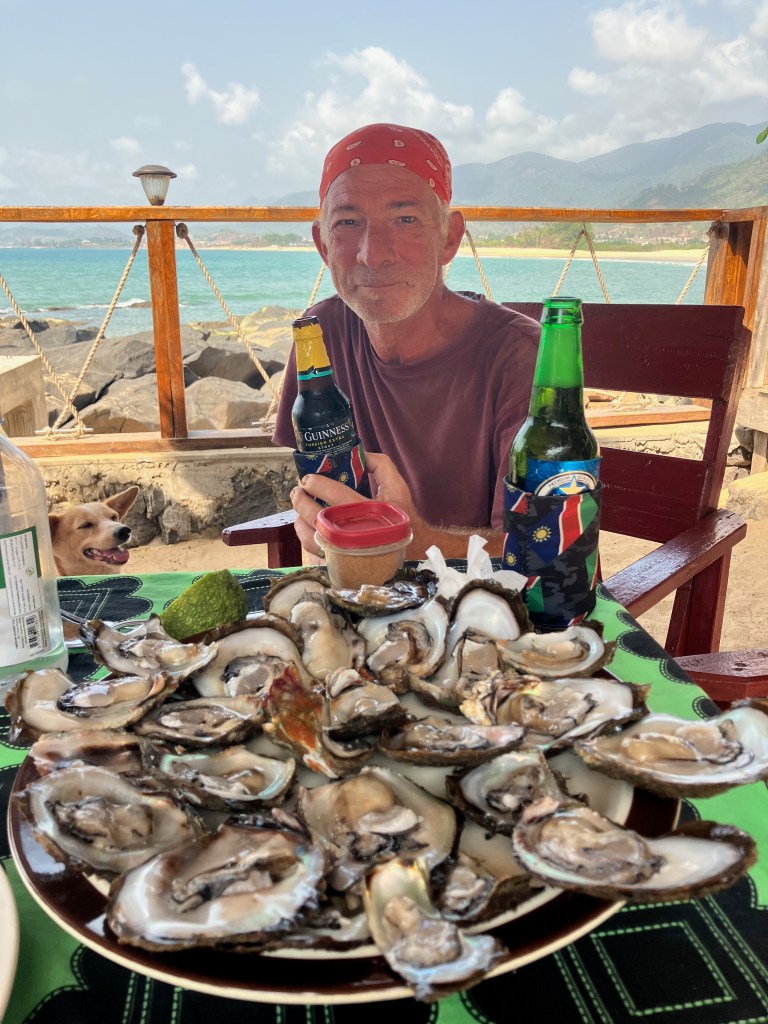
When I first decided to come here, I didn’t know how long I was going to be staying. I’ve visited, lived in, or worked in 50 countries. I’ve found very few places that just feel like home, and this was that in an instant. It was love at first sight when I got to Bureh. I’m not in love with Sierra Leone. I’m staying in Bureh because it’s paradise. It’s not easy. It’s a struggle. I think everywhere is a struggle. Why Sierra Leone? The people are so kind and so needy, so underserved in the world. Every day is a little bit different–it feels like an exploration. It hasn’t gotten old, I don’t feel itchy to go somewhere else.
As you have escorted us around the village of Bureh Beach, people come out of every home to greet us and tell us how you are an important member of the community. It must feel good to be accepted and a part of their lives. What do you think it took for them to trust and acknowledge you like that?
First of all, it’s the white-colored skin. I mean, as much as I feel like what many of them call me, “a black man in a white man’s skin,” I’m a white man. There have been a few others before me who showed the community that we’re not evil, we’re not the devil. We’re just people. Sometimes we help when we can in a way that your next door neighbor here probably can’t. So we’re treasures. When I walked into that, I didn’t really have a lot of appreciation for that part of it. I just was myself. And because I’m not a sunbird who disappears in the rainy season, like most foreigners, I’m unusual. Something happens in the rainy season. The community tightens. So to have been here for a few in a row, I think there’s been a lot of trust and confidence built between people here and me. I haven’t been aloof, like some white people. I’m trying to fit in. I’m trying to integrate. That engenders a lot of respect and it puts me on equal footing with a lot of people. And I do give when I can, so there’s also a sense that the community’s lucky to have me here. I don’t mean that in a boastful way.
Bureh seems like any small town where everyone knows everyone else, small arguments grow into long-time grudges, people have their favorite hang-out spots, and local politics can be feisty. How involved are you in the social dynamics of the village?
That has evolved for me. Little things that used to really bother me or confuse me or horrify me, don’t anymore. I’m used to it. Like, people beat their dogs and their children. They yell at each other, yell over each other, and don’t listen. There’s no resolution. It just sort of gets forgotten or left behind. Yet it’s always sort of mixing differently. Like you say, there’s people who have their favorite place to hang out, but next week they may have moved on or started associating with someone else. It’s fluid. And I’ve tried my best to stay as far away from local politics as I can, because that’s a no-win proposition, especially for me. It’s just gripes and grumbles and it doesn’t go anywhere; it doesn’t solve anything. I think all of that stuff is redeemed by the fact that everyone has a way of finding joy somehow in their life each day despite the hardship. To me, that’s a beautiful thing. That’s something I have struggled to do in my life. Yet here they are facing struggles that I’ve never known and somehow managing to find joy every day.
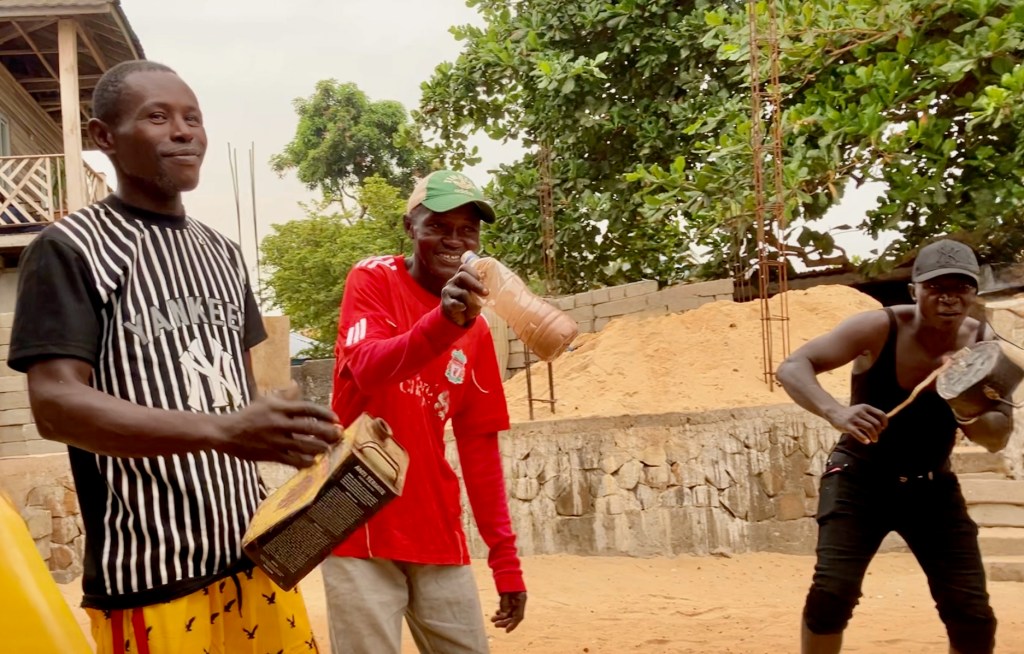
That’s so true—there is joy, but we’ve also seen a lot of poverty here and the challenges that come with it, from a young man with an untreated toothache to children not going to school because they have no money, to the need to be constantly wary of petty theft. How do you feel about living in a community where people have so little and there’s so little any one person can do about it?
Well, I think that the last few words are the answer to the question. There’s really nothing I can do about it. So it’s a waste of time and energy on my part to lament that predicament.
Do you feel like your heart has hardened to that?
No more than it had already before I ever got here. In fact, it may have softened a bit. I like to say ‘yes’ to people; I’m a giver. And I’ve had to say no a lot.
You came here to help young people gain skills that would enable them to thrive. That doesn’t sound like somebody who had a heart that was hardening.
I didn’t choose to do those things in order to combat poverty. I was doing that because I felt that these people had been left behind and were underserved and deserved at least one chance to find a path for themselves out of whatever misery they were in. I couldn’t have expressed it that way before I came here, but the driver for me was not to solve poverty or cure hunger or anything like that. It was to give back a little bit to some people who needed it, what people have been giving me all my life, which is learning, opportunity, skills.
You mentioned seeing joyfulness and a strong sense of community, which we’ve also seen. People come together for celebrations of all kinds, from soccer matches to beach parties, not to mention funerals and weddings. We’ve also met people who want to improve things in the community. What are some of the ways you’ve seen that people find joy and work to make their lives better?
Honestly, I don’t understand where they find joy. They laugh so easily and they just sit and chat together so comfortably. They go through the day and bump into each other and hang out, sometimes they don’t say anything. But a lot of times their laughter erupts, especially among peers, like boys the same age, girls the same age, the little children. I think there’s a good deal of schadenfreud. I think people laugh at the misfortune of others around them, but everyone joins in with that. It’s not that you’re singling someone out or making them feel bad. They become the source of joy. I don’t really understand how that happens. It seems so spontaneous.
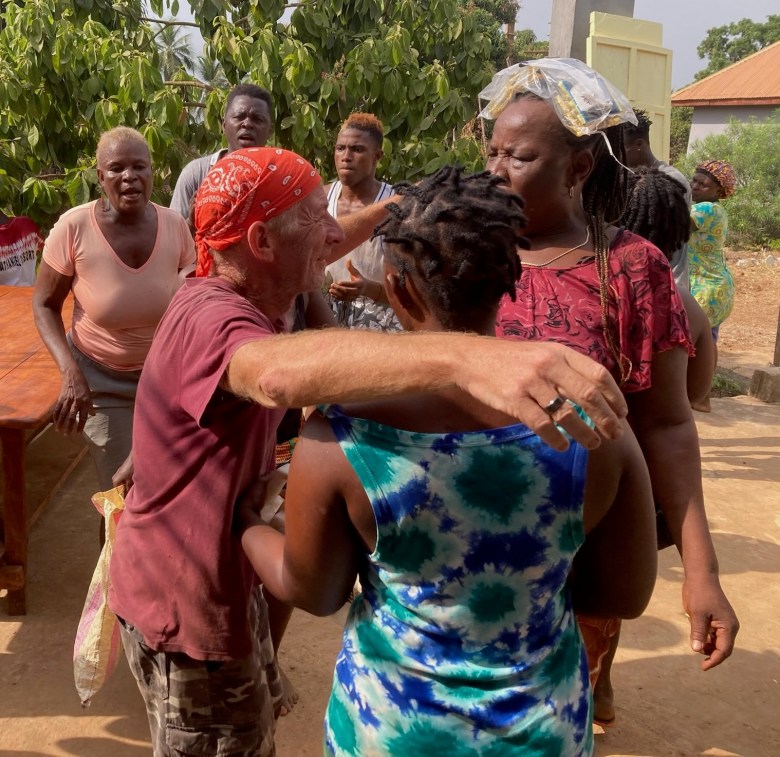
But the second half of the question is what are they doing to make their lives better. They don’t. I think they’re pretty complacent. I think they’re resigned. There are a few who want to do something to lift everyone up. They’ll talk the talk and they’ll do some things, but most things don’t work. Most things don’t materialize. They have great ideas and they work really hard at it and it just never reaches fulfillment. That can make you not want to try again. I think most people get to their mid-20s and realize that if they can just keep eating every day, somehow, that life will have been a success. They’re just glad they’re still breathing.
What else do you want people to know about Bureh Beach or Sierra Leone?
Well, about Sierra Leone in general, the country calls itself one of the ten poorest countries in the world. But there’s a huge amount of wealth here under the ground. If they could just find a way to keep it [instead of companies from other countries owning mineral rights], it wouldn’t be a poor country. Sierra Leone is peaceful and it’s safe—if you use your head. And I think it’s pretty stable. Their civil war was not so long ago that people are forgetting how awful it was. They still resist violence and weapons and cursing. One of the nicest things about it is that it’s really remote and that keeps it pristine in a way, keeps it true to itself. As for Bureh, Bureh is changing. You can already see how it’s not going to look this way for many more years. The city is coming. Light pollution and noise pollution and air pollution are little by little eroding the preciousness of the place. That’s sort of on the negative side, but on the positive side, the place has such a strong energy to it, a magnetism of some kind. If you sit quietly on a rock and listen to the waves and watch the birds, there’s just something magical. There’s some kind of energy here that makes it very special.
If you want to learn more about Russ’s life in Bureh, he also has a blog, called Opoto, at https://www.patreon.com/Opoto. (Note: it is currently a paid subscription model starting at $5 per month, but visitors can preview several posts for free.)
 Seeing the World, One Year at a Time
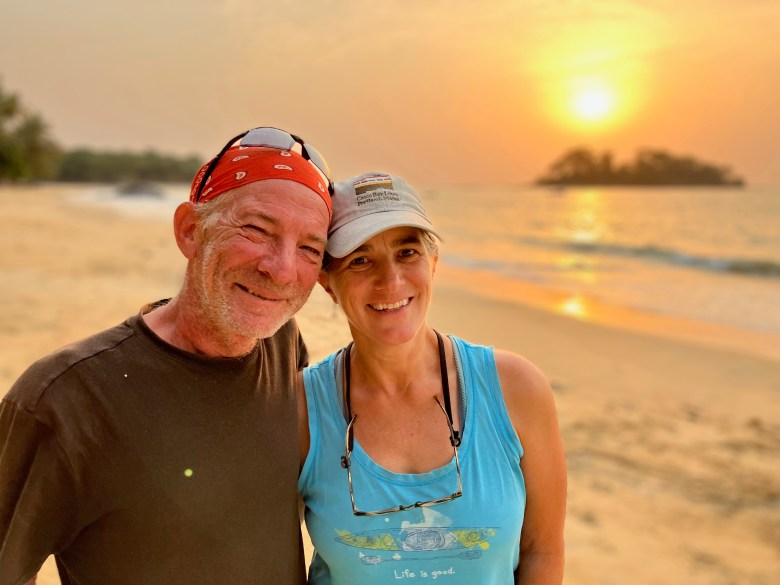
Rachel, what a brilliant way to share Russ and his life. Seeing the photo of you two made me teary. Loved that you got to be together and kinda wish he wasn’t so far away from fam, but he’s found a life he loves. That’s comforting.
LikeLike
Thank you so much for making the effort to get here. I know, as you say, it’s not an easy place to reach. My life here and the lives of those closest to me in Bureh are enriched by your presence. You proved what some doubted: that I’m not a fugitive or a spy, and I’m not here to rob the country; I’m here with a kind heart, good intentions, and with the support of my family and friends around the world.
I loved this post. You captured the feeling of the place and did justice to the beauty and also the struggle and hardship. I know that you were not always comfortable: no hot showers, spotty internet access, moving around with caution, making the best of what this little town has to offer. But you also appreciated the things that make this place precious: (not just the food) oysters, prawns, lobster, barracuda, cashews and peanut butter, mango and pineapple, but the white sands and warm waters, the community spirit, the bird life, the welcoming people, the joy of a simpler time.
im sorry my house was not ready for you to lodge with me. Next time it will be. Thank you for the motivation and resources to improve it so that at least we were able to enjoy these many wonderful days together here.
Please come back again.
LikeLiked by 2 people
Como tuve el placer de conocer a Russ cuando estabais en Segur de Calafell, me encanto leer este blog más personal.
LikeLike