Riding in a small, crowded, chaotic mini-bus, stopping frequently to pick up and drop off locals by the side of the road, was not what I had in mind to get over the attack that ended our time in South Africa. I was still seeing danger behind every corner, wondering if every skinny, scruffy-looking man approaching us was a threat. But even though we were clearly tourists, everyone in the mini-bus welcomed us with smiles. They helped each other improvise seats even when the 10-person van had 16 riders. They paid the driver when they got off, until then riding on some kind of honor system.
We didn’t have to take the van, though it was 1/10th the price of a taxi to get to the “old town” historical sites we wanted to see. But we had a group of four, it was daytime, and a hotel doorman near us recommended it. So we took the leap. Turns out it was just the start of a weeklong therapeutic experience that would help us begin to regain our trust in people.
Cape Verde is an independent African country consisting of 10 islands due west of Senegal. It was formerly colonized by Portugal, so Portuguese is the official language. Like many former colonies, a local “creole” or “Kriolu” language developed, a blend of Portuguese, Spanish, French, and several African languages brought to the island during the slave trade. Kriolu is the people’s everyday language. We speak neither Portuguese nor Kriolu, but we found that many people also speak a smattering of French and English for the sake of tourism, a growing part of their economy.
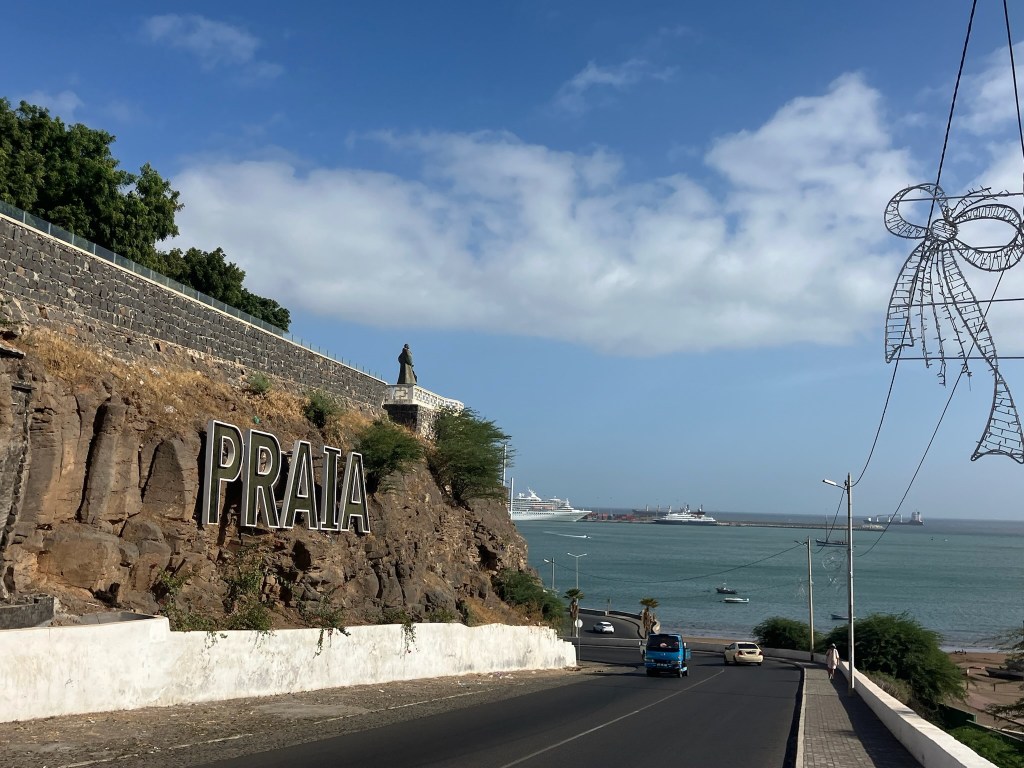
We met up with two of our kids on the country’s most populous island, Santiago, and stayed the first few nights in Praia, the capital. We so look forward to spending time with family and friends during our travels, and this was a particularly well-timed visit. They understood our enhanced sense of caution and we latched onto their enthusiasm. They also brought us the replacement phone and credit card we had ordered before we left Cape Town!
Praia is not a glamorous destination—though we did see a cruise ship in the harbor for a night. We saw only a couple of hotels that look high-end, but a couple more are in various stages of being built, and all signs point to the importance of tourism in the country’s future. Our guide at the colonial fort in the old part of town told us, in perfect English, how he had gone to the U.S. only to realize how much he loved Cape Verde and wanted to show it off to people from other countries. He wants us to tell everyone to come visit, so we are. And you should—just don’t expect it to be Nantucket.
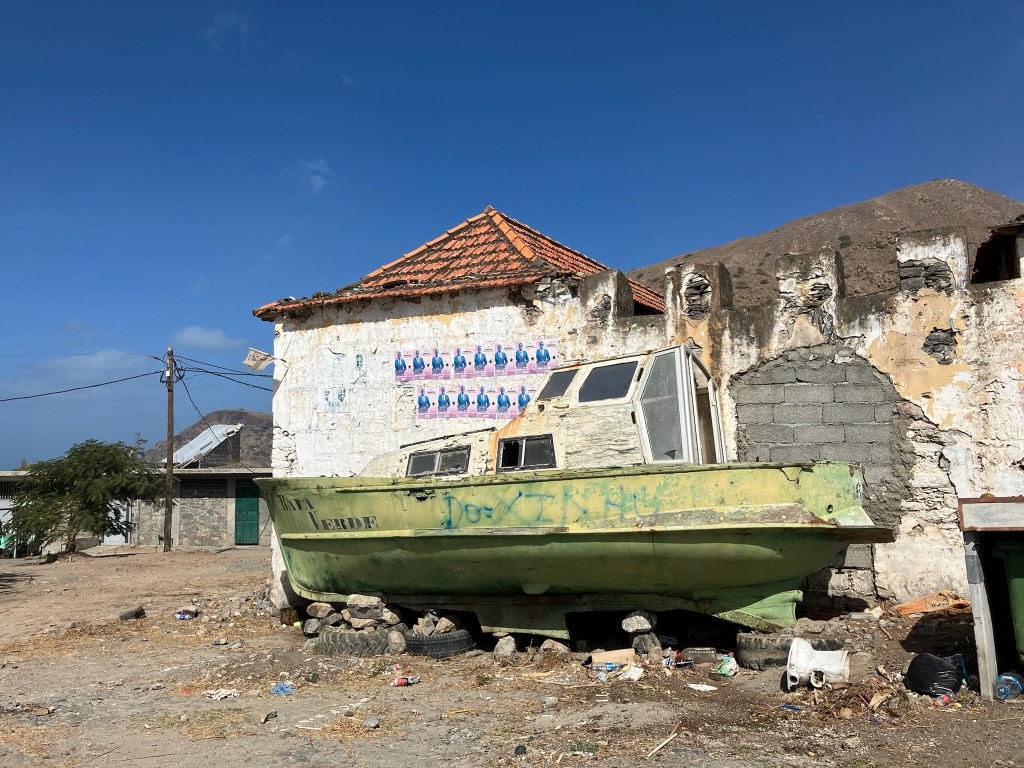
Aspirations aside, by and large there are plenty of broken-down cement walls and buildings, vacant lots, and pot-holed sidewalks (if they exist at all). The restaurants we saw are mostly very humble, though admittedly we did not seek out fine dining. There’s only one small beach for swimming in Praia and it is ringed by some of those higher-end establishments. They seemed to be well-attended by tourists, mostly from Europe. Outside of those areas, you won’t find a lot of luxury here—but you will find a flip-flops lifestyle with plenty of fresh seafood served on rickety picnic tables.

So it was not luxury that broke the spell for us—it was community. “No Stress” is the unofficial motto of the island, and it’s not just a slogan. It seemed to be on the lips of every local we met; even if we were turning down their offer of a tour or souvenir. “No thank you” was inevitably followed by “Okay, no stress.” On the other hand, I think the restaurant workers seem to take “no stress” to mean “no rush,” as a simple meal can take a couple of hours to reach your table in some places. We had also read that wait staff don’t tend to smile much and act as if your order is an imposition, and while we had a few happy exceptions, that did seem to be the rule. But we found if we let go of our timetables and our American expectations, accepting a slower pace really was no stress.
There is another local Kriolu expression, se fixe, which we heard as “say feesh” — essentially, “Are you okay?” or “Is everything cool?” when asked as a question and, “Everything’s cool” or “It’s all good” when said as a reply. Once we were taught, we began hearing it everywhere and even learned to say it. Was our meal a long time in coming but tasty when it arrived? Se fixe.
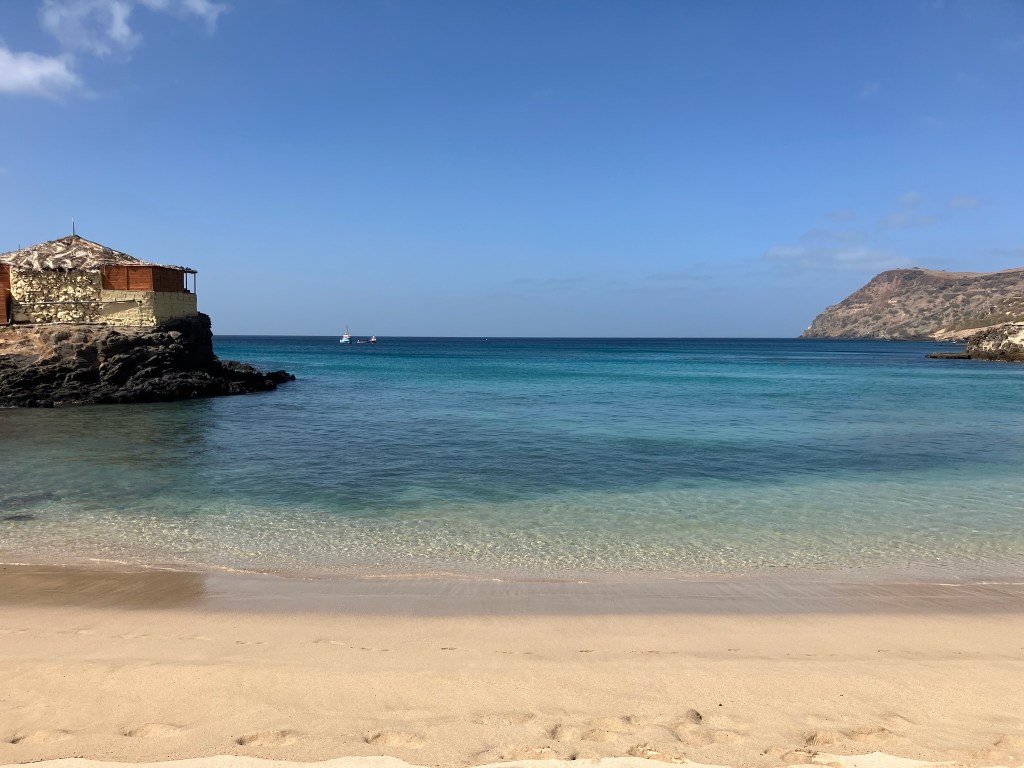
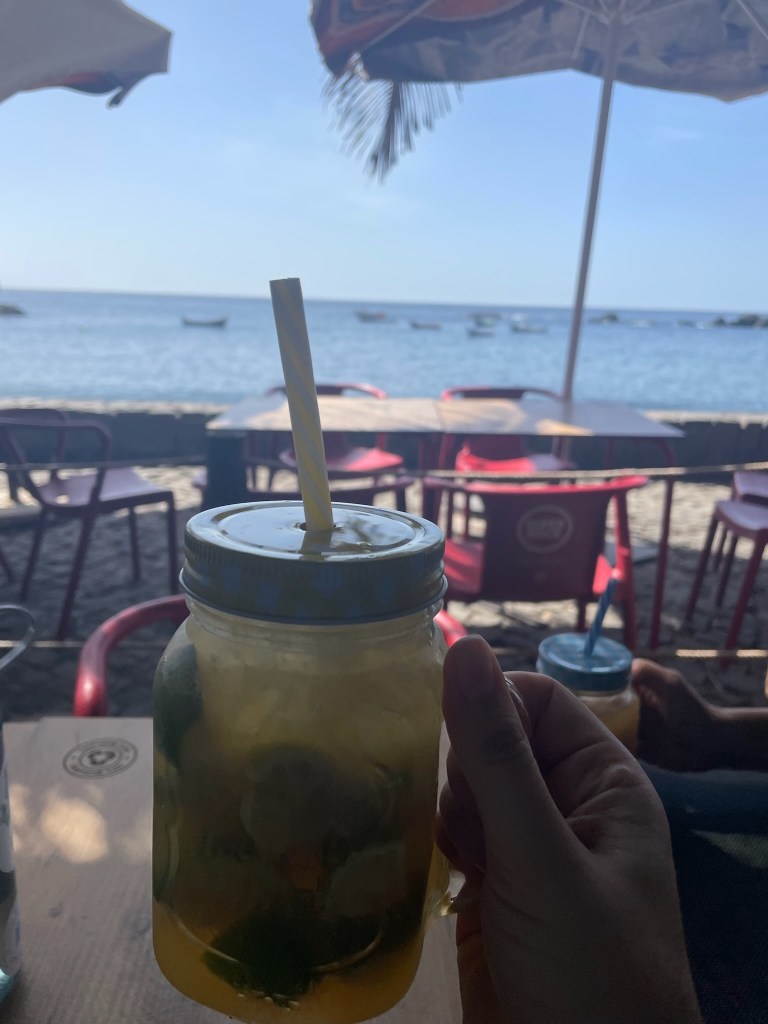
After Praia, we moved to the opposite end of the island, a small beach community called Tarrafal. Like Praia, there were plenty of buildings in varying stages of decay and renovation. Unlike Praia, the beach is the center of local life, both for fishing and entertainment, and it is a classic white-sand gem. Clean, clear water, light waves, perfect temperature to cool off but stay in as long as you like, a few palm trees for shade, and a feet-in-the-sand surfer bar serving tall grog-and-fresh-lime caiparhina drinks at sunset. (Grog is a locally made rum-like alcohol—with ice and lime, it makes for a, shall we say, powerful refreshment.)
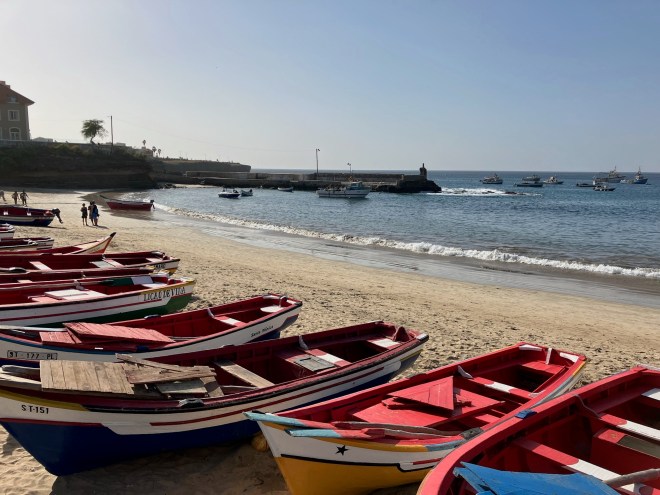
One end of the beach is reserved for fishermen and their colorful wooden boats—by late morning, they haul their boats full of netted fish up onto the beach, where they and their families work together to unload, clean, and sell their catch. On weekend days and after school, local families, people from the hills or down-island, and tourists all gather to relax and enjoy life. Pickup volleyball and soccer games, dancing and singing, swimming, snorkeling, surfing, and of course eating and drinking, all make the beach feel alive with laughter and energy. We saw signs reading “Tarrafal Vibes” and we felt them.
One day, we went for a hike in the towering 3,000-foot mountains in the center of the island. Bowing to our increased sense of caution, we hired a guide and were very glad we did. Not because we encountered anything dangerous, but because the trip was enhanced by having a kind, mild-mannered guide who patiently answered all of our questions about life in the islands. Because we didn’t have to constantly make sure we were on the right trail. And because it included an experience we could not have arranged by ourselves: lunch with a local family.
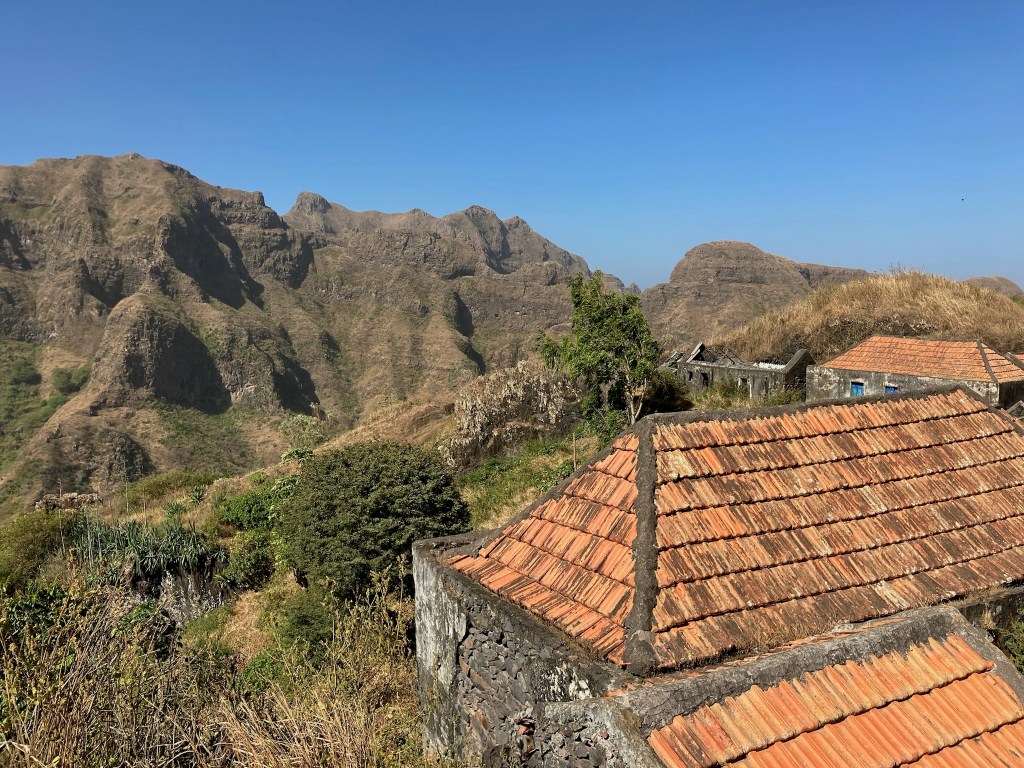
We certainly worked up a hunger after hiking for three hours along green mountain ridges under the nearly equatorial sun, although the mountain breezes kept us relatively cool. Along the way we saw no other tourists, but we were passed by several local farmers and a couple of overburdened donkeys carrying their wares from one village to another up and down the steep trails. At the end of the hike, we stopped in a tiny ridge-top village and called “bom dia” (good day) into the home of a local woman who occasionally makes lunch for hungry hikers. It’s not a restaurant, but the guide’s tour agency made arrangements in advance and she welcomed us with a hug.
While being entertained by her 5-year-old granddaughter—initially shy, but increasingly showing off her dancing, jumping, and peekaboo skills—we sat on her patio admiring the view. We imagined growing up in this tiny mountain village, so different from our own upbringings, as our young entertainer made a balloon out of a cracker bag and had no end of fun with it. Our hostess served us a huge pot of mouth-watering casserole featuring fresh, local vegetables and meat. We hung around for a couple of hours’ worth of cheerful conversation facilitated by our multilingual guide—both the little girl and her grandmother seemed to enjoy the company of strangers. We were even invited to have a nap there if we wanted!
But our driver had arrived, so we bounced our way in the back of his truck, down the steep cobblestone road to Tarrafal to catch a late-afternoon swim. On the way, our guide explained that people in these small villages typically survive by raising chickens and goats as well as potted herbs and small vegetable gardens (which they must protect from raiding monkeys—we saw an older woman with a long stick keeping watch in her potato patch). Then they piece together the odd dollar or two by making a dinner for hikers, for example, or selling some potatoes in town. They also help each other in these communities by sharing what they have with those who need it. But mostly they supplement their subsistence with money sent from family members who have left Cape Verde.
Most places we go, when people ask where we’re from, they’ve never heard of Maine or even Boston. Many have heard of Miami, most have heard of New York. In Cape Verde, everyone we talked to had at least one family member in Boston. Some could even specify which part of greater Boston. We knew there was a sizable community of Cape Verdean ex-pats in Boston, but we did not know that more people of Cape Verdean ancestry live abroad than live on the islands themselves. Of the half-million or so who live outside of Cape Verde, more than 70,000 live in Massachusetts alone. The opportunities for work are few in Cape Verde—at least until the push for more tourism succeeds—so many young men especially must leave to seek their fortune. But they do not forget their families and send as much money home as they can. Eventually, many of them return to their island home as well.
Across the week, all of these small examples of people helping each other began to add up. We didn’t let our guard down — wherever there is great income inequality, there is likely to be crime. We heeded the guidebooks’ advice to take a taxi home from a restaurant instead of walking at night. We hired a guide to take us on a hike. We took only the bare essentials with us when we went out. Yet our week in Cape Verde was a good reminder that mostly in our travels we have seen good, kind people who help each other. We are not fully over our one negative experience yet, but the mental replays are coming less often now. Seeing kindness over and over goes a long way toward healing, especially when combined with getting replacements for the things that were stolen, the time and distance that continues to elapse, feeling nurtured by the warm embrace of family, and building new travel memories. Se fixe.
 Seeing the World, One Year at a Time
The owner of the construction company and his crew that did our big addition was Cape Verdean.
>
LikeLike
I wonder what other industries the Cape Verdean community in Boston is involved in!
LikeLike
Al and Rachel,
So glad that you were able to share your Cape Verde experience with several members of your family, and that all went well. I hope you’re enjoying the summer weather there, and not thinking too much of Boston’s weather, though it must be quite a change for all those Cape Verdeans who live here in the Bay State.
I’ll look forward to hearing from you again soon!
Leslie
LikeLike
We thought about the climate a lot too. The guide who said he wanted to come back had been to Boston and Chicago and said it was way too cold for him!
LikeLike
Here too, am warmed by the outpouring of generosity and people stepping up to help their neighbors and strangers during this fire catastrophe. So glad to know you are able to start healing from that negative experience with an abundance op positive vibes.
LikeLiked by 1 person
So glad you & yours are safe Shirley! Glad the generosity of people living through this nightmare in SoCal is shining through the smoke.
LikeLike
Traveling is so much fun and so interesting — why don’t we all follow your example! Since I work in the court system in MA, I knew about all the Cape Verdeans here. Ah, you don’t speak Portuguese! Well, technology is advancing quickly and I just noticed that there are now earbuds for simultaneous interpretation (e.g., https://www.timekettle.co/).
LikeLike
Thanks Demetrios! We will check out the earbuds. Do they have Wolof? (Senegal is next…)
🙂
LikeLike
No Wolof…”only” 40 languages so far for timekettle, but perhaps other companies have more.
LikeLike
Your resilience is something to behold. Kudos! And happily, your writing is a clear and graphic as ever. I love that you two travel extensively but we landlubbers miss you muchly. These blogs mitigate the pain of separation.
LikeLiked by 1 person
So glad that the scale has begun to tip in the positive direction!
LikeLiked by 1 person
It sounds like Cape Verde was a good “antidote” to your bad experience in Cape Town. Those feelings, flashbacks, and anxious moments will get easier over time. Good for you two to not quit traveling all together.
My parents (from Belgium) spent five weeks in Tarrafal, last winter and they liked the Cape Verdes so much that they returned this winter for five weeks on the quiet island of Sol. I’m surprised how well they fare in a culture like that. They also mentioned there is a building spree going on.
Interesting about the population of Cape Verdeans in Massachusetts!
LikeLiked by 1 person