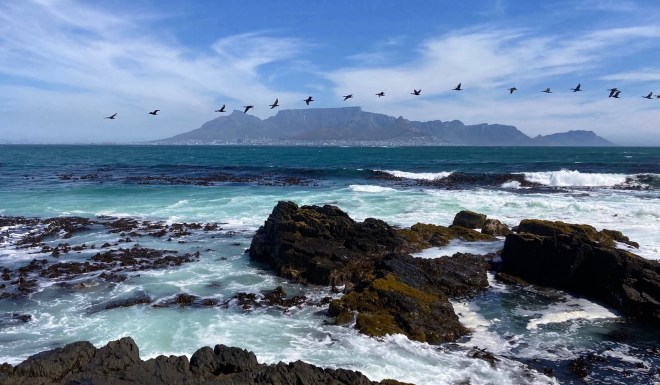
We arrived at the city that crowns the southernmost tip of Africa by land, passing through deserts, jagged mountains, and finally vineyards until we reached the Atlantic. There we looked across sparkling Table Bay and saw the cranes of a working harbor and tall buildings of a modern city. This was our first view of Cape Town. After three weeks here, we flew out with a different, deeper, and more complicated view.
Until recently, most of what I knew about Cape Town related to South Africa’s struggles with apartheid, followed by the reconciliation regime of Nelson Mandela. Later, I began to hear about its natural beauty, fine wines, San Diego-like climate, and the persistence of its problems with poverty and crime. I pictured highly segregated neighborhoods with gated communities for the wealthy White minority and sprawling slums and shacks for the poor Black minority. What we found was strikingly different—at first.
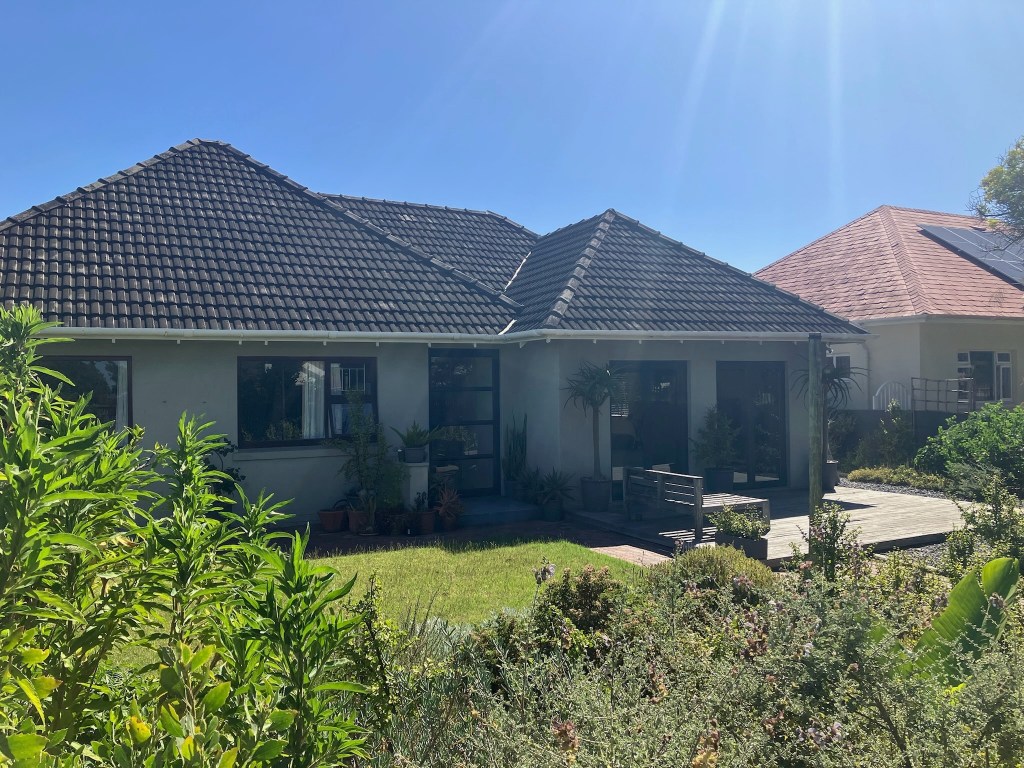
During our first two weeks in Cape Town, we lived in a suburb known as Pinelands, benefitting from an offer to pet-sit in a modern single-story home. We could walk to a mall with a fully stocked grocery store, use a walking path along a canal to stretch our legs, and catch an Uber for $5-7 into the city. In the city as well as the suburbs, we saw little of the chaotic streets we had encountered in Kenya—packed with swerving tuk-tuks, roadside vendors, and scattered trash. Instead we found reliable sidewalks, green spaces, clean streets, a thriving waterfront with high-end yachts and gleaming apartments, and a beautiful sports stadium that hosts 50,000 people for rugby and soccer matches. After three weeks camping (mostly in the desert), simply having breezy temperatures in the 70s, a private, reliable shower, water we could drink out of the tap, a washing machine for our clothes, and access to fresh produce was like a dream. One friend who lived in Kenya years ago said that he and his friends used to go to Cape Town when they “needed a break from Africa” and now we understood what he meant.
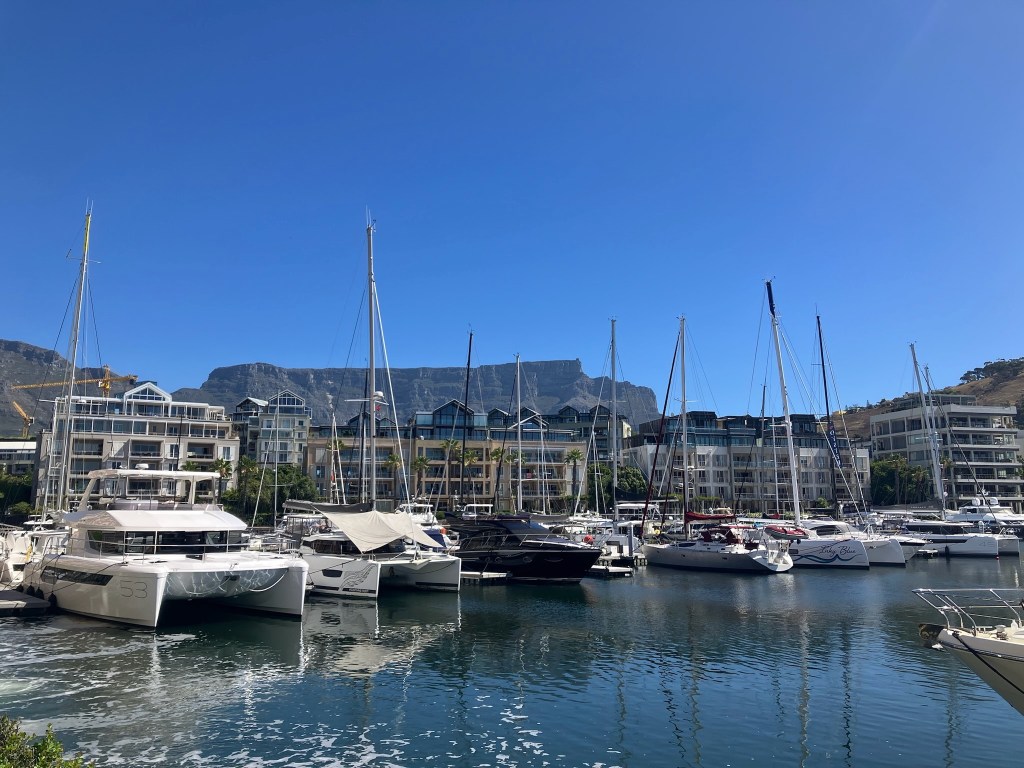
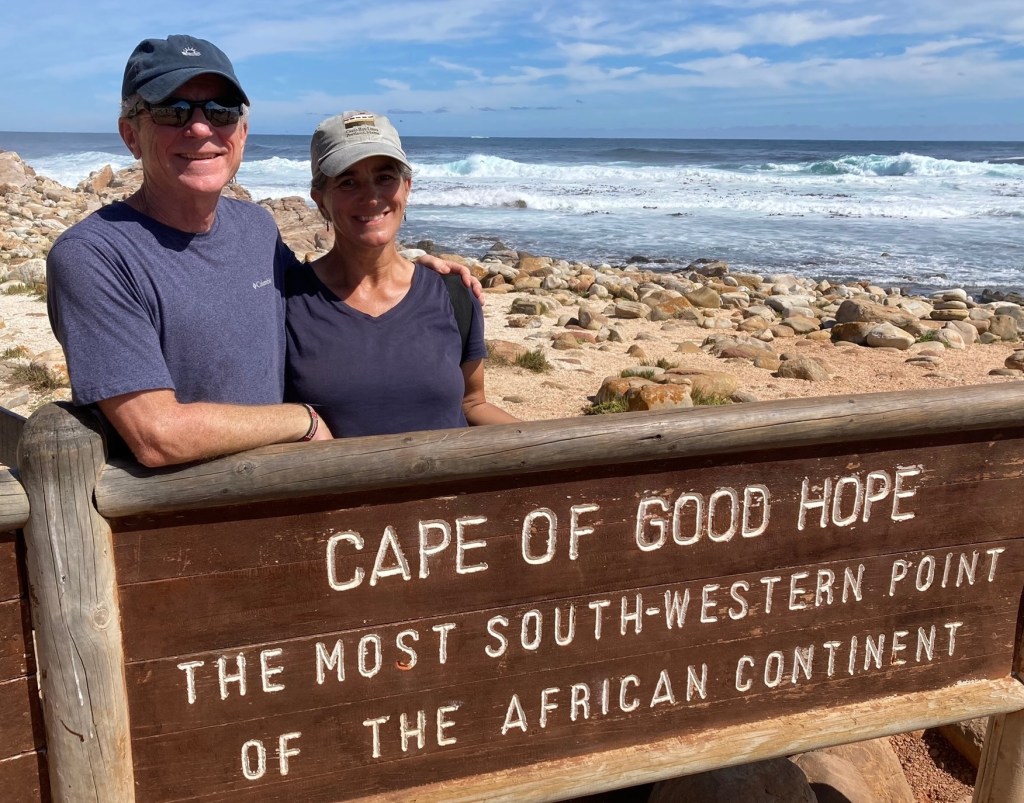
Everywhere we went, Table Mountain—a 3,500-foot, flat-topped mountain bookended by the spires of Devil’s Peak and Lion’s Head—seemed to be there. The city is tucked into the base of the mountains, and its suburbs squeeze out of the top of the valley, exploding northward, the only direction it can grow. Opposite the mountains, the city faces a dramatic rocky coastline with crashing waves and white-sand beaches tucked into cliff-bounded coves. To the south lies the Cape of Good Hope and Cape Point—the most southwesterly tip of Africa, where mariners for centuries finally turn east after navigating the entire west coast of the African continent. The mountains that begin in Cape Town, some of the oldest in the world, continue down the ridgeline of the Cape almost to its tip.
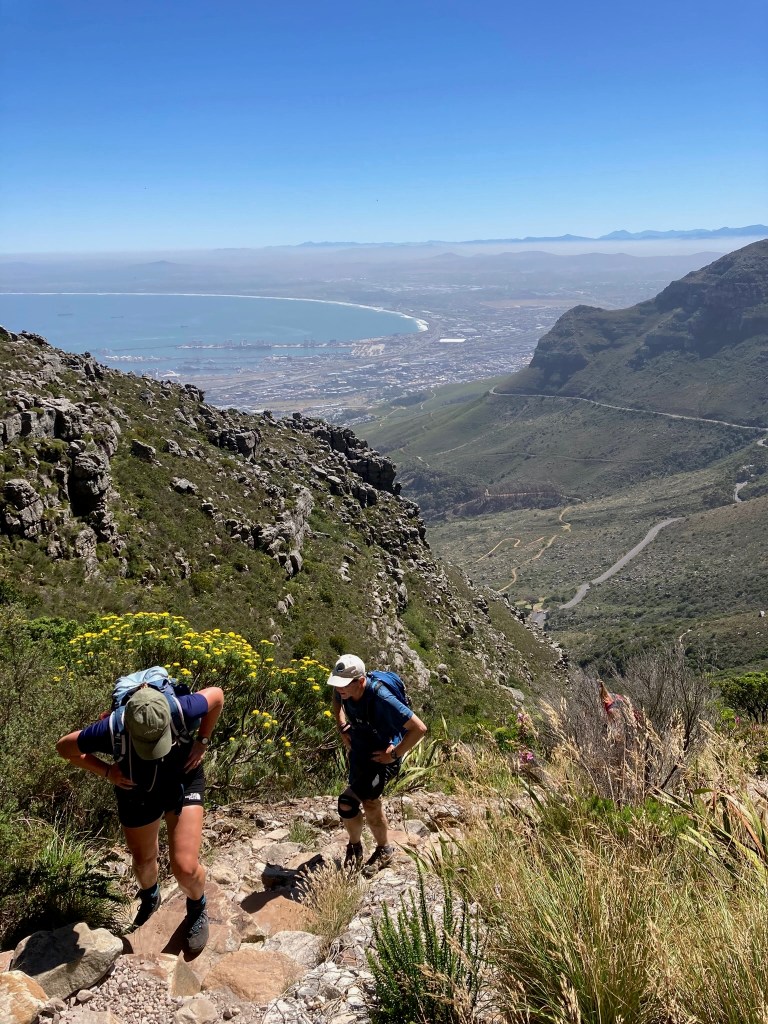
Hiking up Table Mountain is steep and arduous, rising 3,000 feet in less than two miles, but thousands of people every year do it, so of course we did too. We sweated in the relentless sun and sighed in the ocean breezes, all the way swiveling our heads to see the mountain spine, the glittering ocean, and the city in between. We shared the two-mile-long plateau at the top with hundreds of people who paid to take a cable car up. They spoke every language you can think of, crowded the most popular viewpoints, and took ridiculous selfies as tourists do, but we were all there for the same thing: that spectacular, 360-degree view of the wide Atlantic, green peaks, and sprawl of wharves, office buildings, and homes far below.
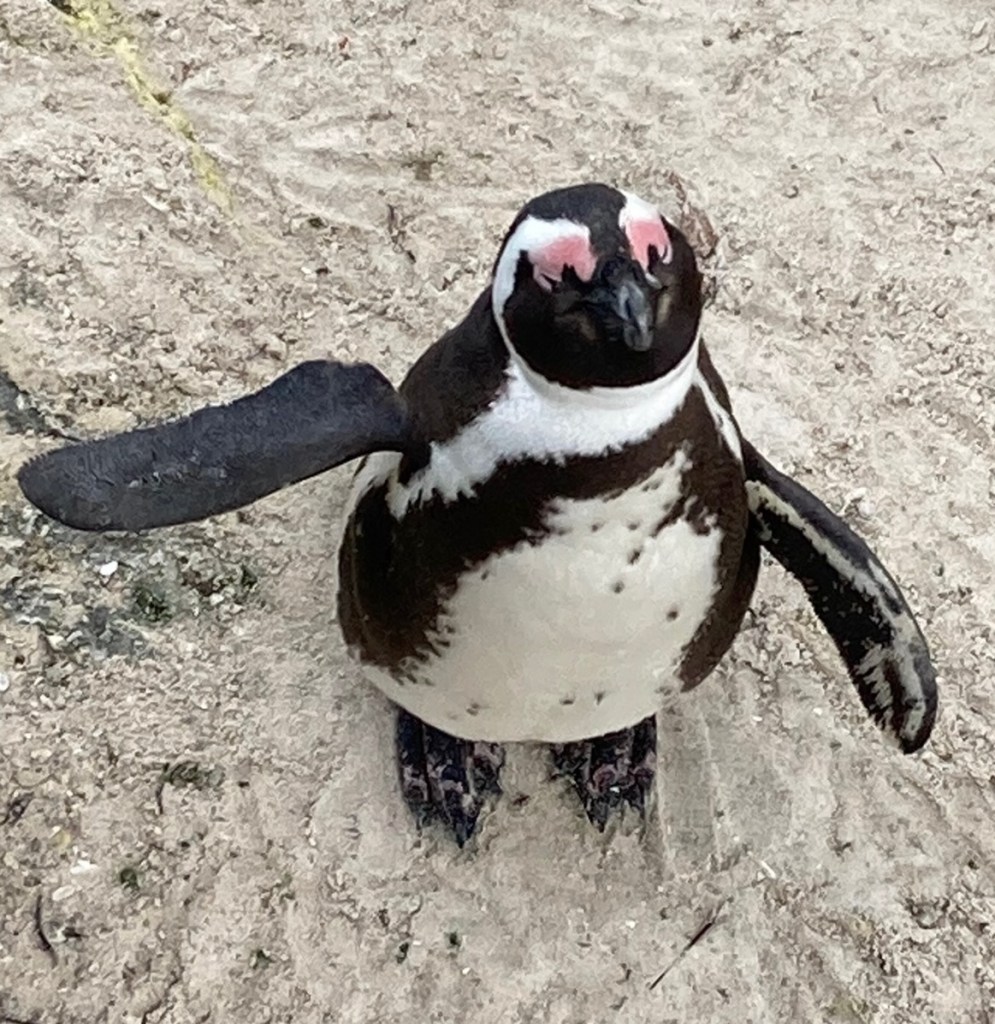
We also took a guided day trip down to Cape Point, stopping along the way to see endangered (and now protected) African penguins, aka Jackass penguins, nesting on the shore and ostriches roaming freely by the roadside. That evening we went to an upscale farmers’ market/food court that stays open for dinner one night a week. It was jammed with people of all ages, colors, and nationalities in what felt like a big, happy party. We shared a table with a mixed-race local couple, a 30-something solo traveler from New York, and an older German woman, chatting over craft beer and Cape Coast food, and by the end we were exchanging WhatsApp numbers.
Another day, we walked along the Sea Point promenade, a five-kilometer paved walkway along Cape Town’s southern coast, where waves crash over the seawall, public art displays shine, and well-used public parks and pools teem with families at play. Only three decades removed from a world where “whites only” facilities ruled, the parks and pools were filled with happy families and couples of all races.
As we learned at Cape Town’s Slave House museum, the San and Khoi people who had been here when the Portuguese, Dutch, and English arrived were mostly killed or driven away. For 400 years the Europeans imported slaves from faraway Mozambique, India, Malaysia, and Indonesia to build their new city, and now it reflects that diversity. The descendents of the San and Khoi—and their languages—are officially recognized, finally. We met one man who speaks English, Afrikaans, Xhosa, Zulu, and German, and many people we met are tri-lingual at least. We frequently heard Xhosa, one of the distinctive, complex languages that includes “clicks,” everywhere we went. Nelson Mandela’s image, like a kindly father figure, overlooks a thriving park outside the National Museum, and Nelson Mandela Avenue now runs through the center of the city.
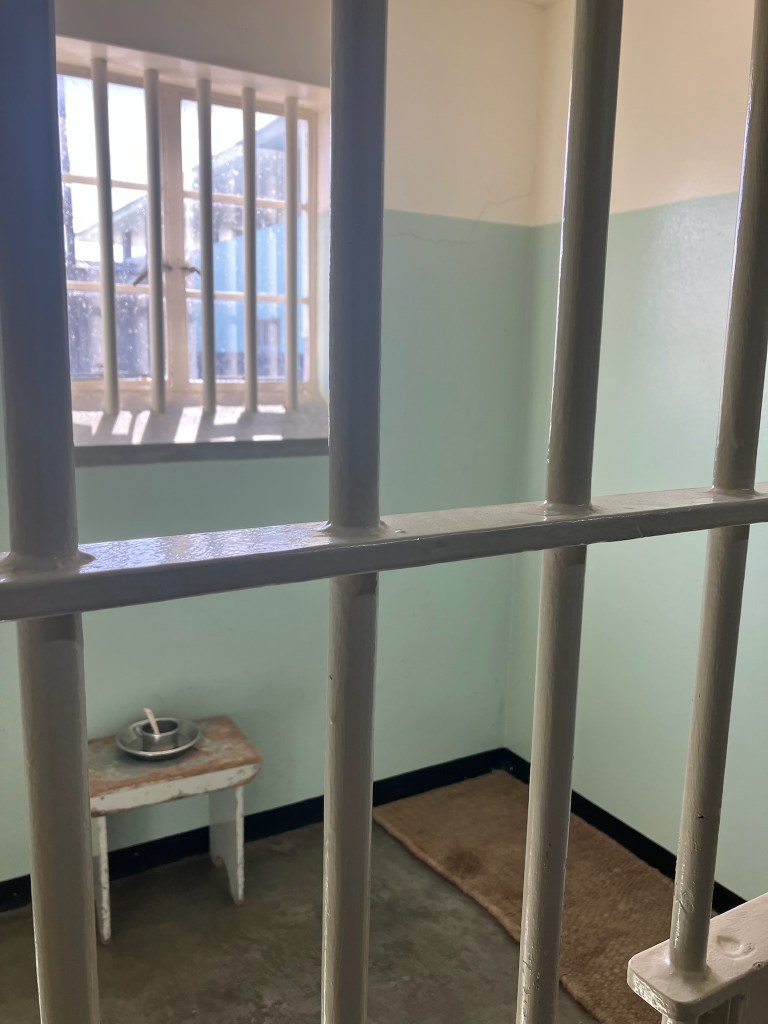
When we visited Robben Island, the notorious prison where Mandela was imprisoned for 27 years, our tour (like all the tours there) was led by one if its former political prisoners. Our guide was arrested at age 18 in 1980 and forced to do pointless, backbreaking labor crushing rocks for 11 years until all its political prisoners were released. He told us it was very, very painful to return there the first time as a free man, but now he sees it as a museum rather than a prison, and he welcomes the opportunity to tell the world what happened there.
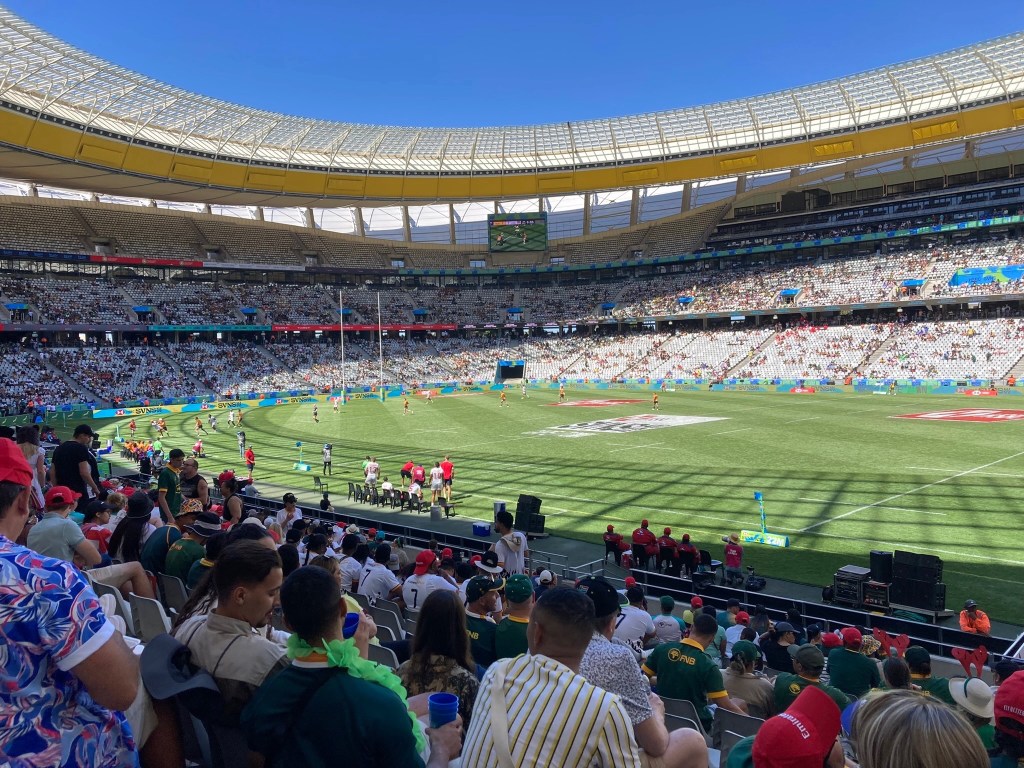
That spirit of reconciliation, of confronting history, really stood out for us. December 16 is Reconciliation Day nationally—a day set aside to acknowledge the past and move forward together. (I can think of another country that could use its own Reconciliation Day.) And one evening, we attended a “Unity Concert” on the grass at the foot of Table Mountain in Kirstenbosch Botanical Garden—probably the most fully integrated concert I’ve ever attended, with neo-soul music, people of all ages and racial mixes dancing, and a feel-good vibe reverberating around in the smiles of the crowd. Based on what we saw in all of the public spaces—parks, museums, the waterfront, even a rugby tournament at the stadium—there seems to be a thriving middle-class that includes all races.
Despite these happy observations, we also noticed a lot of concern about security, though whether it was based on their stormy history or current day issues, we couldn’t tell. We saw no gated, guarded communities in the suburbs, but every house has its own wall, many topped with electric or barbed wire. Guidebooks warn about walking alone after dark or hiking alone in some areas. Even our upbeat walking-tour guide in the city talked about being safety-conscious. In an outdoor gear store, we got into a conversation with the clerks, who said they always carry a knife or pepper spray for protection everywhere they go (we thought they were exaggerating). And we were as safety-conscious as we are anywhere—until we weren’t. After nearly three weeks of feeling perfectly safe and secure, we moved from the suburbs into the city for a few nights. And we let our guard down.
We went for another hike in the hills surrounding town. This time, at the end, we decided to take a lesser-used trail that snakes down into town, so we could enjoy the feeling of walking back to our new apartment instead of always taking an Uber. We were complacent and overconfident. And we were attacked, pepper-sprayed, and robbed by three men. Suddenly all the warnings became real. Fortunately, we were not injured. A carful of friendly locals happened by shortly after the incident and helped us find the police, who happened to be in a car nearby, and take us to the local station. While they didn’t find the robbers, the police did retreive the keys to our AirBnb, and later, Rachel’s phone. My phone, a credit card, some cash, Rachel’s prescription glasses, and a backpack were the only things of monetary value that weren’t recovered. Sadly, our dear rubber-duck friend Olive is also among the missing.
I don’t mean to make light of this experience. It was very serious, and we are incredibly fortunate to be unharmed physically. We spent a full afternoon in a police car and in the station, and let me tell you that experience shows you a different side of a city. We heard so many stories of attacks that were worse than ours. It seems like nearly everyone in Cape Town has a story of being robbed at one time or another. But the things we lost were replaceable. Amazingly, the police sprung into action quickly and used “Find My iPhone” to get Rachel’s phone back. We were able to lock both phones down remotely so they couldn’t be accessed, and the credit card company’s fraud protection worked perfectly.
That said, we keep replaying the incident over and over in our minds. The experience affected how we saw the city—maybe any city. It shattered the naive picture we had been forming in our heads. We began to see danger where we didn’t before. While eating ice cream at a sidewalk table, we quickly shut down a scruffy-looking man who approached our table, only to apologize when it turned out he worked for the ice cream shop. Our trust, our joy, has been shaken.
At the airport when we were leaving Cape Town, we bumped into a couple we had met at the police station after they were robbed in a cafe, and they shared similar feelings—replaying it, questioning themselves, feeling jaded about people, and seeing danger everywhere. This is trauma—we know what we experienced is nothing compared to the trauma that many people with less privilege face constantly, and yet it is real.
The couple in the airport said they want to come back to Cape Town in order to create new memories of a place that truly is beautiful, historical, and inspiring—and we agree. We want to reclaim the affection for the city that had been growing in us. We had begun to say this is a place we could have settled in for much longer.
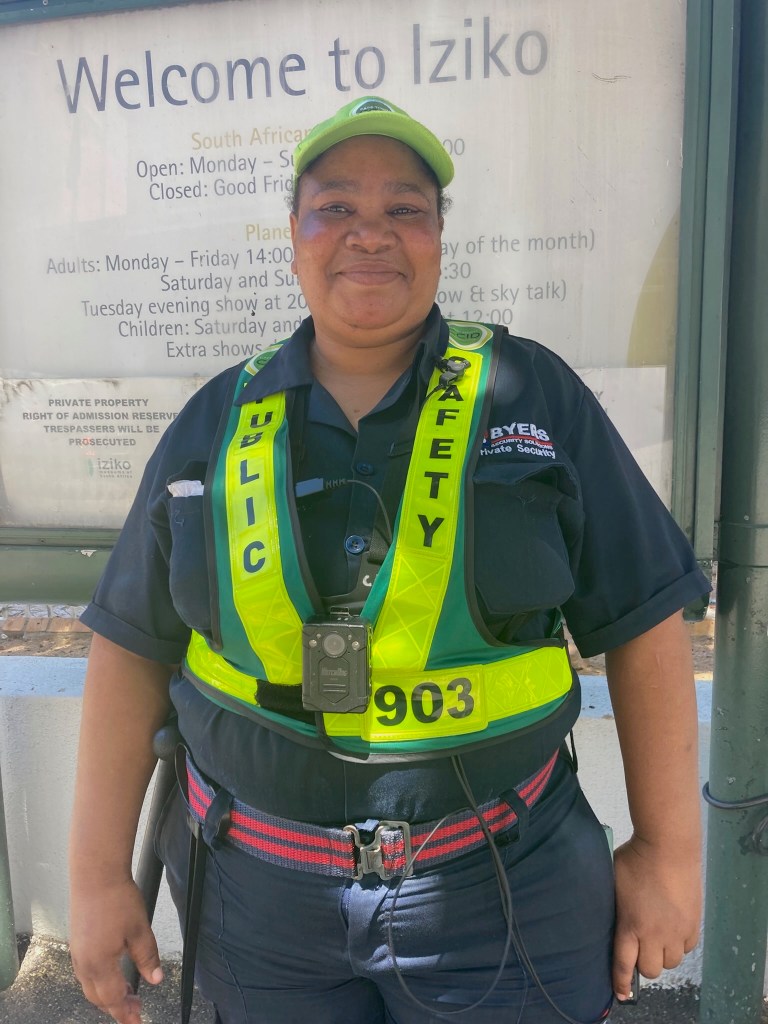
It’s a place where 99% of the people we met were above-and-beyond friendly and welcoming. A place where there really is attention to security—particularly the security of tourists, but really benefiting everyone. The Board of Tourism has security people who contacted us after the robbery to make sure we were being taken care of. There’s even a special squadron of security officers on nearly every street corner in the pedestrian-heavy areas of town. We don’t want to hold this incident against Cape Town. We were warned.
We also don’t want this experience to taint our enthusiasm for travel more broadly. We still want to hike and walk and explore—just with more caution. We will take only the bare minimum of things when we go out, we will not hike in isolated places (especially near a city), and we will take seriously whatever local security knowledge we can gather. We want to trust and welcome interactions with strangers again, but it will take some time to regain our trust and our joy. For now, we are just moving forward with good hope and a new backpack full of lessons learned.
 Seeing the World, One Year at a Time
I loved Cape Town and fortunately did not experience the trauma that you did! I am so glad you are ok!
Lucy Gatchell
LikeLike
Thanks Lucy! We are moving on!
LikeLike
Wow, guys. I’m so sorry this happened to you. It seems to be part of the travel experience when you extensively roam about, unfortunately. Luckily, the police knew how to handle the robbery.
In the two years while RVing in South America, we’ve experienced an attempted armed robbery, had one of our hard-to-find tires stabbed, and my phone was stolen. We involved the police in every one of these cases, but nothing ever came of it.
Time will help with the shock and different stages and feelings regarding the robbery. It truly sucks! We loved Colombia, but two of our events happened there. Yet, we don’t blame it on the Colombian people as a whole and look forward to returning there one day.
LikeLike
Thanks Liesbet. It’s both good and bad to know someone else this has happened to. I’m sorry all of us had to go through it. Thanks for sharing your experiences!
LikeLiked by 1 person
So glad you are both OK! That’s a scary thing, and I can only imagine that it would have to affect your travel light heartedness. Let’s hope this is the worst thing that happens to you in your travels.
AND…your trip is truly amazing–loving that you’re in Africa.
Happy New Year!!
LikeLike
Thanks Sarah — it really has been an incredible time in Africa and there’s a lot more to explore!
LikeLike
We already knew the story, but reading it in the blog makes it chilly once again. I am so pleased that you’ve tolerated this episode and taking away a very important lesson. I know the rest of your trip, including the moments with your children, will be very fulfilling and happy. Continue the good rating. Thanks.
LikeLiked by 1 person
Dear Al and Rachel,
Your writing continues to bring me close to you…in this case, too close. I knew the story, but reading it again made me scared all over again. I hope you will remember the good parts of Cape Town and keep the lessons where they belong.
Lane
LikeLiked by 1 person
Taking off so much wiser now. Thanks for so beautifully sharing this painful , but instructive episode. Love the final photo! As 2025 unfolds (a perfect square), may your journeys continue to be full of enriching discovery. Cheers, Shirley
LikeLiked by 1 person
As I’m sure you know “it could’ve happened anywhere.” I’m glad it wasn’t worse! I was pick pocketed recently but similarly blame myself partly for not being more present in the moment.
LikeLike
Thanks Steve. Definitely, everywhere has crime, but some places are safer than others, even within a city. We just needed to be more aware of that within Cape Town.
LikeLike