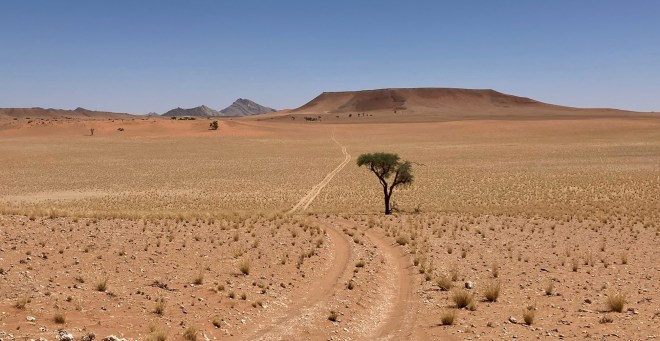
“Hello family!” said the big man with a wide smile, giving us a queen’s wave. I was seated on a deep couch in the comfortable, open-air lobby of a hotel in Victoria Falls, Zimbabwe, with a group of nine strangers. “Family” seemed like a weird word choice at the time, but now three weeks, 5300 kilometers, 60 meals, and countless conversations later, it feels just right.
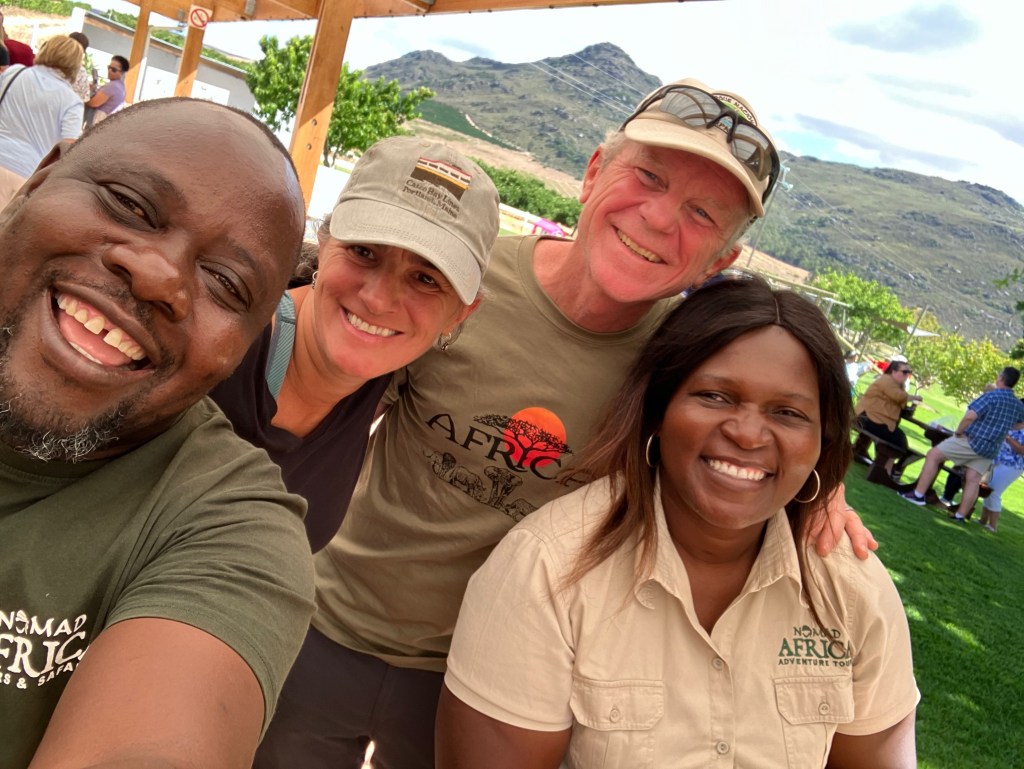
Al and I signed up for what is known as an “overland” trip, in which a group of people travel together in a truck outfitted with bucket seats and storage space, typically in rugged, underdeveloped places. Our starting point was Victoria Falls, our destination Cape Town, South Africa, with our route passing through the national parks, deserts, dunes, coastline, and rivers of Botswana and Namibia. We were shepherded by two talented, capable, knowledgeable people—Para, our driver/heavy lifter/papa, and Tracey, our guide/cook/den mother. The other important member of our crew was Otis the truck.
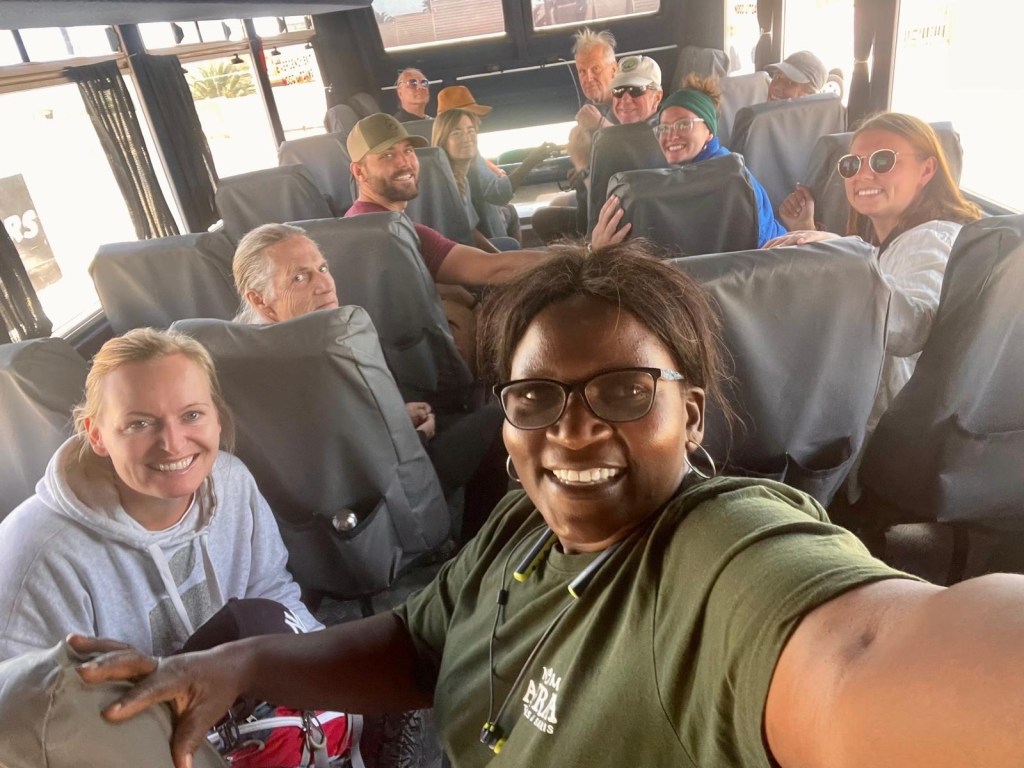
Otis is one of more than 30 trucks in the Nomad Africa company’s fleet of overland vehicles. It has been outfitted with 24 seats that are reasonably well cushioned but don’t recline or have arm rests. At the back of the passenger area, lockers have been installed for stowing personal bags, while the front area has a built-in fridge in the floor so Tracey could stock it with ingredients for meals when we passed through towns with amenities. Passengers shared a cooler, which we tried to always stock with ice to keep our drinks cold. Large windows could be opened down the length of the truck, which was essential for creating breezes as we traveled in the hot, dry desert regions of Southern Africa. Otis also carried our camping and cooking equipment, our drinking water tank, and tables and chairs for dining. But most importantly Otis was built for handling rugged roads through sand, dirt, mud, and gravel. Trust me, we all spent plenty of hours receiving what they call “an African massage”—bouncing up and down on rutted dirt roads like gigantic washboards.

Our group was fortunate to have just nine passengers, so everyone could spread out and have a window seat if they wanted. We started with two Canadians, a German, a Swede, an Austrian, and four from the U.S.; five women and four men. Our ages ranged from 24 to 69 and the lingua franca was (luckily for us) English. The overland model allows for doing sections or the full route, so along the way, the Canadian couple left us and we picked up an Estonian man and another German woman. The mix of ages and nationalities only adds to the richness of the experience, and there’s a common love of adventure travel that connects everyone who chooses an overland trip. We quickly found that we had a compatible group and continued to bond ever more deeply as the shared miles and experiences added up.
There are overland trips that go between Nairobi in the north to Cape Town in the south and take nine weeks. Some companies offer trips in South and Central America, Asia, the Middle East, the U.S. and Canada. You can choose to camp in a tent or stay in modest lodging or even a mix of both. Pretty much every day had a planned activity ranging from safari game drives to hiking among petroglyphs, from boating with hippos and crocodiles to wine-tasting in a vineyard. Some of the activities were true peak experiences—seeing a hungry lioness take down a buffalo, spotting rare African wild dogs in their den and a leopard resting on a tree branch, seeing the sun set over a salt flat and rise over 1,000-foot dunes, screaming down a 300-foot dune head first on a piece of wood paneling, or paddling in canoes past wary-eyed, wallowing hippos. Of course, not everything can be a peak experience—some game drives turned up more dust than animals, some desert days melted the energy out of the best of us, and one campsite happened to be next door to Namibian revelers celebrating the election of their first woman president—who knew? But all of them are part of the package, the set of experiences that bring people together. (Check out our African Overland photo gallery here or under Photos above for more on those experiences.)
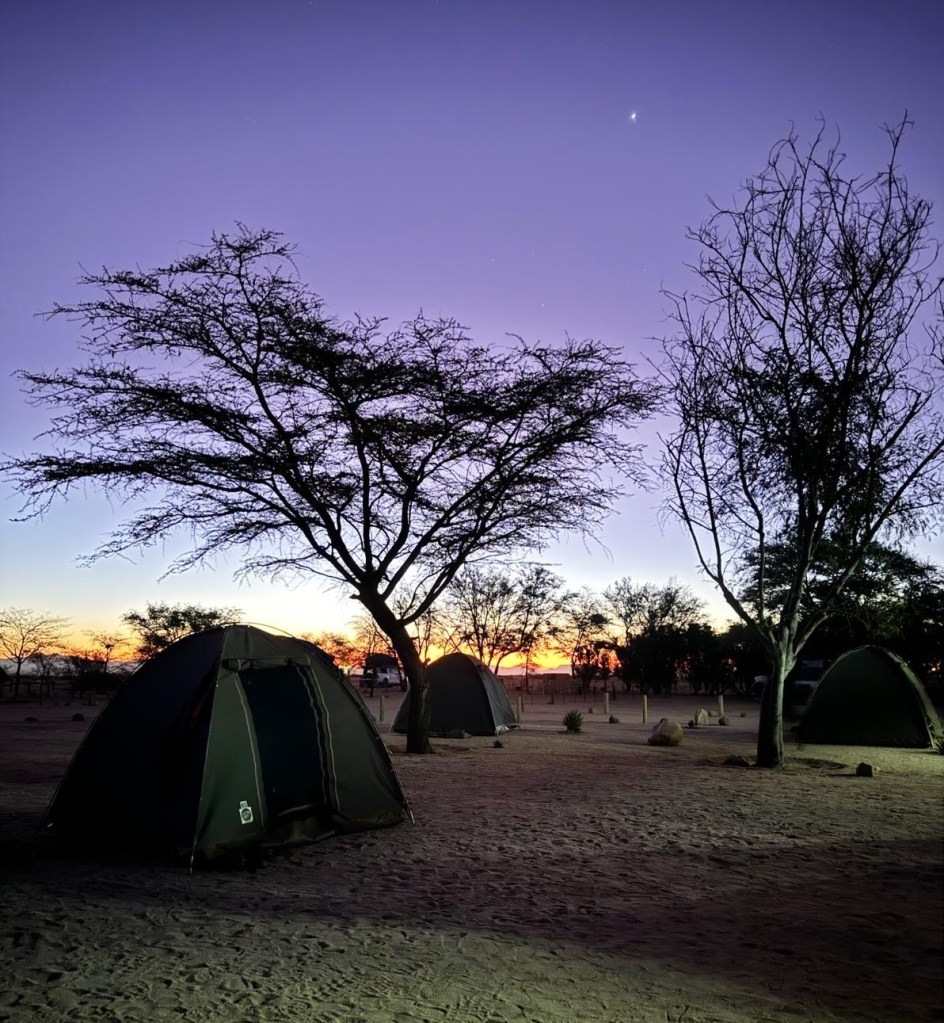
As with all travel it is the creature comforts (or lack thereof) that can make or break the experience. Overlanding is no exception, and the comforts of this mode of travel have come a long way since I last did one in the 1980s! That said, any expectations of luxury should be left behind on an overland trip—most of this trip involved camping (in some cases “glamping”), and everyone pitched in to help with the work. Al and I shared a tent that was plenty large enough for the two of us and our gear. It was easy to set up and take down and Otis carried thick, comfortable sleeping mats for us to use. In fact, since we were just nine on the trip, everyone could have two mats, so it was practically like sleeping on a mattress. We bought sheets and a blanket in Victoria Falls and packed clothes and towels around some “borrowed” airplane pillows to make a nearly proper bed.
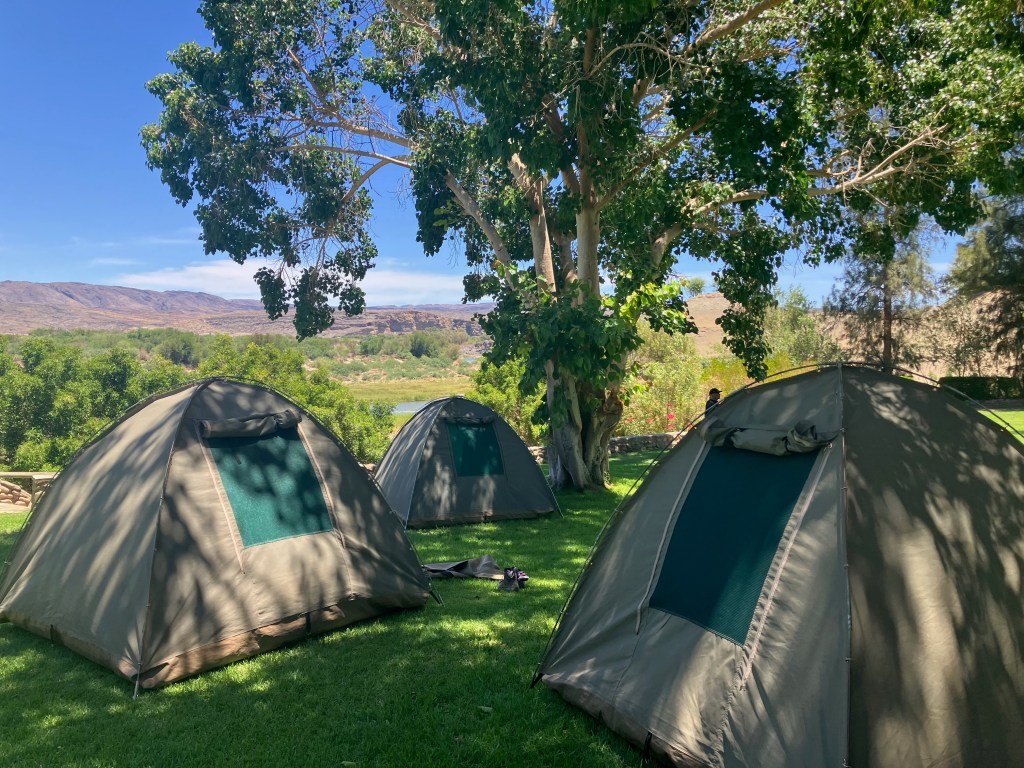
Over the three weeks, there were a few nights when we did not pitch our tent. About halfway through, In the Namibian city of Swakopmund, we stayed in a beautiful, oceanside hotel and ate our meals in restaurants. In Botswana’s Okovongo Delta (a place I highly recommend visiting), we lodged in safari platform tents with full en suite bathrooms. In the Namib-Naukluft desert we chose to upgrade to a room with air conditioning so we could catch a break from the heat. Yes, it was hot for much of the trip—well over 100 degrees on some days. We made sure to set up our tents in the shade whenever possible, and basically didn’t enter them until the evening coolness made them habitable.
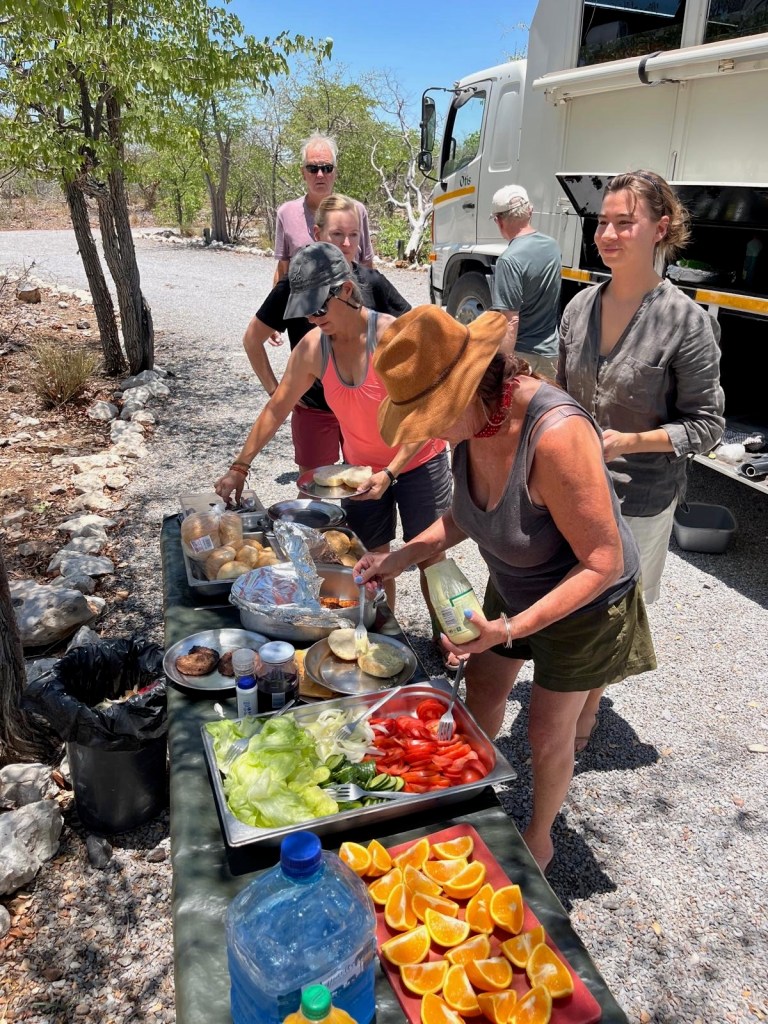
Our meals were hearty, varied, and familiar. For breakfast we typically had yogurt, cereal, eggs, toast, and fruit. Some days Tracey got creative and made us pancakes or French toast. Lunch was often a garden salad, pasta salad, rice salad, or sandwiches. For dinner Tracey filled our bellies with delicious comfort foods, including one night when she surprised us by making a tray of lasagne, baking it under a blanket of hot coals. At one lodge where we set up our tents, Tracey got a break from cooking dinner. There we were treated to two nights at a gourmet buffet that had grilled-to-order wild game meat. I tried kudu, impala, hartebeest, and oryx, which all tasted more or less like venison, and all of which we had seen walking around during our game drives. I admit, I passed on eating zebra.
I bet you are curious about bathrooms. Well, I will say that they varied. At the campgrounds we had “shared ablutions”. They were well-maintained and clean for the most part. They all had showers—some with better water pressure than others—which were welcome after a day of heat, dust, sightseeing, or hiking. Most were open to the outdoors, so we could expect a bug or two, but also a refreshing breeze. On the road, we often pulled over to do what they call “bushy-bushy,” which perhaps is better left to your imagination. Suffice to say there are not always bushes to hide behind, so we all became accustomed to turning our heads both for the privacy of others and to keep an eye out for nearby wild animals. Unexpectedly, all the campgrounds had swimming pools. While most were quite small, one place had an olympic-size pool with lanes and diving platforms. We took full advantage of them (have I mentioned that it was hot?)
Daily life on the road on an overland trip has a unique rhythm. We woke early to break camp and have breakfast. Very quickly the travelers learn what jobs need to be done and everyone shares the load. Once the truck had been packed up, we’d take a seat and enjoy the passing view on the way to our first stop. In transit you might have an interesting conversation, listen to a podcast, read, or get a little more sleep. Usually we’d do some activity before arriving at the lunch spot or next campsite—take in a view, hike in a canyon, see some rock formations or interesting plants, shop at a local craft market. Other days we’d stop for groceries and pick up beverages or even an occasional ice cream treat. Often the heat of the day was spent swimming, and then in the later part of the afternoon we’d have another fun activity planned. Dinner was our time to reflect on the day and hear what we had to look forward to the next day. “Hello family,” Tracey would say in her Zimbabwean accent, “so tomorrow is another day.” Some nights we listened to music—”The Lion Sleeps Tonight” was stuck in most of our heads for days—or waited for the stars to appear to see if we could spot the Southern Cross. Most nights everyone would head off to bed soon after dark, knowing that Tracey would be waking us early to get a jump on a new day.
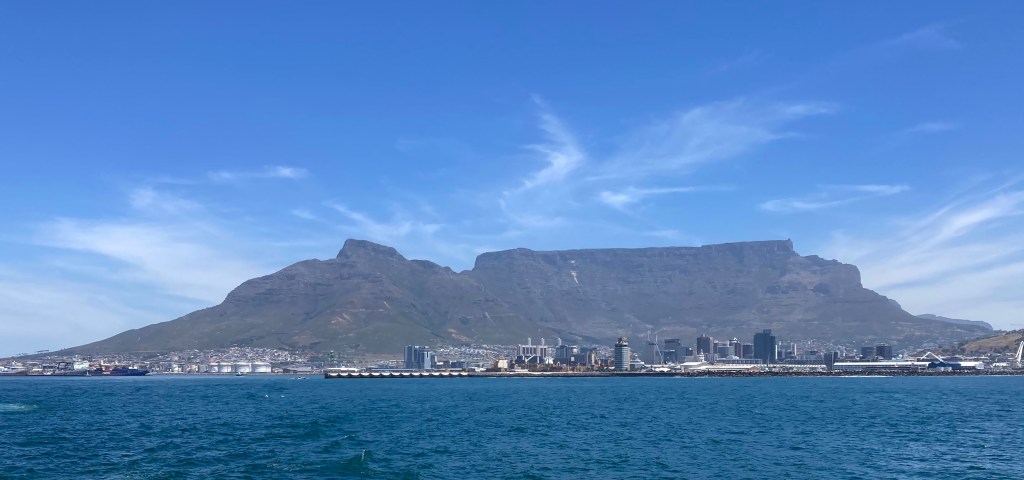
Overlanding is a special kind of travel. Before starting out, the idea of trucking across southern Africa seemed challenging. Along the way we formed new friendships. We found humor, camaraderie, and enthusiasm in our daily routines and new experiences. We set aside our concerns of the world beyond the parameters of Otis, the 11 people in our group, and the sights and sounds in our immediate surroundings. I did not know it at the time, but Para chose exactly the right word when he greeted us with “hello family” three weeks earlier. When we saw Table Mountain looming above Cape Town, signaling the end of our trip, it was saying goodbye that turned out to be the most challenging part of all.
| Be sure to see our African Overland photo gallery for more on the incredible animals, sights, and activities we enjoyed on this trip! |


lucky you. I am so impressed by this life of yours that I wish I could do mine over.
No more words, I’ll just enjoy the mental image.
Dad
LikeLike
All the amazing travel you and mom did inspires me to keep seeing the world. Thank you for setting the tone and teaching me to love exploring.
LikeLiked by 1 person
I loved every single word of this. I am so happy that you are sharing these once-in-a-lifetime experiences. 🥰
LikeLiked by 1 person
Wow! What a great experience. Well done!
LikeLiked by 1 person
Hi, Rachel (and Al)!
Another terrific description of a segment of your African trip – thank you! We have some Dallas friends who have taken quite a few safari trips, but never the overland kind that you both undertook. Can’t wait to hear in what direction your next explore of that continent will take you, but do know how fun it is for me to read your impressions and experiences.
LikeLiked by 1 person
Another amazing adventure! The wildlife photos are outrageous! Thank you for sharing your experiences.
LikeLiked by 1 person
Another amazing episode. What a journey. Savoring every drop of my vicarious experience. Thanks for your marvelous descriptions and sensational photos.
LikeLiked by 1 person
I agree completely with all previous comments. This is a wonderful account of an amazing leg of your amazing journey!
LikeLike
An amazing experience! And they call what we do “overlanding.” It is a tad different, for sure. Both forms have pros and cons, but doing the African overlanding trip is something that my husband and I would enjoy. So nice that everything is organized and taken care of. Maybe one day. When we don’t have a dog anymore and sell our current rig. 🙂
LikeLiked by 1 person
For those who are interested, our tour company was Nomad Africa Tours (https://nomadtours.co.za/this-year/victoria-falls-to-cape-town/) and we learned about them through a fabulous agency that works with all of the major overlanding companies, African Overland Tours (https://www.africanoverlandtours.com/). Some of the people on our tour love Nomad so much that they were repeat clients!
LikeLike