Just shy of the Nairobi airport at 1:30am, our taxi driver pulled up to a toll plaza and told us we had to get out and walk. We were still a good half mile from the actual terminal and all our worldly travel possessions were in the car, so we were justifiably reluctant. But he insisted, pointed to a small office we had to walk into, and promised he would meet us on the other side of the toll booth. Seeing no other option, we left the car and all our valuables and walked into the office, which had a metal detector to scan our bodies, while Francis, our driver, drove away with all of our luggage. One minute later we were back in the car, having a chuckle at the absurdity of the system and saying silent gratitudes that Francis had been good to his word. Next we encountered a long security line for every traveler and their bags hoping to enter the terminal, and still another security check to get to the gates, yet, unlike in the U.S., our full water bottles were no problem at all. Despite the chaos, the whole process took just 30 minutes. Befitting our overall experience in Kenya, a simple thing like getting to the airport was a delirious mix of bewildering chaos and friendly competence.
But I’m getting ahead of myself. Our final hurrah in Kenya consisted of ten days in and around Nairobi, where we relaxed, did some sightseeing and shopping, and washed all of our safari-dirty laundry. Nairobi only exists because a stopover town was needed when the British built a railway from the coast to inland Lake Victoria, and now it is home to over 5 million souls. LIke any big city, it suffers from extreme disparities of poverty and wealth; teeming with people looking for work and people who want The Good Life. Not being especially fond of large cities, my expectations for Nairobi were low. Therefore I was pleasantly surprised to find that, while it is absolutely not a pedestrian-friendly city, with broken sidewalks that crumble into muddy paths, if they exist at all, at least the neighborhoods we explored were otherwise friendly, colorful, and interesting.
We stayed in a comfortable, clean, and centrally located apartment in a modern high-rise building with a roof-top swimming pool and a gym with a commanding view of the city. We found a well-stocked supermarket just a few blocks away and, yes, fellow ice cream fans, a passable scoop shop just outside. Venturing farther afield, we found the Central Business District (known simply as the CBD), where business people in Italian suits share the uneven sidewalk with ragged vendors of every kind. We found the “Maasai Market,” which pops up in a different neighborhood every day and features row upon row of vendors sitting on the ground, each imploring every passerby to stop and take a look at their elephant figurines, colorful kanga cloths, and souvenir t-shirts.
The CBD is also where the central post office is located—if you can find it. Stepping inside the building brought to mind the satirical movie Brazil, with its dozens of booths behind bulletproof glass and scores of citizens waiting in plastic chairs for who-knows-what and who-knows-how-long, praying that the enigmatic bureaucracy will eventually reach some kind of resolution. It took us about 10 minutes of going from desk to desk asking uniformed people to figure out that stamps are the one thing you can’t get there—you have to go around the corner to a different government building.
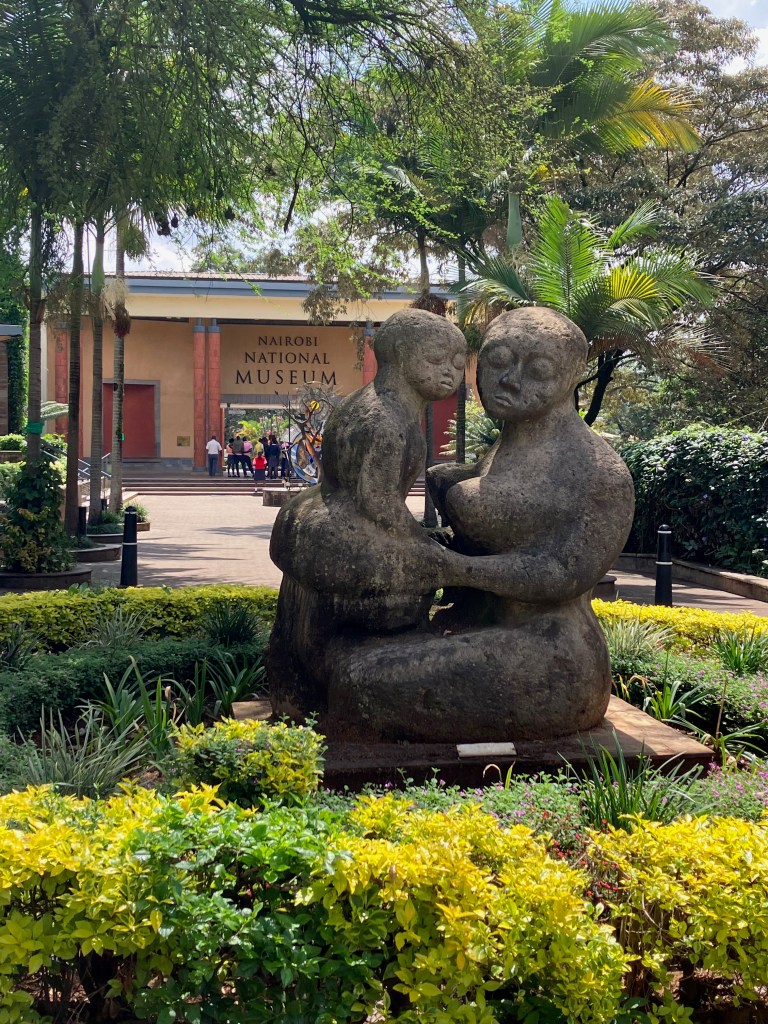
A short distance down the street from our apartment building—but a 15-minute walk on account of it not being a pedestrian-friendly place—was the National History Museum and Botanical Gardens. Our first day we decided to visit the gardens and walked through the imposing gates at the entrance to the complex with a wave to the guards. A couple days later, wanting to walk through the park again, we went to the gate and were told we could not access the botanical gardens that way. Go figure. Third time, guess what? We said we wanted to go to the museum (true) and were allowed to pass. The museum has a collection of bones and tools from proto-humans, cases and cases of stuffed birds from East Africa, huge, taxidermied wild mammals you might encounter alive on safari, and a history of post-Colonial Kenya (which by the way, hasn’t a single kind word to say about the British so you can rightly assume the museum was not created by the country’s former colonizers). As Al says, “It is not exactly a destination museum,” but we enjoyed a few hours there and learned a thing or two.
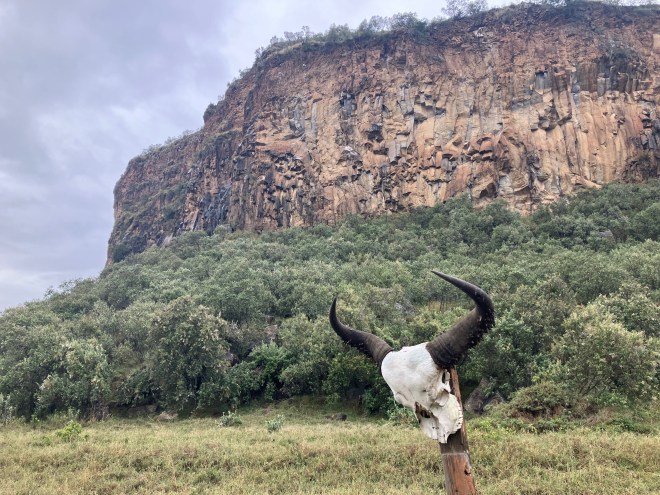
Perhaps my favorite day during our time in Nairobi wasn’t in the city at all. We joined our amazing guide from the northern safari trip, Fidel Ndegwa Lutta, for an outing to the Rift Valley. Starting early in the morning, we drove over the hills northwest of the city and down into the vast valley created millions of years ago when three tectonic plates collided. Kenya’s Great Rift Valley stretches from Lake Turkana on Kenya’s northern border all the way to Tanzania in the south and is bounded on the west and east by walls of escarpments and volcanoes.
We started at the entrance to Hell’s Gate National Park, named for red rock towers flanked by geothermal steam gushing out of cracks in the ground (tagline: Welcome to Hell). There we rented mountain bikes and spent a couple hours in near-solitude, pedaling through the starkly beautiful park. Because there are no top predators in the park, the herbivores who populate it have virtually no fear of humans. We were able to get up close to giraffes, zebras, buffaloes, eagles, and other amazing, docile animals. The park is also home to the first geothermal energy system in Africa, a startling, smelly eyesore in such a beautiful park that ostensibly generates clean electricity for the region as well as Nairobi. Kenyan contradictions strike again.
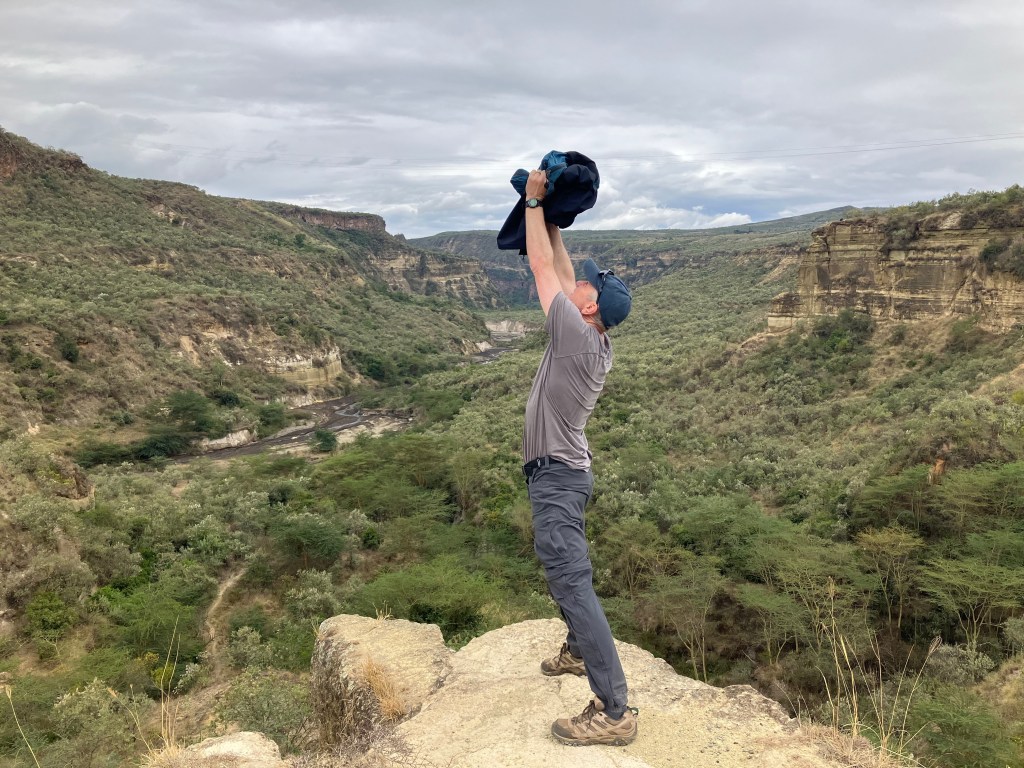
While in the park, we set our bikes aside for an hour or so to take a hike into and above a deep gorge with a local Maasai guide. We could see the boiling water flowing and steaming from the rock walls and meeting up with cold river water at the bottom of the gorge. We hiked up to an overlook, which supposedly was the inspiration for the iconic “Circle of Life” and “Pride Rock” scenes in The Lion King. Of course, Al had to act out the scene celebrating Simba’s birth by hoisting his backpack in lieu of the lion cub, future king of the jungle. And amid all of this beauty, we learned that deadly flash floods occasionally rip through the canyon, imperiling anyone who’s in there without a guide. Beauty and danger go hand-in-hand in this complicated country.
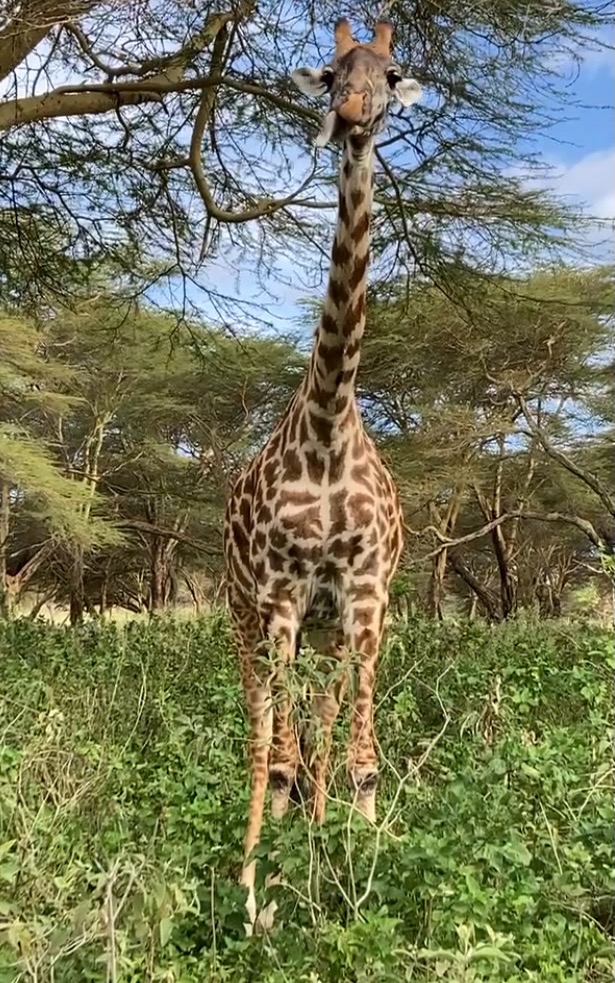
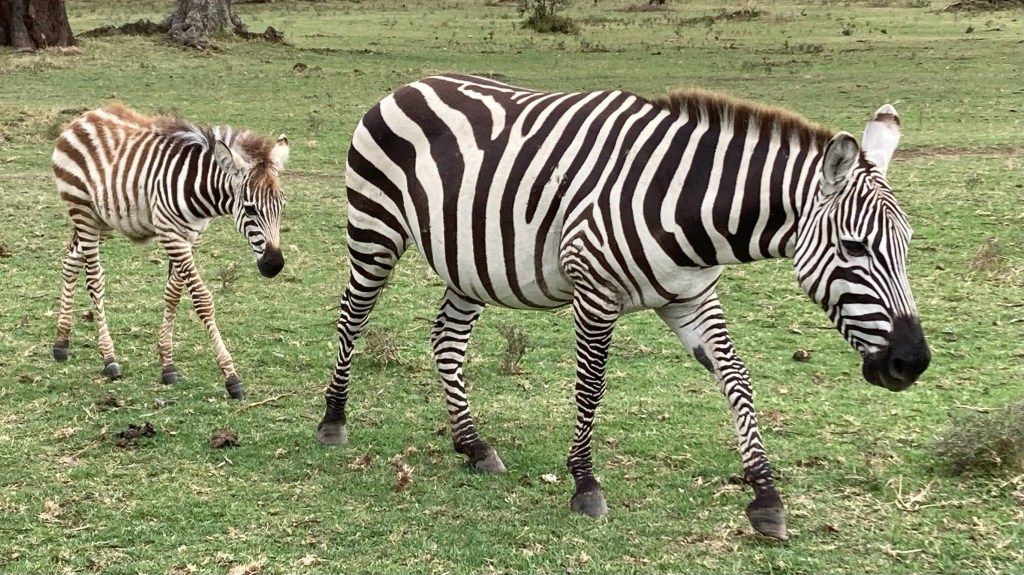
In the afternoon we visited Lake Naivasha, home to over 3000 hippos and more than 450 varieties of birds. Speaking of beautiful and dangerous, you might already know that hippos cause more deaths per year than any other wild mammal in Africa, but did you know that even lions don’t dare attack them? And they are plant eaters that can’t swim, can’t climb, and waddle on short legs! While on the lake, we stopped at Crescent Island, which was used for filming parts of Out of Africa. Apparently the movie producers couldn’t work with the scenery elsewhere, so they shipped giraffes, zebras, and wildebeest to the island to populate it for “authenticity.” These imported animals’ descendants are still living on the island but have no predators, so, like the Hell’s Gate animals, they fear no humans. We wandered freely with a guide (who, as a child had played a small role in Born Free, another locally filmed movie) and communed with wildebeest and antelopes, and then had a startlingly close encounter with an adolescent giraffe and cooed over a seven-day-old zebra with his mom. On the drive back to Nairobi, darting in and out of Kenya’s ever-present truck traffic, we stopped at the top of the pass and watched the sun set over the far hills west of the Rift Valley.
Nairobi holds the distinction for having the most shopping malls of any African city outside of South Africa. We needed to buy a quick-dry towel for our upcoming camping trip, so we headed to the infamous Westgate mall (site of a mass shooting by Somali guerillas in 2013). No signs of that tragedy still exist, and honestly, we could have been just about anywhere in the developed world. Malls are malls, with their piped-in muzak, food court, fluorescent lighting, and clean shops. The one difference I noticed at this one was the men’s clothing stores and the women’s were segregated on opposite sides of the building. I admit that shopping in a sterile environment where items had price tags and I didn’t have to run the gauntlet of people on the streets desperately bargaining for a sale was a relief. We found a towel and, heeding the warnings of our camping trip organizer, bought a couple of shirts in colors that do not attract tse-tses (flies known to carry the dreaded Sleeping Sickness), unlike basically all of the shirts we had brought with us. We wove our way on foot back through gritty, dangerous traffic to the peace and quiet of our modern apartment.
Nairobi found us at a crossroads of our own—headed out of Kenya. Clean, rested, repacked, and satisfied with our time here, we made our 4:00 am flight to Ethiopia— incongruously to the north en route to Victoria Falls in the south. There we and hundreds of other travelers pressed like cattle with roller bags, backpacks, and overstuffed duffles through a narrow opening in a gate to board a bus that would take us on a runway-level tour of the airport to finally reach our plane to Zimbabwe. After all of that mayhem, we had a comfortable, five-hour Dreamliner flight and then landed in the 95-degree wet heat of Victoria Falls. Proving that contradictions are not unique to Kenya, we were met at the airport by a man holding a sign with our names, who we assumed was the driver we had prearranged with our hotel. He turned out not to be our driver, but instead escorted us outside and then disappeared.
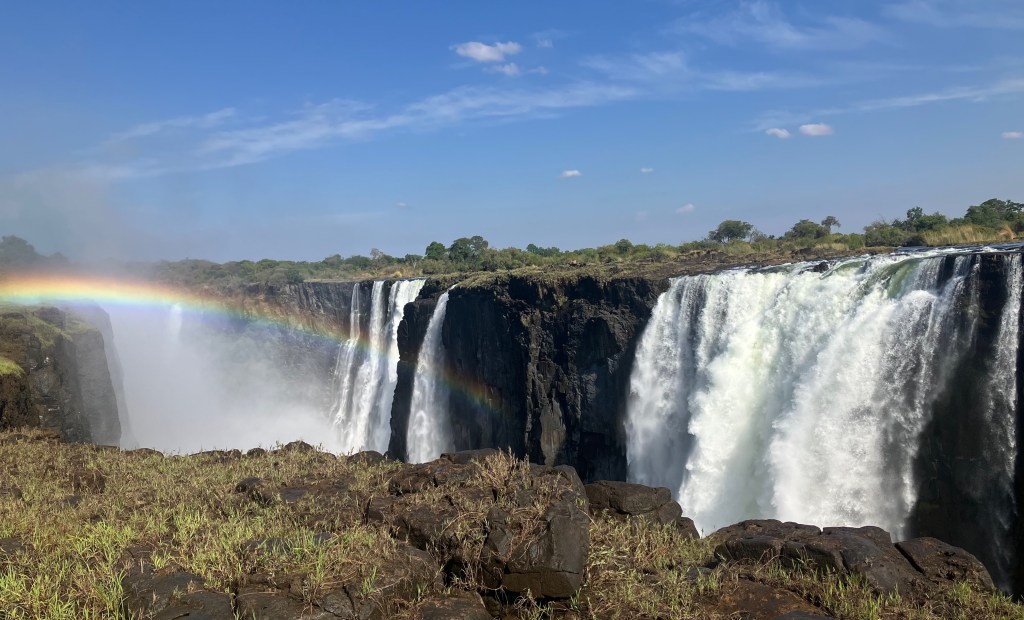
Eventually our driver found us and we made it to Mosi-Oa-Tunya, also known as The Smoke that Thunders or Victoria Falls, after 12 hours of travel. There we found that the dry season has extended into a drought, so the mile-long wall of water that forms the largest waterfall in the world during the rainy season had dwindled to a relative trickle. At least the benefit of the dry season is that we could see to the bottom of the massive canyon and there were enough cascades to give us a proper taste. So after our quick visit, we prepared to set off on our next adventure: an overland camping trip from Zimbabwe through Botswana, Namibia, and South Africa, terminating with three weeks in Cape Town. We can’t wait to see what surprises the rest of Africa has in store.
Update: After writing this post, but before putting it online, we found wifi (and spare time) hard to come by during our first week on the road in Botswana. We now have a free afternoon at a wifi-equipped lodge in the fast-growing town of Maun, near the Okavango Delta. We promise more updates about this trip soon. Curious? You can learn more about our route and mode of transportation here or take a look at our route below.

 Seeing the World, One Year at a Time
Fascinating — what a great trip. Don’t forget to go sandboarding while in Namibia (https://en.wikipedia.org/wiki/Sandboarding).
LikeLike
Rachel,
Just enjoyed your description of your travels in Nairobi and getting to Victoria Falls! So glad I seem to be getting your blogs again. Looking forward to the next one. Your trip down to South Africa sounds wonderful. Hope it is as good as it looks.
Lucy
LikeLike
Elegantly written. Reading this piece, one hears the sounds and smells the aromas of the streets of Nairobi. When we were in Kenya, we too encountered the friendly inefficiency of the system . At least five pages of our passport were stamped or pasted with stamps before we were allowed into the country from the airport. That was then, now is now and things seem to have changed little.
LikeLike
luckily you got to go to the Masai Mara. The entrance fee for the park is now $200/day and it takes at least 2 days to get any time for game drives.
LikeLike
What a mind bending experience!
LikeLiked by 1 person
I’m so sorry about the “trickle” of Victoria Falls. I read something online about the drought causing the water to diminish so much. The photo still looks impressive! So, what are the colors that tse tse flies don’t like?
LikeLike
supposedly they are most attracted to black and blue (which is basically all we wear when we travel) but some sources say they are attracted to pretty much all colors so perhaps it’s better to just avoid getting bitten.
LikeLiked by 1 person
This was the best yet! I have read it twice and will again. I
LikeLiked by 1 person
What a wonderful and beautifully written account of an amazing segment of your exploration. It’s impossible to get the full flavor of it through pictures and writing but you’ve done a fabulous job of making it as real as possible. I can’t wait to sit down with you and go back through all of the sights and experiences you two have had here in Africa so far… and then help you create yet another new experience of Africa, West Africa is obviously so different from what you’ve experienced so far. I am so excited to share it with you!
LikeLike
Thanks Russ. We are really looking forward to being with you and exploring west Africa.
LikeLike
So grateful to be along on this journey with you. Enriched by every paragraph. Just say no to tsetse’s. Bunches of love, Shirley
LikeLike