“Yeehaw” flooded my ears in tandem with a full body dousing of cold water. I had two breaths in which to reorient myself before our raft, filled with flailing arms and legs, paddles, screeches and smiles, collided with the next wave of the rapid. Our co-paddlers pulled as a team through the wave and into the placid pool beyond. We had just met, coming together for a multi-day adventure to navigate a series of rivers from the Chilean Andes to the Pacific Ocean. In a country as narrow as Chile, boating from a river’s source in the mountains to its terminus in the salt water of the Pacific in just a few days is a real and exciting opportunity.
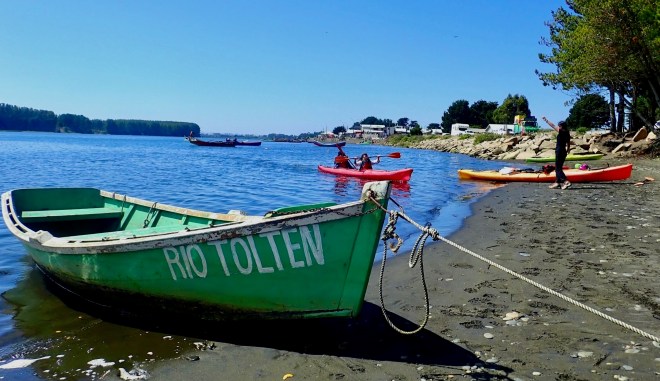
Our journey on the Río Toltén started on the calm waters of Lago Villarrica, the lake at the base of the volcano Villarrica and on whose shores lies Pucón, the town we’ve been calling home most recently. The group consisted of a young Dutch couple caravanning through South America for ten months, a Chilean woman accompanied by her two children (ages 4 and 11), her partner, and her best friend, plus the two of us. Besides the paying guests, we had five crew. The coordinator and capitan Rodolfo, co-captain and head chef Nico, yoga instructor Luciana, and support crew Magdalena and Michaela for a total of 14.
I have to admit that I had my reservations when I saw the kids. I wanted to have an open mind but I couldn’t help but think that they would be in the way or slow us down. Then a funny thing happened that first day. As we settled into the tightly shared space, we started to get to know one another and we worked together to propel the raft safely around obstacles. The English speakers called up their Spanish and the Spanish speakers found their English and together we began to learn about one another. I found myself feeling a growing connection to the members of our group. Maite, the 11 year-old girl, shyly sidled up to me and tried out her school English. In keeping with my innate impulse to teach, I struck up a conversation with her. It turned out that she spoke English enthusiastically and gained confidence as I encouraged her with questions.
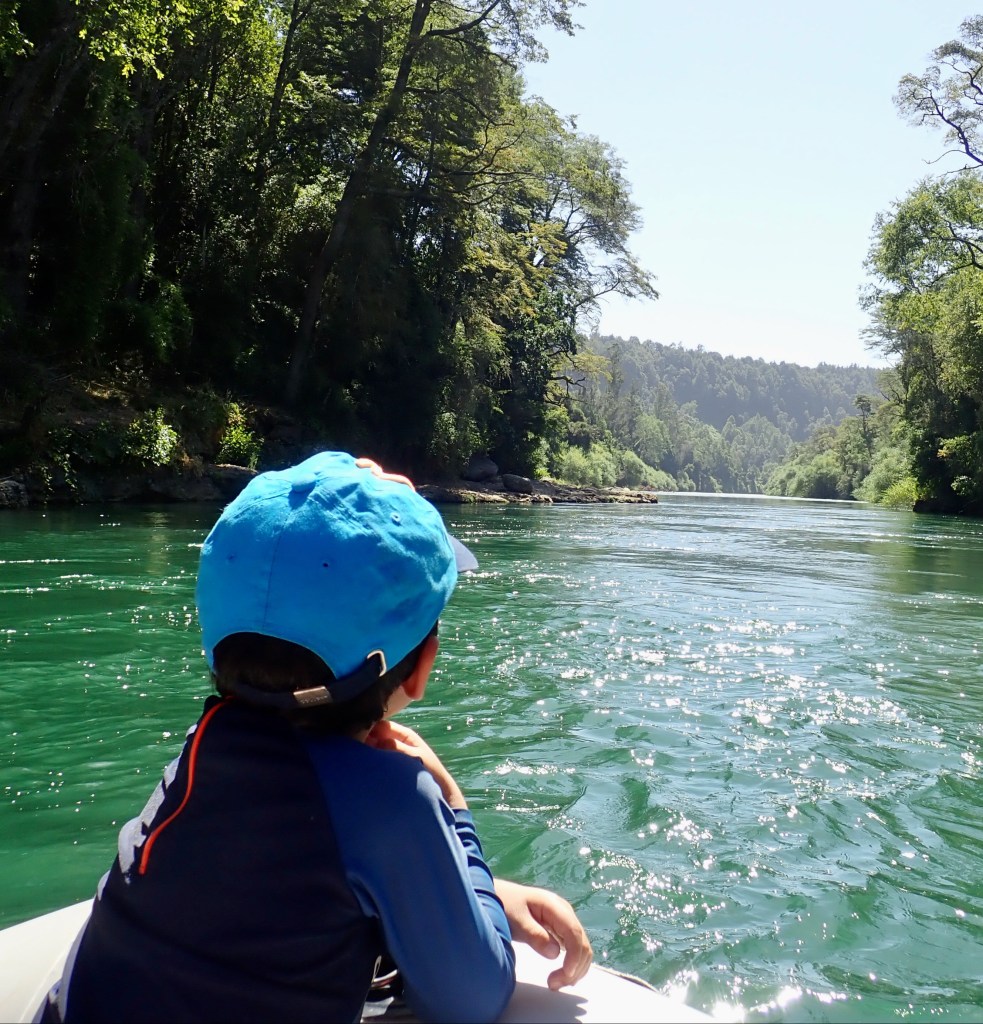
The exuberance of our youngest member, four-year-old Adolfo, was infectious. He quickly got his sea legs and clambered about the raft, frequently exclaiming loudly, “¡Qué fantástico! ¡Mira! (Look!) ¡Qué lindo! (How beautiful!)” By the time we hit our third set of rapids, which shoved our craft into a tangle of low hanging branches and threatened to sweep little Adolfo into the water, everyone reached to protect him, comically neglecting our job of paddling the raft out of harm’s way.
At day’s end we disembarked at our first campsite, a tranquil, riverside spot where we were met by our wonderful support people and a delicious spread of fresh, nutritious snacks and cold beers, followed by a filling dinner. I fell asleep to the river’s lullaby singing in harmony with the birds.
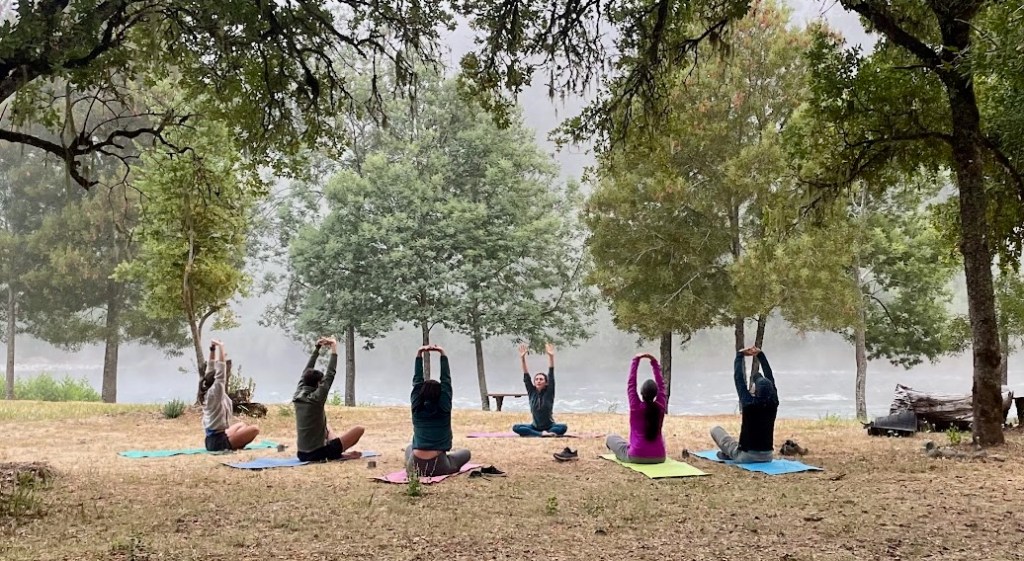
Group camping has a funny way of quickly breaking down barriers. We had known one another for less than 24 hours, yet here we were sleeping (and in some cases snoring) in close proximity, padding around tousle-haired and sleepy-faced in our pajamas, and sharing a communal bathroom. Together we greeted the morning with yoga and stretching before fortifying ourselves with a hot breakfast. Why does food always seem to taste better when it is prepared and eaten outdoors in nature?
For our second day, those who chose to could abandon their seat in the raft and wiggle into a sea kayak. Maite, with our encouragement, decided to try kayaking for the first time. The plan for the day was to cover nearly a marathon distance of 35 km. Fortunately, we had an assist from the river’s current. Unfortunately, we also had a serious headwind for most of the day. Sadly, Maite had to return to the raft since she was too light to make progress against the force of the wind. But I felt as proud of her for giving it a try as if she were one of my own children. As the miles stretched out behind us the landscape began to change. No longer was the seemingly ever-present volcano looming over our shoulders. We traded pine-covered hillsides for fertile fields, hawks for ducks, steep river banks for rocky beaches, and burbling water for intermittent sounds of humans at work beyond the shoreline.
Rodolfo, in his own kayak, joined the six kayakers in three tandem boats and left the raft group in Nico’s capable hands. Throughout the long day he gave each of us ample opportunity to lead the way. I felt his trust in us to choose good paths in the water, taking advantage of the currents, avoiding whirlpools and strong eddies, and negotiating the rocks and shallows. Occasionally when the river forked we would regroup and consider our options. We trusted Rodolfo’s knowledge of the river but also came to trust one another as we learned to “read” the river. When one of the boats tipped and spilled its paddlers into the cold river, Rodolfo quickly pulled them to shore and we and the other dry paddlers rustled up dry clothes to lend them. Our faith in each other strengthened our connections. Once again, I went to bed, exhausted but elated from the day.
We broke camp the next morning, anticipating the final stretch of river before encountering the ocean. Nico, Micaela, the two kids, and their mom chose to travel the last section by road. Those of us in kayaks set off in the cool morning mist, enjoying the quiet of the river. After a time we started to notice new changes. At first I caught a faint whiff of salt in the air. The river widened into a delta. A few seabirds began to show up and the current we had grown accustomed to was confronted by the push of the incoming tide. Soon we could hear waves in the distance and at last we rounded one final river bend and saw our destination—the small fishing village of La Barra at the confluence of the Toltén River and the Pacific Ocean. The members of our group who went by truck to the beach landing greeted us as if we had been voyaging uncharted waters and unknown lands for months. Our reunion was joyous, sincere, and celebratory. We hugged and high-fived. It was hard to imagine that just a couple days prior we had been a group of strangers.
To our surprise and great good fortune, co-captain Nico arranged for us to have our final camp on the property of Joel, a member of the indigenous Mapuche community from the Lago Budi area. Nico was befriended by Joel at a transitional moment in his life and looks up to him as a tutor, mentor, and source of wisdom and inspiration. When we arrived at Joel’s home, we were met by a small herd of cows milling around on the patch of grass we were going to use for our tents—needless to say, we inspected the grass carefully after shooing the cows away and before pitching our tents.
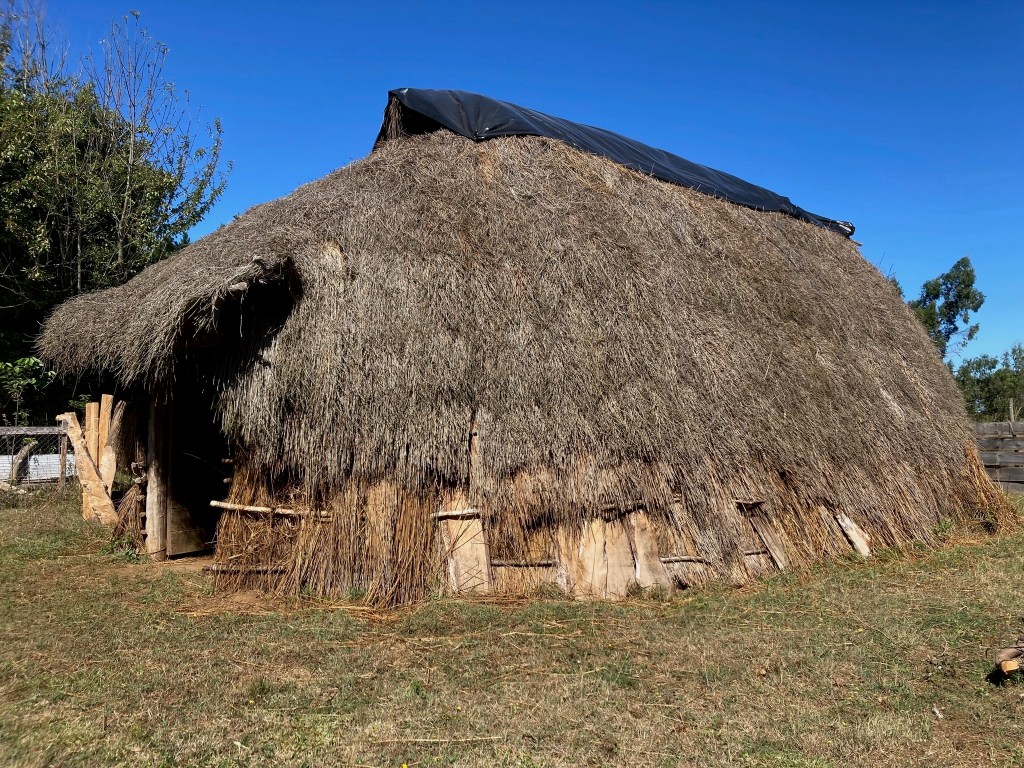
Though the Mapuche people live with their feet firmly planted in the 21st century, many continue their traditional way of life. They have a deep respect for Earth and all its plants, animals, resources, and beauty. They live simply and cooperatively, connected to their history, to the land and water, relying on the abundance of their environment and in harmony with the natural world. On his land Joel has a ruka, a traditional wooden structure with a thatched roof and dirt floor, which is used as a place to gather, cook, perhaps sleep, and tell stories. He invited us to use it to warm ourselves and cook dinner over the wood fire. Joel joined us and told us that he is his community’s keeper of traditional songs in Mapudungun—the language of the Mapuche. We fell silent as he graced us with three gentle, soothing songs. He then asked us to introduce ourselves. In the gloaming, we spoke in turn, with the light of the fire illuminating our faces. We spoke our names and then in the warm, womb-safe space of the ruka, among new friends, we shared our hearts, our hopes and dreams, and in some cases even our tears.
Sometimes when a group of strangers join an organized excursion they become acquaintances and fellow travelers, but nothing more. Sometimes it is even annoying to be with other people—they may go more slowly than we’d like, they may complain or be needy. Once in a great while, if you are lucky, you get a group that just clicks and you come away with new friends and an emotional bond. Differences in language, age, culture, and background don’t cease to exist but they do become irrelevant when we focus instead on empathy, love, and caring for one another.
Perhaps it was the ruka, a place whose door faces east in order to capture the positive energy of the sun each morning, whose very design is based on the flow of the air and the connection to the land. Perhaps it was the team-building effects of paddling, camping, and sharing meals together. Perhaps it was the model set for us by the harmony, trust, and kindness of the crew, who also became our friends in a short time. Perhaps it just was the nature of the personalities that happened to be in this place at this time. Or perhaps it was all of these things. Whatever the source of this feeling of togetherness, for us, the trip transported us far beyond “from the Andes to the sea.”
Note: If you’d like to see one of Joel’s public performances (he has done many around the world), check out this YouTube video. To see one of the songs he sang for us, click here. We give Joel heartfelt thanks for sharing his home, his ruka, his wisdom, and his songs with us.
 Seeing the World, One Year at a Time
Wow, sounds wonderful. You were lucky! I’m jealous.
LikeLike
I wish you had been able to join us. It was a great time. We are talking about going rafting with Rodolfo in Zambia. I’ll keep you posted…
LikeLike
So grateful to be taken along on this magical journey. Love learning that YOGA was included. Can’t wait to hear what’s next.
LikeLiked by 1 person
We are off to Patagonia in a couple weeks, and then more and more exploring in this amazing part of the world. We don’t take a moment of it for granted.
LikeLike
Your wonderful, descriptive essay brought back memories of the Colorado River trip we took years ago with our kids (9 and 12?), full of gorgeous adventures and some frightening moments, too, when our kids fell into the swirling, dangerous rapids. It also brought back the exhilaration and peacefulness as we gazed hour after hour at the timeless cliffs surrounding us. Thank you for sharing your exceptional river trip.
ELEANOR JAFFE
LikeLike
My family also rafted the Colorado years ago. It is a magical place and puts one in touch with the splendor of our natural world in a profound way.
LikeLike
What an amazing and unique experience! I immediately wanted to look into this multiple-day rafting trip when I started reading your post. But then I remembered we have a dog with us…
We finally made it to northern Chile in our camper – after taking 15 months to get here from Colombia (yes, we are very slow travelers) – but it will still take a while to get to your current area. Probably next summer. 🙂
LikeLike
What a luxury to take your time. We will be heading to northern Chile in a couple months. Chasing the warmth and sunshine. I am happy to put you in touch with Rodolfo. He is amazing. If we could do it with a 4 year-old, I bet you could do it with a dog 🙂
LikeLiked by 1 person
Haha. Good point. Yes, the temperature is great here at the moment. By the way our “luxury” is our lifestyle. We’ve been nomads for twenty years already, working from the road – or the water, preciously. 🙂
By the way, I got your blog info from a communal friend. Was it Patti from Bend!
LikeLike
Yes. I did not realize we have Patti in common. She is also living the nomad life these days. Too bad we are not going to cross paths in the Lakes District. I’d love to meet you in person.
LikeLiked by 1 person
Meeting you both in person would be cool. It might still happen somewhere, some time! I’ll keep an eye on your locations and wanderings. 🙂
Yeah, Patti is in Europe now. If I end up visiting my family in Belgium this summer, it would be cool to meet up again. We’ve been good friends for a long time – since our sailing days.
LikeLike
Magical! I was especially touched by your honest account of your feelings about having the children along. Yet, their presence contributed to your delight in the adventure. A good example of the benefits of intergenerational activities!
LikeLike
Yes! It was good for me to confront my assumptions and then to have such a wonderful time with the kids. Thanks for the comment.
LikeLike
Wow! That was a transformative, memorable journey for the young and not-so-young. Thanks for sharing it with us and topping it off with lovely photos. Love from Maria Elena (Lane)
LikeLike
Thanks for your comment. It truly was a transformative experience that will stay with me.
LikeLike
Clearly, this piece was written from the heart. I am proud that you allow yourself to be vulnerable. You shall have to be renamed the “Ambassador from Love.”
Dad
LikeLiked by 1 person
So happy for you both. What a great experience. I love small group tours, they’re always interesting..
LikeLike