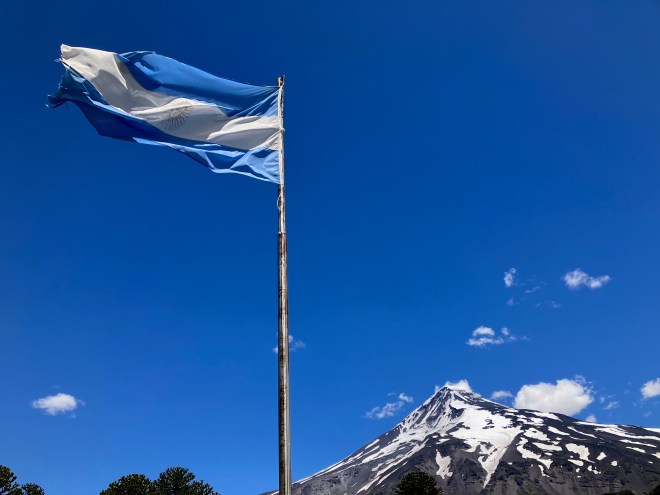
I know it sounds a bit absurd, but we decided to take a vacation last week. It must seem like we’re on a permanent vacation, but actually once we land in a place, most of our time is spent on everyday living, not being tourists. We are living in Pucón, for about four months out of the eight or nine we will be in Chile—November to March—and it’s just a short drive from the border of Argentina (what part of long, skinny, mainland Chile isn’t close to a bordering country?!). We had heard that the Seven Lakes region of Argentina, just across the mountains from here, is particularly beautiful, has loads of great outdoor activities, and is famous for its chocolate (Seven Lakes: you had me at chocolate). Plus, with the new regime devaluing the peso, it is very affordable for foreign tourists. Besides all those compelling reasons to go, we needed to “make a run for the border” to renew our Chilean tourist visas, which expire every 90 days and can be renewed simply by leaving the country and returning. So, we booked a rental car and some Airbnbs and mapped out our road trip.
You know the old saying: Man plans, God laughs? God was surely laughing at us when we went to the car rental agency a couple of days prior to our trip just to confirm that we were good to go only to discover that they had never processed our paperwork to take the car across the border. So much for hitting the open road with our own wheels. Time for a quick pivot to plan B. We spent a hectic 48 hours trying to figure out the bus system. Could we get from points A to B to C and back again by bus? Turns out we could; it was just going to take a bit longer and we would not have the freedom to stop and take photos at every scenic overlook. On the upside, we could just relax and enjoy the views.
Despite sharing the third longest border in the world, at least one volcano at the border, the Spanish language, their liberator from Spanish rule (José Francisco de San Martin), and the whole region of Patagonia, we could tell right away that Argentina was a different animal from Chile.
Take the border crossing as an example. We crossed at Mamuil Malal, about one hour from Pucón in Chile and two hours from San Martin de los Andes in Argentina. On the Chile side the approach is on a well-maintained, asphalt road. The immigration offices are in a modern building with bathrooms, seating, and a luggage scanner much like what you would find in an airport. You are prohibited from taking pretty much any and all plants, animals, foods, and things from nature into Chile. They seem to take it pretty seriously. (On our return to Chile, one fellow passenger had stowed his kayak in the bus’ luggage hold and the agents even x-rayed the boat.) Once through the Chilean side, you cross no-man’s-land, all of about 100 meters, and present your passport to an Argentine agent sitting inside a metal trailer on a large patch of dirt, where they admit you without even stamping your passport. You get back in your vehicle and drive about 20 km on a rough, dusty gravel road as you head deeper into Argentina. This is not to say that Argentina is behind the times or less developed nor did it seem to be the result of recent “austerity” budget cuts. They just seem to have a different attitude: Rules? Pshaw.
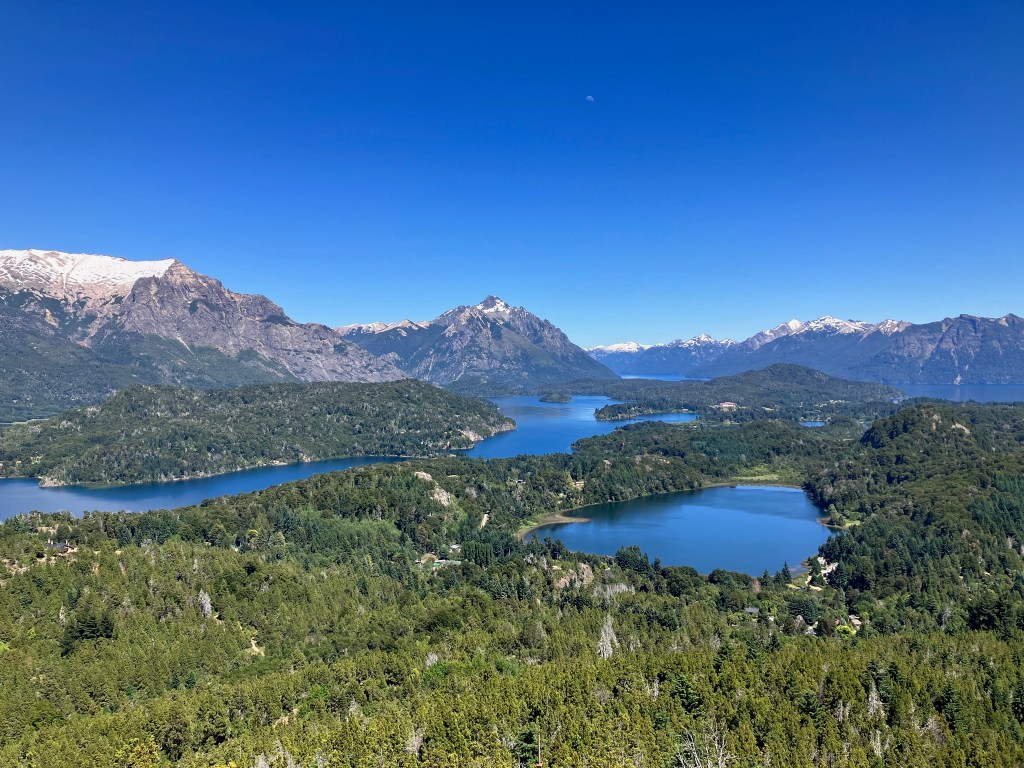
Day 1 involved two car transfers, three bus rides, four passport checks (two each), and 12 hours of travel until we reached our destination in the lovely alpinesque town of San Carlos de Bariloche. The buses were plush and we were treated to spectacular views along the route. Clearly this is why so many people take the drive alongside these lakes. With the sunset at nearly 10 p.m., the mountains were aglow as we pulled into town. It turns out Argentina gives Spain a run for its money in the dining late category. Restaurants typically don’t open before 8:30 p.m. and tables start to fill up closer to 10:30, so we would have had no issue finding a meal after getting to our Airbnb if we hadn’t filled up on snacks along the way. Bariloche hugs the shoreline of Nahuel Huapi, the largest lake in the region, fourth largest in the country, though strangely not officially one of the seven lakes. The homes and other buildings climb up the hillsides, and the snow-capped Andes rise up in the distance. It has the architecture of a village in the Alps and heavy Swiss and German influences in the street names, blonde, blue-eyed physiognomy of the residents, and gastronomy (did I mention the chocolate?).
Because the new president is dismantling the financial structures and institutions in Argentina as I write this, figuring out money in Argentina is a bit of a challenge. We were told that there are essentially no functioning ATMs, banks are not reliable for exchanging money, and the exchange rate changes hourly. In fact, people clamber for the almighty U.S. dollar because it’s more stable. If you want Argentine pesos, you find a guy on the street selling something, for example socks, and he will offer you pesos for dollars. The street rate is much better than the official “bank rate” but sadly we did not have U.S. currency with us, given that we were arriving from Chile, so we mostly relied on our credit cards when we could and Chilean pesos otherwise.
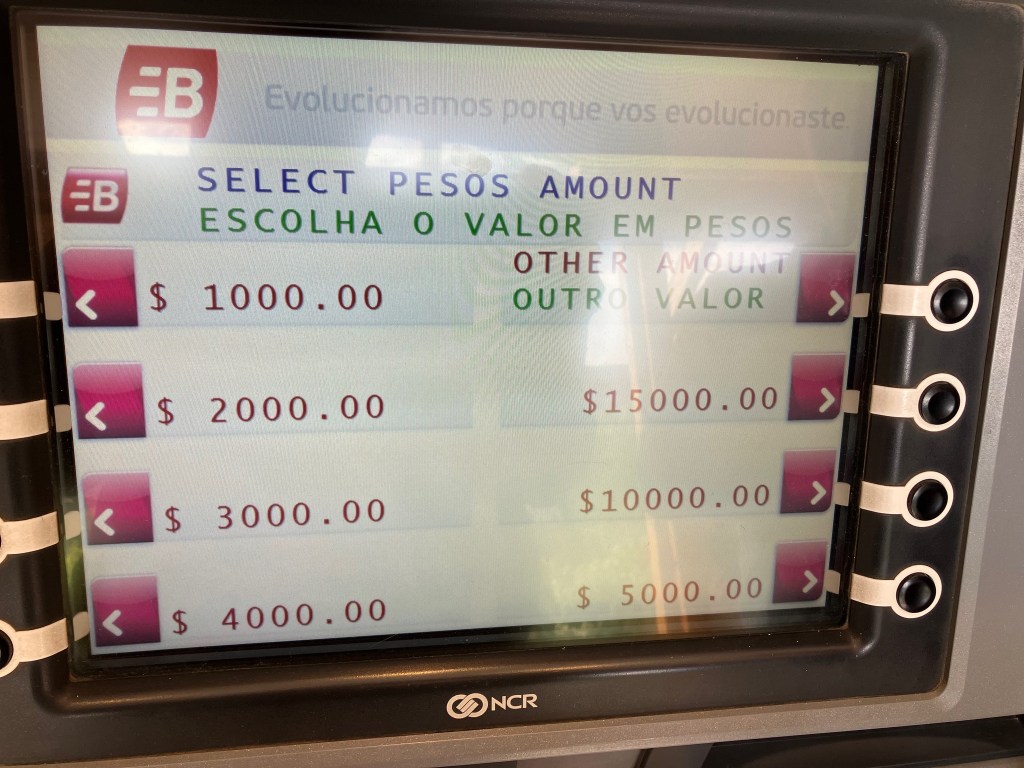
We did eventually find a working ATM in Villa La Angostura, the second town we visited. They even had a mobile ATM in a van parked on a busy street. Stunningly, there appear to be no bills in circulation larger than the 1,000 peso note, which is currently equivalent to about $1.20 U.S. When we went to the ATM we were given seven withdrawal amount options starting at 1,000 and going to 15,000 pesos ($18). One day we arranged to go kayaking and had to pay 100,000 pesos (about $120) in cash. So we hit the ATM and after numerous withdrawals walked away with an unwieldy wad of 120 bills.
A few other notable differences became quickly apparent on the Argentina side of the border. First, everyone over about 12 years-old carries a thermos, a bag of mate leaves, and a mate cup and straw. Mate (mah-tay) is a hot beverage similar to loose tea that is sipped basically non-stop throughout the day. But more than a beverage, it is a ritual of community, family, and friendship. There is even a verb in Argentinian Spanish, matear, which means to engage in the ritual sharing of mate. If you are partaking of the mate, it doesn’t matter the size of the group you are in, everyone drinks through the same straw from the same mate cup. You can imagine that Covid caused a national crisis, more for its impact on the mate ritual than for the illnesses that resulted.
Second, despite its proximity to other Spanish-speaking countries, the accent of Argentina is distinctly different. The best comparison I have is the way Jamaican/Caribbean English sounds different from stateside English. Argentinian Spanish is sing-song, filled with drawn out, rolling, vibrating consonants. The double l in particular is very different. In most countries it is pronounced like a “y” sound – llamar (to call) would be ya-mar. In Argentina it’s closer to a j or zh sound – zha-mar. If language can be compared to weather, Argentina’s is a warm summer rain that quickly soaks you to the bone and suffuses you with a sleepy calm. I might not have understood a word of it but I wanted to keep bathing in its beautiful sounds.
In sharp contrast to the calming nature of the language, we quickly noticed that we needed to be fully alert when walking through town. In Chile and Spain, pedestrians own the rights to the road, but in Argentina we risked life and limb every time we stepped off the sidewalk and into the street. Even crosswalks are essentially disregarded by drivers and everyone seemed to be in a hurry to get somewhere. Sounds kind of like the U.S., doesn’t it?
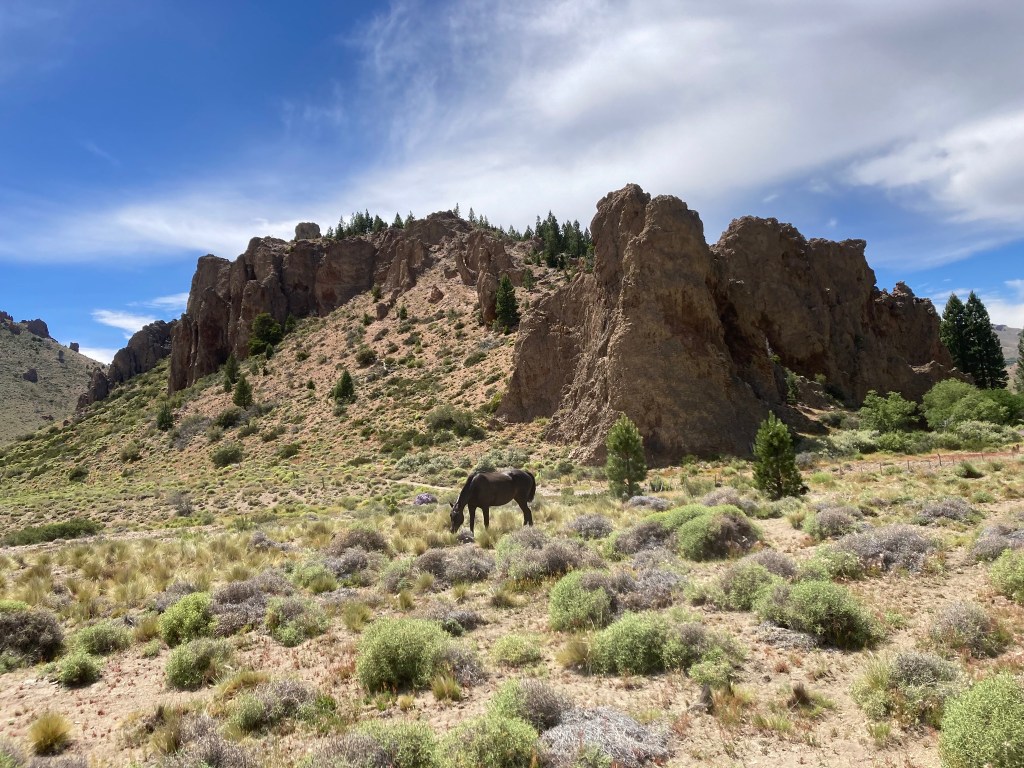
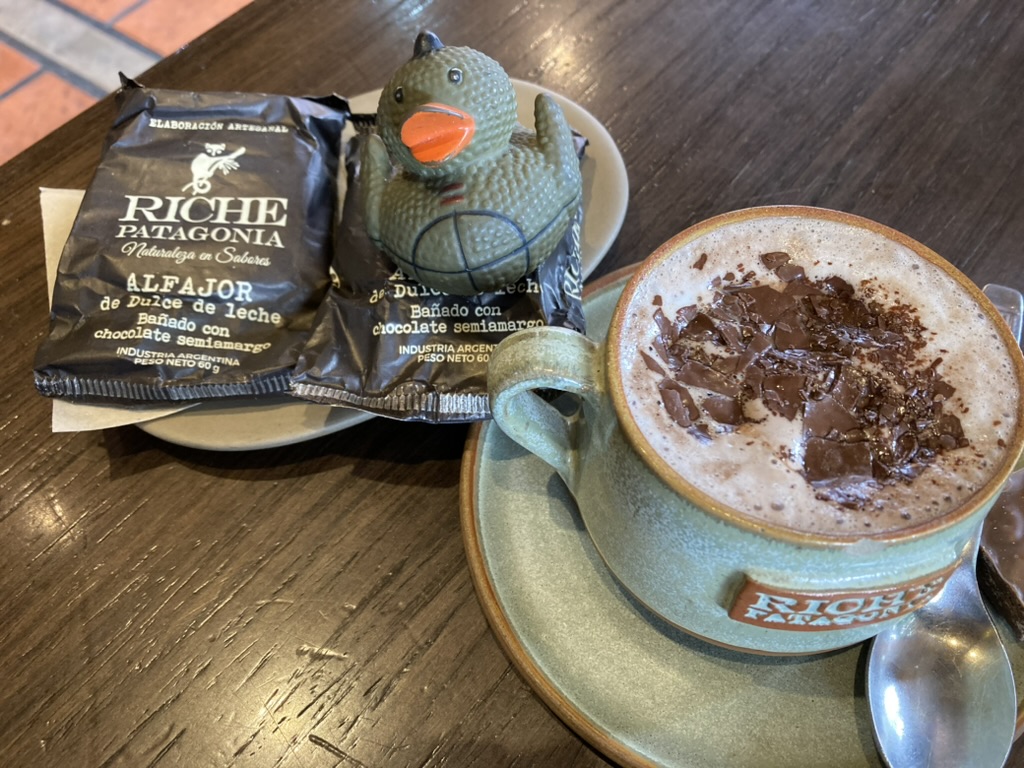
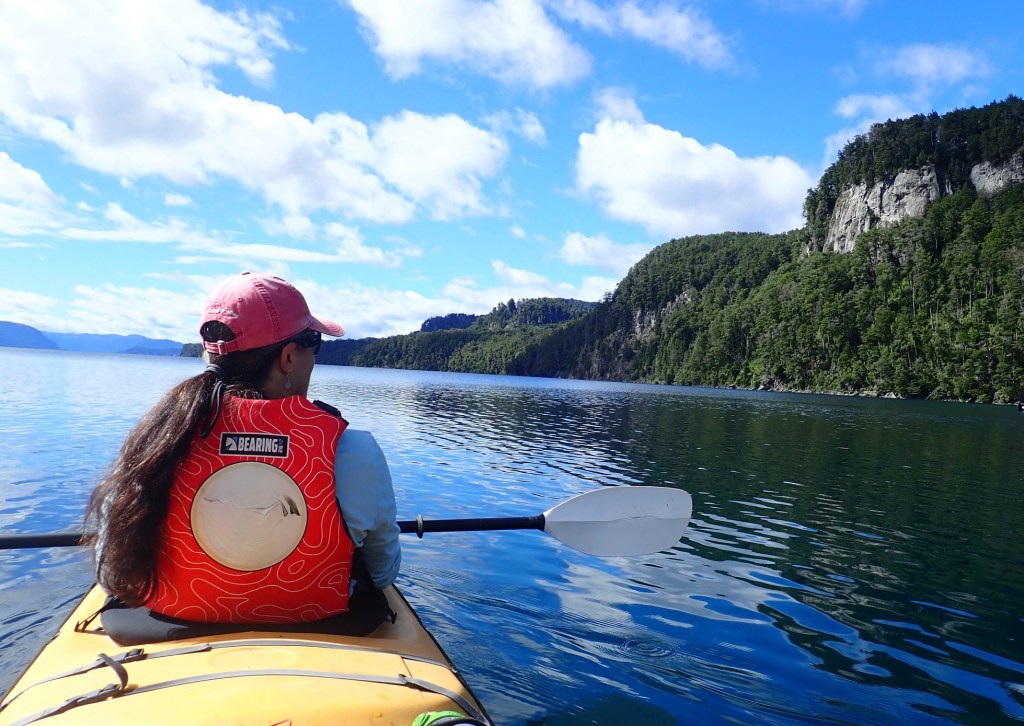
Despite its differences, the natural beauty—and people’s desire to explore it—were quite similar to where we are in Chile. In one short week we did some stunning hikes, rode horses across the scrubby Andean foothills, enjoyed an asado – a traditional Argentinian grilled meat-a-palooza lunch, kayaked along the perimeter of a verdant national park, ate pounds of chocolate, and spent a lovely afternoon lazing on a lakeside beach. This being the start of summer vacation in Argentina, the roads were jammed with tourists taking selfies with gorgeous mountain scenes as the backdrop. We saw people swimming in 50-degree water, taking hikes with their young children and mate thermoses, and tent camping by the lakes. And of course, waiting in long lines for the most popular chocolate and ice cream shops in town. Travelers’ tip: seek out the smaller, family run chocolate shops a bit off the beaten track.
As was our experience last year while living in Segur de Calafell, the excitement, effort, and novelty of a week of travel and exploring a new area is made all the more wonderful when we know we have the familiarity and comforts of our home-for-now to return to at the end. This time was a little different, as we had just relocated from our house in the hills of Pucón to an in-town apartment a three-minute walk from the bustling commercial center. Despite not returning to the same abode, somehow seeing the smoking Villarrica volcano as we neared Pucón and passing the roads, river, and shops we’ve become familiar with still felt comfortingly like coming home.
 Seeing the World, One Year at a Time
Dear Rachel, I’m always transported when I read your blogs. You admire and respect the natives and their lifestyles and I’m sure they are enamored by you and Al, no matter how many American tourists they meet. Thank you for giving me a glimpse of where you are. Love, Lane
LikeLike
Thanks Momo. I wish you could be here with us.
LikeLike
Bariloche! On our whirlwind tour of South America almost 20 years ago, I wanted to see Bariloche and taste its chocolate…but alas, we bypassed the region. Now I can experience it through your eyes and taste-buds. Thanks for that. You have a way of filling my bucket list.
Dad
LikeLike
You have seen so much of the world and yet there is so much more. I am glad you gave me the love of travel. That is one bug I am happy to have caught.
LikeLike
Mmm chocolate with gorgeous views! Sounds wonderful!
LikeLike
This place has my number!
LikeLike
You beautifully captured the beauty and life in the mountains of Argentina. Interesting for you to compare the economic and language differences. Eleanor and I were there in our winter of 1999, stayed in Bariloche, had an excursion into surrounding mountains for spectacular views of Lake Nahuel Huapi. You probably learned that he Swiss came there to ski when Switzerland had summer weather, and brought with them those fabulous chocolate treats. You guys are so lucky to
keep having one great adventure after another.
LikeLike
Thanks Burt. I think there are still plenty of people who take advantage of the reversed seasons whether it be to ski (winter) or run the river rapids (summer). Thrill seekers are drawn to the area. I love that you were here in 1999. I wonder how much change you would see if you came back today.
LikeLike
Quite the contrast in border crossings! Let the Chileans do the work while the Argentina “police” want your money in the country – no questions asked! Another adventure – for sure. Thanks for sharing!
LikeLike
What a wonderful vacation. Thank you for the well-written report and the details of Argentinian life.
We are still in Bolivia now (running a campground in La Paz for a month), but will hit the road again in our camper next week and expect to be in Argentina in less than a month. The wads of cash is super interesting. We have been saving and collecting USD for our months in Argentina. We can’t wait to immerse ourselves in its nature, food, and wine! 🙂
LikeLike
Thanks for your comment and for reading our blog. It sounds like you are also having an amazing adventure. Have a great time in Argentina. I hope to get back there soon and explore more broadly. And visiting Bolivia is very high on my list!
LikeLiked by 1 person
It is strange, isn’t it? To take a ‘vacation’ when you’re a full time traveler. You make me want to return to south America again! I did not spend enough time there and only really saw parts of Ecuador (where I met you & Al) You’re also showing me (with this story) that my visa runs have gotten perfunctory… I need to change that lol.
LikeLike