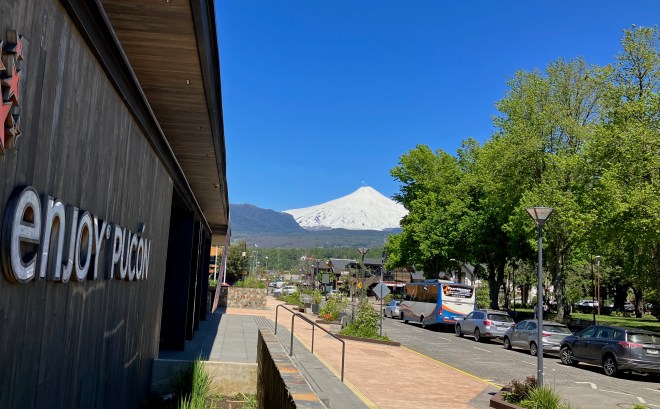
Whenever we settle into a new place, the first thing we do is explore it on foot. The second thing is buy some groceries. We might also look around to see what’s available in the area for craft beer. And ice cream; finding artisanal ice cream or gelato is like spotting gold nuggets in a river—if you see ‘em, you grab ‘em, and you remember where you found ‘em. This is what we call “The First Explore.” The idea is that we get a better sense of a place by walking around than just driving through town. We buy some things we need and look for the things we like. Often, it tells us more about what not to do than what to do—the first market we go to is rarely the one that becomes our regular go-to, but we learn what they do and don’t have there. We see The First Explore as an essential first step in learning about where we are living.
We made it to our new (to us) home outside of Pucón late on a Thursday and, true to form, on Friday we drove 20 minutes into town, walked around, and bought supplies (including food and the essentials for a long stay: a coffee-maker, toiletries bigger than 3 oz., a yoga mat). We ate some quite serviceable ice cream. We have yet to find outstanding craft beer, but we’ve got some leads and a placeholder that’ll do just fine. This year will be a bit different in that we need to plan ahead—being outside of town up a long gravel road, with some rainy and maybe even snowy days in the forecast, we tried to buy enough food to last us a week. Last year in Spain, we could just walk downstairs to our favorite grocery store and snow was never an issue. This year, it’s a bit closer to homesteading, although real homesteaders would scoff at 20 minutes to artisanal ice cream and supermarkets.
Pucón is a lakeside town with a startling view of an enormous, snow-capped volcano soaring into the sky. The bright white, cone-shaped volcano looms over one side of town and still catches us by surprise when we turn our heads and there it appears, jutting up from the end of a street, between houses, or beyond the lake. In the other direction, the lake is framed by craggy green mountains that would be the main feature anywhere else. A couple of black-sand beaches (there’s a volcano nearby, remember?) ring the shore in town, and I’m sure as spring becomes summer the number of people and activities down by the lake will grow exponentially. Racks of rental kayaks await.
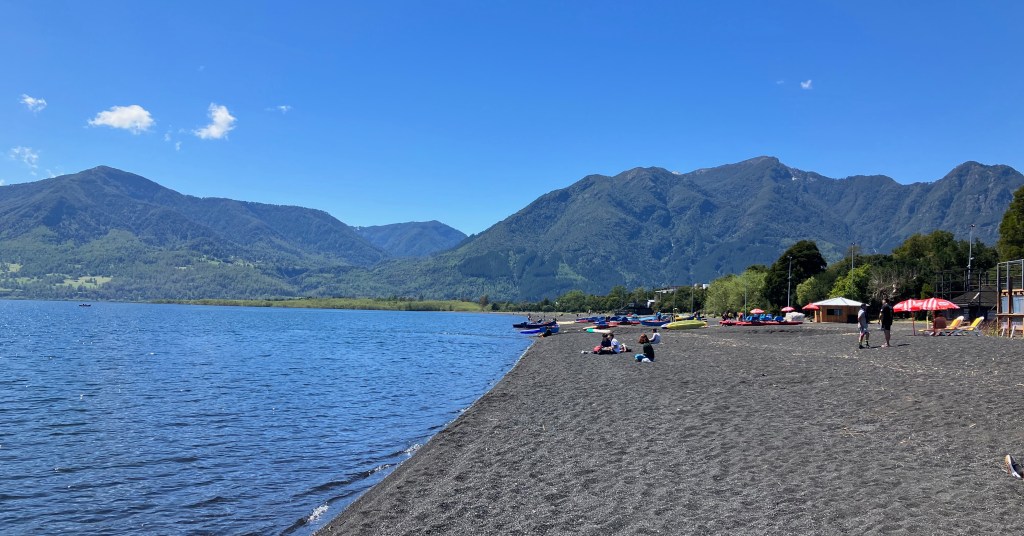
It’s early spring here—similar to Maine in early May—so it’s still the off-season. In the winter there is backcountry skiing nearby on the Villarrica volcano, but summer is the real peak. There are plenty of end-of-winter sales going on now at the outdoor clothing stores (NorthFace, Merrill, and other shops all carrying the same kinds of fleeces and outdoorsy clothes). A few touristy shops and one large hall with stalls selling local crafts like wool ponchos seem mostly devoid of shoppers now. But the streets are still busy: as in Maine, there’s plenty of construction to do between winter and summer—roadwork, sidewalks, buildings. The town feels like it’s awakening and preparing, like the blossoming trees and buzzing bees of spring.
A wide range of restaurants serve Chilean food as well as hamburgers, pizza, vegan and vegetarian food, sandwiches, sushi, and more. We’ve only eaten at one so far, a local diner where we had the cazuela del dia (casserole of the day), which turned out to be like a beef stew or soup, with a hunk of tender beef falling off the bone and sitting in a steaming beef broth with vegetables, rice, potatoes, and half an ear of corn floating in it. Perfect for an early spring day. We’ve been grocery shopping twice now—there are two big supermarkets with all the usual products but we also found some nice independent fruit and vegetable stands, farm eggs, local honey, and a couple of places for organic oats, grains, dried fruit, and nuts by the kilo. We even picked up some fresh artichokes and asparagus from a man walking the streets with a wheelbarrow full.
Over the following three days, we explored the grounds around the house and walked out our long gravel driveway and up the dirt road. You won’t find our house, nor even our road, on Google Earth or Google Maps – it’s that remote. The house itself is more rustic than we have been used to in our city-based apartments. Built on a hillside in three levels, it has a mostly wood and stone-tile interior and custom-built furniture and decorations, unlike the all-IKEA decor in many of the Airbnbs we’ve stayed in. The bathtub is deep and the shower has a view of trees and sky through a large picture window. We can see one snow-capped volcano in the distance from the master bedroom, and another one much closer if we walk down the driveway a bit. The quiet is interrupted only by bird calls, creaking pipes, wind in the trees, and dogs barking at dusk.
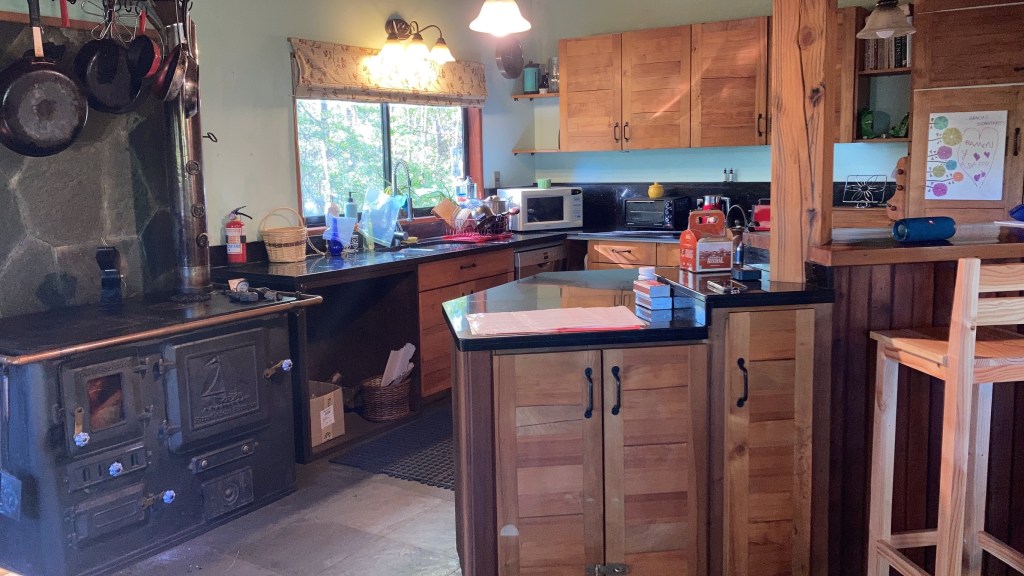
The first level has a large kitchen/dining/seating area with a wood stove/oven for heating and cooking (as well as more modern appliances), a half bath, a mud room, a porch, and an attached greenhouse. The second level is unheated: the garage, a workshop, washer/dryer, and an office. The upper level is two bedrooms, a shared bathroom, and a wraparound deck. Another wood stove heats the master bedroom like a warm wool blanket. There’s a sense of space we haven’t felt in quite some time. The air is clean and fresh (especially compared to Santiago, where smog hangs in the valley like a clog in the drain). When the sun shines, it has gotten up into the upper 60s, but it’s been cold and rainy at least half the ten days we’ve been here—in the 30s, 40s, and 50s—and in the latest storm we even had some snow, sleet, and hail. Those wood stoves have gotten a workout, and so have I, from chopping the wood for them.
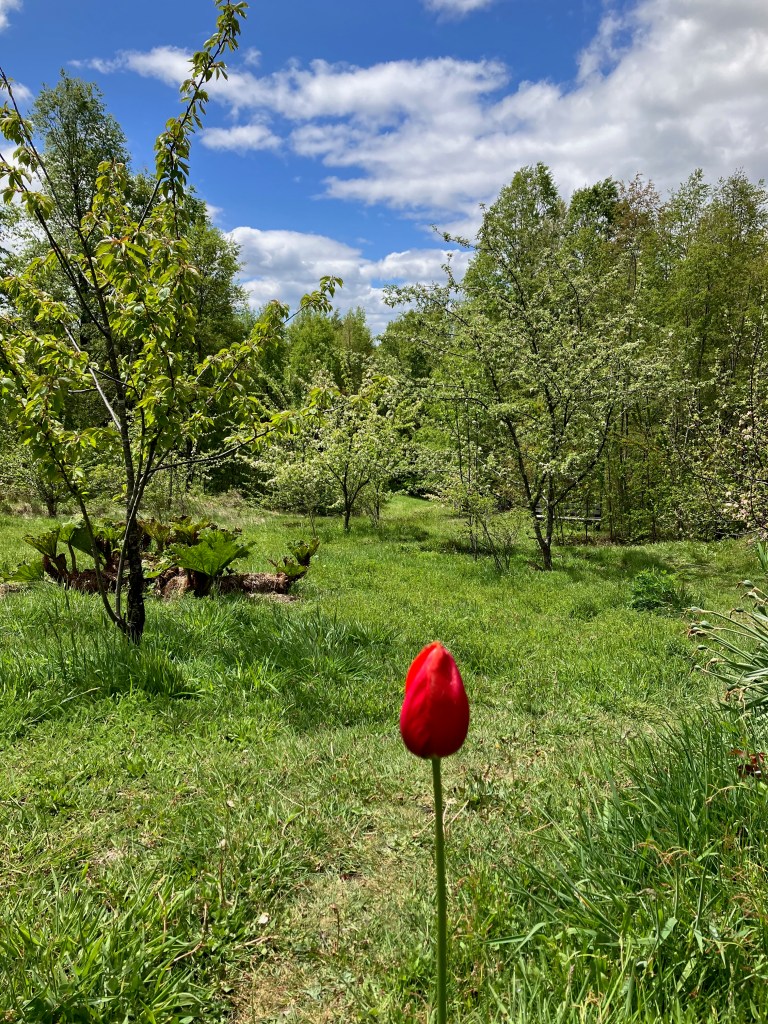
The grassy hillside rolls down in front of the house through apple trees in bloom and an explosion of flowers to an expansive garden at the bottom of the hill surrounded by a weathered wooden fence. There are two large, enclosed areas, one just for raspberries and blueberries and another with well-tended beds for whatever we want to plant. Lettuces, fava beans, asparagus, and artichokes have already emerged, and we bought some seeds from a local woman in town to grow peas, spinach, squash, and beans to start. The garden has already become a focal point of our life here outside of town. On every clear day, we’ve spent time turning the earth, churning in manure, trimming back the dead raspberry and prickly blackberry canes, and repairing the fence that keeps out hungry rabbits. I am not a gardener by nature, but I enjoy being outside with purpose, and my mouth waters at the prospect of fresh-picked berries and salads all summer.

The gravel road that brought us in continues up into the hills beyond, dead-ending somewhere near a national park that encircles the closest of the region’s four volcanoes. We’ve walked up the road an hour or so a few times, taking two different forks. We have not yet found any real trail heads, but we’ll keep looking. The walk on the road offers views of the volcano and other mountains, as well as farms set on rolling green hills with cows eyeing us warily and chickens skittering across the road (to get to the other side, obviously). Two friendly dogs live next door to our house and often accompany us as we wander up the hill, much to the annoyance of the cows, chickens, and other neighboring dogs. Not knowing their names, only their happy troublemaker vibe, we have taken to calling them Thelma and Louise.
The First Explore is just the beginning. Pucón is known for adventure travel, so there are multiple storefronts advertising white-water rafting, volcano treks, kayaking, ATV tours, horse riding, and more. We’ve seen lots of signs for thermal baths, which are fed by natural hot springs, and we know there is an abundance of hiking in national parks. Next week we have tickets to see a Mapuche music show at a tavern on the outskirts of town, and we’re looking into taking Spanish lessons in town.
We may be out at the end of a dirt road, we may grow some of our own food, and we may settle in by the wood stove for a few days, but we’re determined not to be hermits. The Second Explore awaits.

 Seeing the World, One Year at a Time
Ayer me acordaba de vosotros porque empecé a ver “El Conde”, una peli chilena comedia/terror donde Pinochet es un vampiro. Es nueva en Netflix. Pero no creo que tengáis Netflix……
LikeLike
Bueno! Voy a ver la. Gracias.
LikeLike
Gracias, Luis! Tememos Netflix, si… Esperamos todo esta bien para ti!
LikeLike
The prose creates an aura of presence. I feel the chill in the air [brrr] and sense the gravelly road underfoot. Sadly, although I am sure it will happen, I can’t taste the beer nor enjoy the swirling of ice cream in my mouth. I expect the 2nd Explore will provide those treats.
Keep on trekking and writing, I love being close to you
LikeLiked by 2 people
What a beautiful essay! You have a gift of bringing us along on your journey and we are richer for it. I await your descriptions and photos of the bounty from your garden. Stay well and enjoy your magnificent surroundings.
Love,
Lane
LikeLiked by 1 person
Beautifully written and yet another stunning peek in on your amazing journey across our planet. Thank you!
Sending love & blessings your way!
Marti
LikeLiked by 2 people
Chile already sounds incredible. So excited for you two on this leg of your adventure. I love that you’re homesteading (though you def need some chickens). I can’t wait to hear more about life there!
LikeLiked by 1 person
Great to hear from you, Beth! Hope all is well in Salem. Chickens? Um no thanks! 🙂
LikeLike
Ah we live in Western Mass now! Doing a bit of homesteading here. Chickens are a handy homesteading addition. Entertaining, and useful.
LikeLike
Hi, Al and Rachel!
Love all your descriptions of your first impressions of Pucon and new home! Keep your news coming for all of us who aren’t quite as brave as you two are about exploring the wide world.
LikeLiked by 1 person
The view of the volcano is spectacular. Enjoy your stay and your Second Explore. Sound a bit too cold… We will save Chile and southern Argentina for summer. 🙂
LikeLike
The exploration sounds delightful! This leg of your journeying seems like it will be both homey and adventurous.
LikeLiked by 1 person
It would appear the 20 minute is less homesteader and more true survivalist in order the get ice cream but I’m sure you’ll persevere!
Thanks for the first impressions!
LikeLiked by 2 people