We’re about to go live in the shadow of one of the most active volcanoes in South America on a road so remote that Google Earth has not yet captured it on camera. To get there, we’ll take an overnight flight from Miami to Santiago, another two-hour flight to the closest airport, and finally a two-hour drive to the house. It’s a far cry from our easy 40-minute train ride from the Barcelona airport to our seaside condo in Spain. Chile is shaped like a string bean—long and narrow, with a craggy geography and history of earthquakes. It has neither the comprehensive, well-kept infrastructure of Spain nor the compact size of Ecuador. Its people apparently speak a version of Spanish so fast and different that even fluent Spanish speakers from other countries have a hard time understanding. (Think of us trying to understand the variety of English spoken in Ireland or Scotland.) Why in the world did we decide to do this?
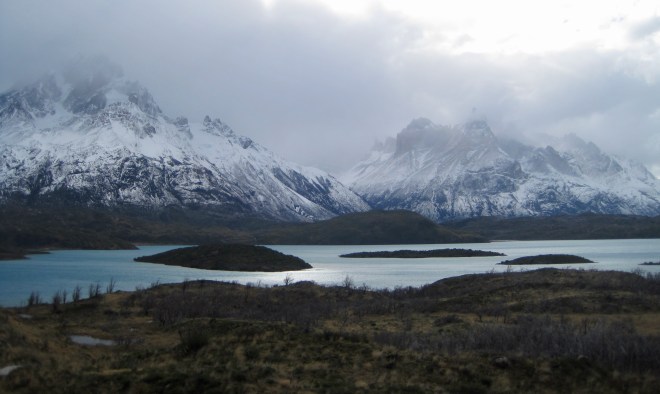
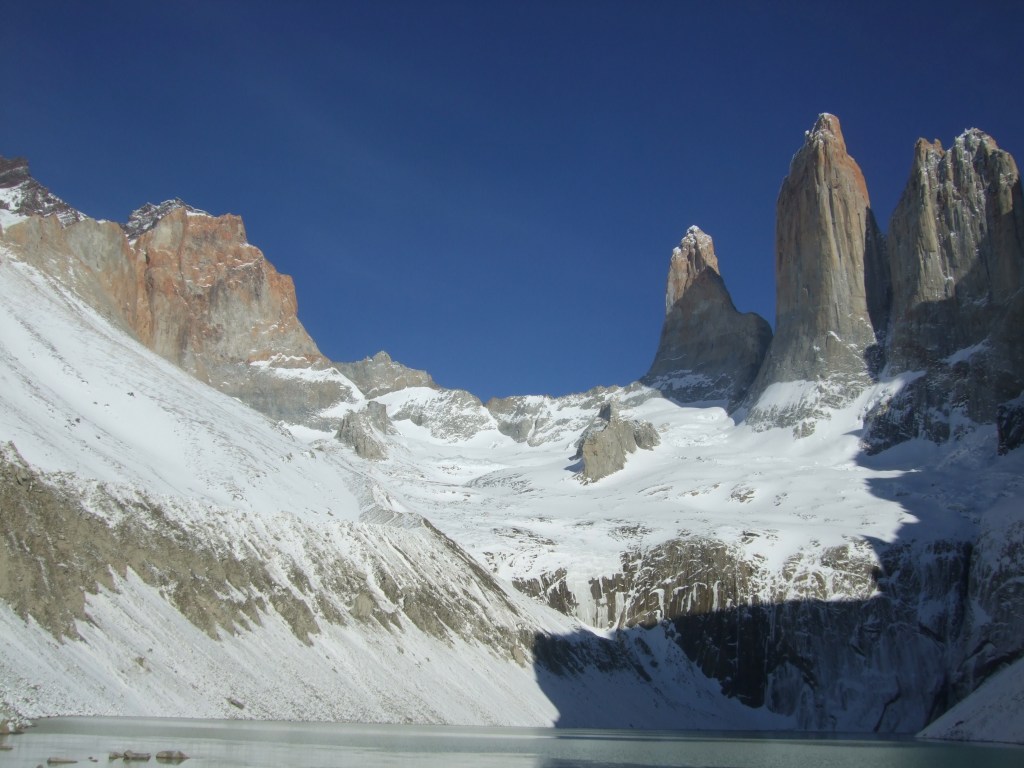
Natural wonders. I have been to Chile once before to go winter hiking in Patagonia with my daughter, who was interning in Santiago at the time. I vowed to come back to the iconic Torres del Paine area (see photos above and below) when the weather was less harsh and bring Rachel with me. Everyone raves about the peaks and glaciers of Patagonia, but there’s so much more to Chile’s wonders. And I’ve only seen pictures of the rest: 9,000-foot volcanoes, pristine lakes, and nearly 4,000 toothy miles of coast. Atacama, the driest nonpolar desert on Earth, spans the coast of northern Chile and crosses into Peru. Tierra del Fuego, the southernmost tip of the continent, is a windswept archipelago that looks across the fearsome Straits of Magellan to Antarctica. Two thousand miles west into the Pacific lies Easter Island, also known as Rapa Nui, just one of many Chilean National Parks. This is a country we’ve long wanted to explore.
Spanish. Some friends have asked us if we are limiting our travels to Spanish-speaking countries only. The answer is no, definitely not! Each year we’ve talked about lots of possible destinations—New Zealand, Australia, several places in Africa, Southeast Asia—these are all regions that remain high on our list. But each year we weigh the pros and cons, and so far continuing to learn and practice Spanish has tipped the scale. I’ll be honest—for me, it’s more the fear of losing all the work I’ve put in to squeak by in Spanish than it is excitement about continuing to learn it. Each time I take a few weeks off from daily practice, I feel like I’m almost starting all over again. Not quite, but I know if I take a year or more off, trying to shake the cobwebs off that part of my brain when we next visit a Spanish-speaking country will take a lot more effort than it does now. So even though we’ve been told that Chilean Spanish is among the hardest in the world to understand, at least it’s not a whole different language. And we’ve been told that people will be forgiving if we plead with them to speak Castiliano (aka “Spain” Spanish).
Culture. If you’ve ever read any works by Isabelle Allende or Pablo Neruda, how could you not want to see what makes the Chilean people so poetic and emotional about their homeland? The bohemian harbor town of Valparaiso, with its steep hills, funky funiculars, and colorful street art, keeps popping up in “best places to visit” articles. Santiago has loads of museums and foodie favorites. There’s a rich and troubling history of indigenous cultures, from the mysterious Polynesians who built those massive stone statues on Rapa Nui to the mainland Mapuche, who have their own thriving culture of arts and poetry and continue to fight for their stolen rights and lands. There are the Spaniards who came to claim riches and then centuries later the Spaniards who sought refuge here during their civil war. There’s the ubiquitous Tyrolian cultural influences from generations of Germans settling in Chile. And there’s the dour specter of Pinochet’s brutal dictatorship, not to mention the distasteful role the U.S. played in overthrowing the democratically elected government that preceded him. All of this adds up to a rich and complex set of influences that I’m looking forward to learning much more about.
Location, Location. Okay, it’s not easy to get to. At least it’s the same time zone (almost)! Seriously, if you’re not steeped in hemispheric geography (and I am not), it can be surprising to learn that Santiago (on the Pacific coast), is at nearly the same longitude as Boston (on the Atlantic coast). We often think of South America as being, well, south of the U.S. And of course it is, but it’s also much further east than we tend to think. In fact, the westernmost parts of South America are all east of Miami! Oddly, Chile’s time zone is currently one hour ahead of Boston, and after Daylight Savings ends, it will be two hours ahead, despite being on the same meridian. Go figure—I guess it just proves that time zones are a political invention, not a geographic imperative. Nevertheless, after being six hours ahead of the eastern U.S. when we were in Spain, we realized how the time zone does, in fact, affect our ability to connect with family, friends, banks and other businesses, and consulting gigs back in the States. When compared to the other, further afield destinations we were considering, Chile seemed downright convenient.

The House! This year we’re doing something completely different—we have rented a house for six months without having ever visited it. But what a house (we hope)! We had settled on the “lakes region” a few hundred miles south of Santiago, and began looking for one-month rentals in a few towns around the region. One of them, near the adventure-travel town of Pucón, caught our eye, and we saved it to look into further. Around the same time, a long-time, dear friend of Rachel’s mentioned that she had a dear friend who used to live in Chile. When we finally connected, we learned that this dear friend-of-a-friend is, in fact, the owner of the very house that had caught our eye! It just seems like such a great fit for us—great views, hiking trails out the back door, a great kitchen, a garden with fresh berries and vegetables, eco-friendly, quiet, and yet with up-to-date wifi. It’s near a town known as a launching point for hiking the volcano, kayaking the lake, and biking the hilly roads. The downsides: We’ll need a car (four-wheel-drive), it’s a long way to the nearest airport, and the town can get busy with tourists at times. But there’s no one place in long-skinny Chile that can serve as a hub for seeing the rest of the country other than Santiago, so we decided to just pick a place that looks enticing and deal with the rest when we get there. If we can handle the challenges—and our new dear friend-of-a-friend has already begun to share her wealth of knowledge and local contacts—then it seems like the risk is worth the possible reward.
But most of this is conjecture. We don’t really know what we’ll find when we get there. We’ve been so busy this fall we really have no plans in place for after we arrive—we’ll just have to improvise. In that way, each year’s adventure is unique, but also similar. We get on a plane; we land somewhere new; and we figure it out.
 Seeing the World, One Year at a Time
I’m sold! So excited to follow your Chilean adventures. Travel safe, and be well!
LikeLiked by 1 person
Sounds like another spectacular adventure! I look forward to sharing it vicariously!
LikeLiked by 1 person
Our family reunion in Spain last summer is a marvelous memory. Looking forward, we await all your blogs of your great adventure in Chile. Safe travels.
LikeLiked by 1 person
Love your blogs and adventurous spirits. Adventure for us is fighting off mosquitoes while glamping at Folly beach.
Pura Vida
LikeLiked by 2 people
Hello, Al, hello Rachel:
Having grown up in Chile and continuing a close link with friends in this country, of course I’m delighted to know that you are planning to move there for a while, certain to enjoy the many attributes of the place.
I do believe that you won’t find too many problems in understanding the Spanish spoken in Chile. It’s by far more grammatical and easier to understand than the Spanish spoken in neighboring Argentina.
I’m also pleased to read about your intentions to learn more about this country.
Frankly, it has dismayed me to have you believe what the international, left-leaning press has reported about Chile since Day One after Allende’s overthrow.
Yes, Allende was “democratically elected” in 1970, by the slimmest of majorities. He and his communist buddies, particularly Fidel Castro, immediately set about ruining the country, bringing it to the peak of ultimate disaster which impelled the widespread call by the majority of Chileans for his overthrow in 1973. My ex-husband, Jack Fitch, often travelled on business in South America during those three years, and his tales about what he was able to witness in Chile were horrific. Of course I also heard directly from my many Chilean friends, of all societies, about the ruinous rule of Allende and the widespread suffering.
Pinochet’s government was vastly supported by the Chilean people. Yes, there were incidents of brutality but they were swiftly condemned and some of Pinochet’s government members resigned because of these incidents. One needs to consider that these incidents were prompted by the deep and intense hate which Chileans had developed against members of Allende’s government. Contrary to what the international press proclaimed from Day One, Pinochet was popular and oversaw the financial – albeit slow – finncial recovery of the country. Unfortunately Pinochet was in power during the lamentable assassination of Orlando Letelier here in Washington, but this murder was found to be a terrible decision by someone else in the government, who was instantly dismissed.
Seeing what was happening to Chile under Allende, the United States understandably sympathized with the suffering Chileans. They did NOT contribute funds to Allende’s overthrow. This has been researched at infinitum and has been corroborated many times. Chileans were WISHING that the USA would bring financial help to their cause, but this was never the case. The US is blamed unfairly for actions they never committed.
The Araucanos/Mapuches were almost decimated by the Spaniards way back when. When the country started to compensate them for their human and other losses over many years, they evolved into a lawless, criminal group which now terrorizes a wide swatch of Chile in the Araucania, burning, pillaging, destroying, murdering, financed to a great extent by the international drug traffic. A good friend of mine had his house in the Araucania burned – also his workers’ houses – and his prize cattle and Andalusian horses butchered, with his forests and fields burned to crisps. No insurance company is willing to issue any insurance any longer to anyone living in that pretty vast area. Attacks against people, properties, agriculture, etc. continue on a daily basis.
In 1974, when I couldn’t figure out why the stories I read in the press and the reports I continued to receive from my Chilean friends were always black and white, I decided to travel to Chile to try and make heads and tails out of it all. I stayed with different people, some longtime friends who had been adherents to Allende, others of the typical middle class, a few others from the wealthier society. I roamed the streets, sat on park benches, talked to taxi drivers, listened to what women were saying in beauty parlors, traveled north and south, speaking with teachers, industrialists, visited a jail, visited a mine, roamed the countryside, trying my best to form a balanced view of what had happened under Allende and what was happening under Pinochet.
Discoveries continued after my return to the Boston area, with incidents happening in Boston, at Smith College, etc., all organized by pro-Allende groups. Yet the drumbeat against Pinochet continued and continues.
So my suggestion is: by all means seek to learn as much about Chile as possible. Bear in mind that many of those who were witnesses during 1970-1990 are no longer with us. Many of my present friends in Chile have given up fighting against the one-sided tales in the press and popular opinion. They find it to be a hopeless endeavour.
The US Ambassador to Chile in 1974-1977, David Henry Popper, wrote a well-researched and balanced book about what had happened to Chile under Allende and his 1973 overthrow. I unfortunately lent this book to a friend and never had it returned, and it is now out of print. But it countered a lot of what the one-sided international press had been reporting.
Your take about the attitude of the US during those years, the opinions about Allende vs. Pinochet, is entirely understandable given the international and immediate misrepresentations by the press. But please withhold judgment, consider everything with not grains but pounds of salt.
I have no doubt that you will find your stay in beautiful Chile enjoyable. I look forward to your travel reports once you get settled in. Que lo gocen!
Bea Fitch
LikeLike
Thank you for such a detailed response, Bea, especially from one who has lived there and tried so hard to understand what is undoubtedly a many-sided, complex history! I’m looking forward to learning much more. It’s not just press accounts but literature as well that has influenced my impressions, which are admittedly only lightly informed. It will be interesting to dig deeper.
LikeLike
One more comment: Isabel Allende is a very talented author. I admired her sty
LikeLiked by 1 person
I am making my way through La Casa de los Espíritus right now and loving Isabel Allende’s writing style and language.
LikeLike
I hope you weren’t too exhausted by your long flight south. Welcome to Chile!Nobody
LikeLike
Wow! Such a complex history and so much to unravel. Thank you for wetting my appetite for greater understanding. Looking forward to hearing more as you navigate your way on this new adventure. Shirley
LikeLiked by 1 person
Have a wonderful time! I look forward to the posts & pics! I hope to get there eventually.
LikeLiked by 1 person
Hello from Manchester, MA! Sounds like you have yourselves another good six-month adventure, and a lovely place from which to take in experiences, travel, and learn Chilean Spanish! I’ll look forward to hearing more from you both!
Leslie
LikeLiked by 1 person