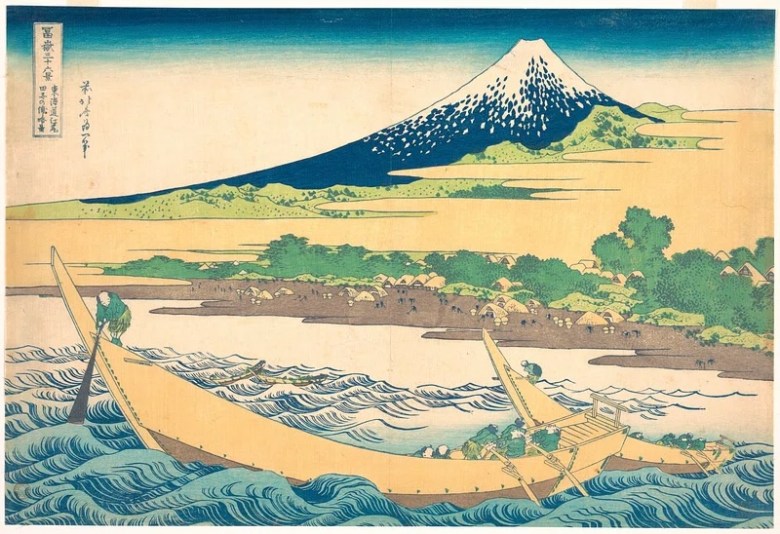
The Japanese artist Hokusai is best known for his original 36 woodblock prints depicting views of the sacred Mount Fuji. Up close, from afar, in rain, snow, sun, nearly hidden behind a giant wave, peeking out from behind a bridge, beyond the Tsukuda islands, and mirroring the pointy rooftops of a city, are just a few of the views Hokusai chose to immortalize. I thought of Hokusai’s work on a recent kayaking excursion in Auckland’s Rangitoto Channel, after climbing to the top of Rangitoto Island and looking back across the water at Mount Eden, Auckland’s own iconic mount.
While not nearly as impressive as the snow-capped Mount Fuji, the dormant cone of Maungawhau (Maunga means mount in te reo Maori; whau refers to a native cork tree with heart-shaped leaves) rises about 650 feet above sea level. Known in English as Mount Eden, it was the highest point on the Auckland skyline until 1997, when it lost that title to the 1,076-foot Sky Tower. Having started our time in New Zealand by walking around Mount. Eden’s cone, and now seeing it from across the water, I realized that we, too, have been on a sort of quest: To see Auckland from many different vantages.
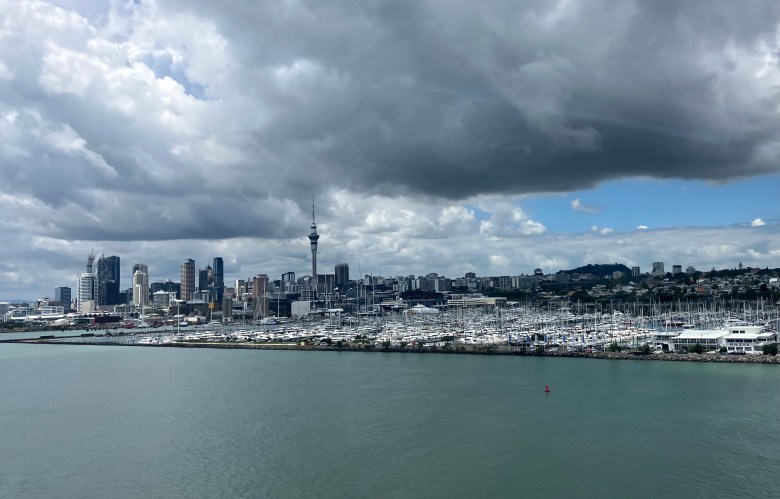
Unlike our time spent in other cities around the world, in Auckland we have set our bags down in six different locations so far, spread around the city, with more to come. Usually we would pick one place and settle in there, recognizing that this limits our viewpoint and often wondering what it would be like to live in other parts of a city. This time, we decided to stay in multiple neighborhoods with a mixture of house sits and Airbnb rentals. Just like Hokusai, through a deeper investigation of one place, seeing it from many different angles, we have begun to appreciate the broader picture—how the city serves as a focal point and backdrop for all kinds of activities, cultures, and lives splayed out in all directions around it.
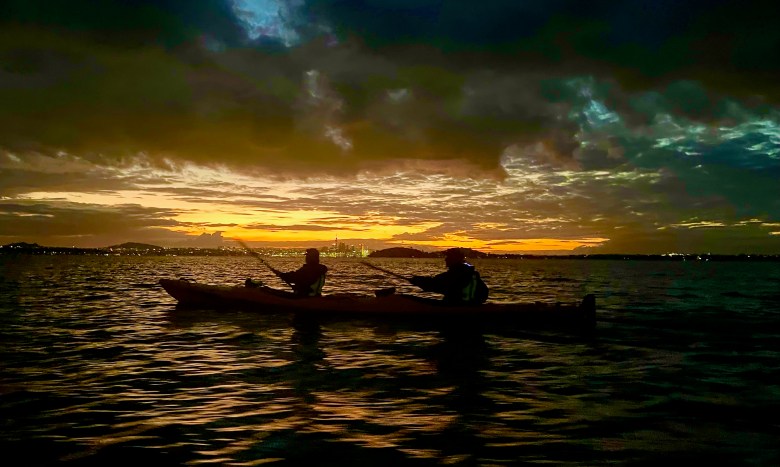
Our kayaking guide told us that Auckland has over 50 volcanoes (mostly dormant or extinct), of which Mount Eden is the most prominent. Rangitoto Island—a three-mile paddle from St. Helier’s Beach on the mainland, is the youngest of all the volcanos, at a mere 400 years since it exploded up from under the ocean, much to the awe of the Maori people who lived on an island right next to it (and survived to tell the tale). We admired an impressive view of Auckland from atop Rangitoto’s cone—including the grass-covered top of Mount Eden—and then paddled back across the channel, into the reds and oranges of sunset splashed across the horizon. Seeing the stars begin to reveal themselves overhead and the lights of the downtown area reflected in the calm water, I too reflected on our time in New Zealand’s largest city.
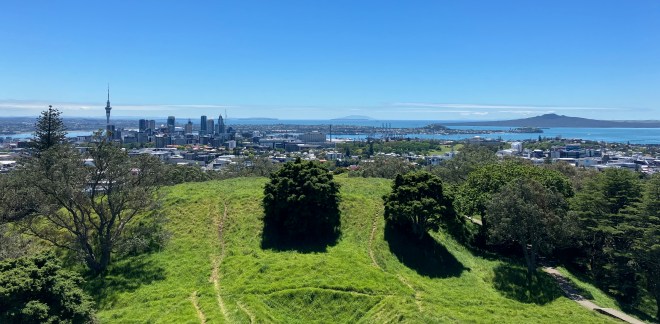
On day one in New Zealand, we were met at the Auckland airport by the husband of a former workmate of Al’s. The couple now live here and have cheerfully introduced us to their adopted country. He gave us a grand tour of the area highlighted by the “must-do” walk to the top of Mount Eden for a sweeping view over the city and its surroundings (as shown in the top photo). We got our first introduction to Maori culture, learning of the sacredness of the mount and the legend of its use as the home of Mataaho, guardian of the secrets hidden in the earth. The mount lip rings a crater 165 feet deep that has been used in the recent past for staging musical performances and solstice ceremonies, but longer ago was the site of a tribal pā or fortified village. Today Mount Eden is well used by dog-walkers, tourists, lovers, and people getting exercise.
That week, we stayed at our friends’ home in Herne Bay, a quiet neighborhood nestled at the foot of the Auckland Harbour Bridge, walking distance from both the downtown city center and three small beaches. Mount Eden would have dominated the view 100 years ago, but today, a mere three miles to the south, it has some stiff competition from urban development.
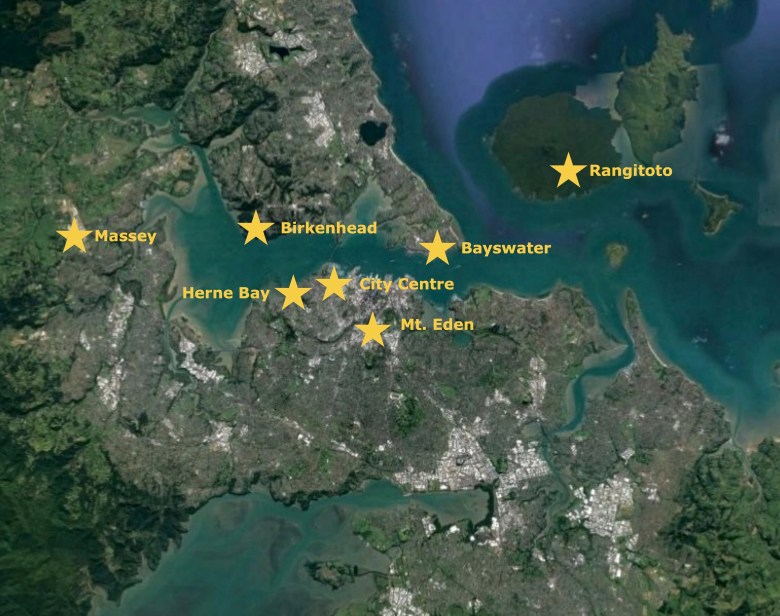
Then we spent nearly three months exploring other parts of the country before returning to the Big City. We started the month downtown in a densely urban area, in a small, one-bedroom apartment near the university. We were excited to really “do” the tourist things, so despite the heavy rains and fierce winds of a passing monsoon, we suited up in head-to-toe waterproof gear and hit the town. It was great to be able to walk to the museums, have a thousand restaurants within a ten minute radius, do some shopping, and feel the pulse of the city. That said, it felt hectic and loud, especially in contrast to our most recent three weeks near the beach in suburban Tauranga. So, we didn’t mind moving on to our next digs.
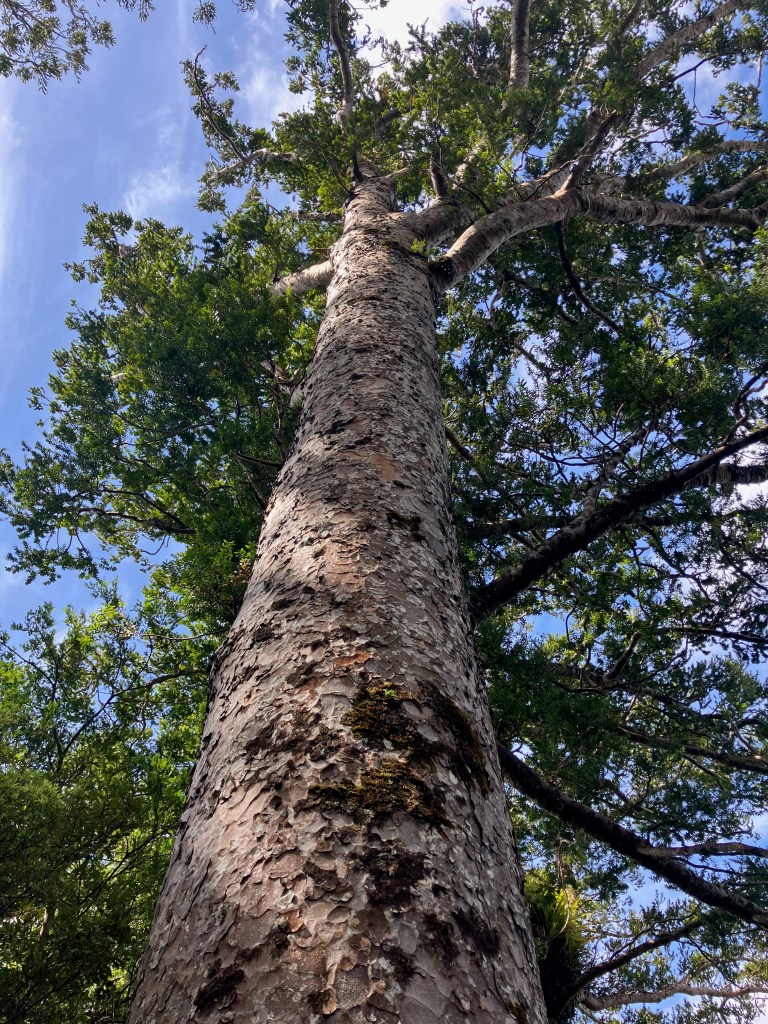
From the heart of the city we headed north, across Auckland harbor’s iconic bridge, and into the suburb of Massey, where we had agreed to a one-week house sit with two beautiful dogs. The sun came back out and we were able to take advantage of the home owner’s car to explore some of the natural features of the area. Amazingly, just a 30-minute drive from the center of Auckland, you can visit a coniferous forest densely inhabited by ancient, massive, and revered Kauri trees, known to live over 2000 years, where a quiet walk among them is a soul-soothing experience. In this area there are also wind-swept, black-sand beaches (remember all those volcanoes?) and, if you are so inclined, one of the biggest mall complexes in the country (oh joy). We got an insight into what life as a young, professional family might look like in a bedroom community of starter homes with a wonderful mix of ethnicities from house to house.
Next, knowing Al was going to have a week or so of work, we moved to an Airbnb in a different suburban neighborhood known as Birkenhead, which has easier access to the City Center by bus or ferry and fantastic views of the water in pretty much every direction. Auckland and environs are built on the narrowest section of the North Island. Picture a wasp. Auckland is the thin “waist” between the two thicker body sections, and is nearly entirely surrounded by bays, harbors, inlets, a river, a gulf, a sea, and an ocean. At its narrowest the land is less than two kilometers wide east to west between access to the Tasman Sea and the Pacific Ocean (for reference, the Panama Canal is 82 kilometers across). In Birkenhead, we enjoyed cliffside walks with views back toward the tall buildings of the city and watching the various types of watercraft moving in and out of the harbor. Perhaps because the area is much closer to the financial district but has the space for larger single family homes, it seems wealthier and more homogeneous than Massey.
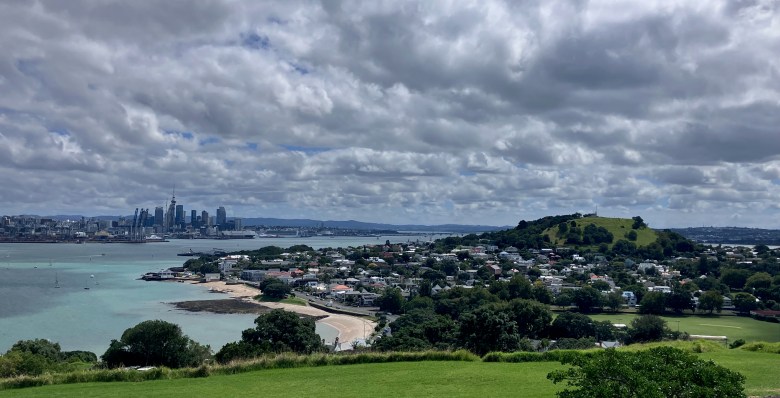
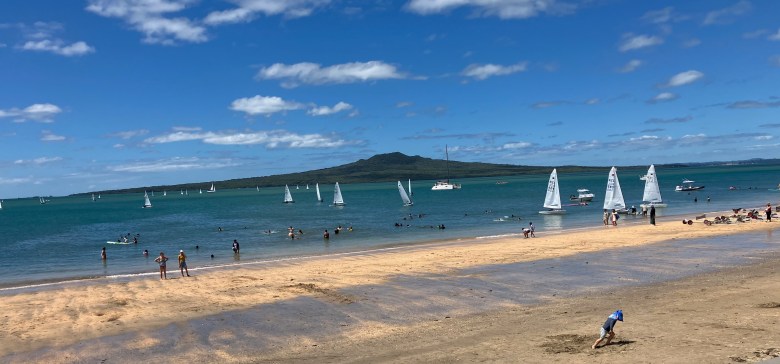
Once Al had completed the bulk of the work, we moved on to another housesit. This time we settled in upscale Bayswater, which lies at the end of a peninsula gesturing like a large land finger towards the city. The area is verdant, the homes are modestly elegant, and there are palm trees and water views at every turn. People here enjoy their beach life, with sandy strands and clear, protected bays ringing the area, yet still just a 10-minute ferry ride to the city. The appeal of Bayswater is clear, but if I had to commute into Auckland everyday by car, the traffic would be a serious buzzkill, as there is only one road that connects the peninsula to the city center. From our bedroom windows we could watch the tide come and go, look across to Birkenhead, and see the Southern Cross at night. Standing at the top of Maungauika, yet another one of Auckland’s volcanic cones, in a park at the very tip of the peninsula, we could see across the water to the cone of Rangitoto Island in one direction and Mount Eden in the other. From this vantage point, it is obvious how the land here was formed, with the many lumps, bumps, and cones of the 50-plus volcanoes.
This week, we are headed back across the Auckland Bridge to a beautiful 1920s bungalow at the foot of Mount Eden. Here we’ll care for an enthusiastic dog who loves to play fetch and enjoy yet another perspective on Auckland and its famed mount. Though we are not finished with our time here, in a way it feels like returning to the place we started. I am sure we will stand at the top of Maungawhau/Mount Eden, and look out over the sweeping view of the city and its surrounding area with a deeper appreciation for what we are seeing, knowing that we have looked at the hill from a great variety of angles much the way Hokusai did with his Mount Fuji.
 Seeing the World, One Year at a Time
How great to get to explore while living in various houses to get a feel for real life in New Zealand- great perspective builder!
LikeLike
Thanks for your comment April. It is fun. Today we climbed Mount Eden again and it was fun to be able to identify places we have now been. So different from our very first day’s perspective when we stood at the top of the Mount, knowing nothing of this amazing country and the city of Auckland.
LikeLike
thank you Al and Rachel. We are in Maui and still are envious!
steve and helen
LikeLiked by 1 person
Ooh, Maui! How wonderful to get out of the deep cold and monochromatic palette of a New England winter and see all the variations of green and blue in the warmth of the Hawaiian Islands. Thanks you for reading our blog.
LikeLike
Rachel,
Your poetry is lovely and the composition of this blog was especially well informed. You know that I have loved Japanese art since my first year in Medical school where my professor of anatomy was an avid collector of Japanese woodprints, including Hokusai. My roommates attended his art lectures with me and at the end of the year, as a wedding gift to me and mom, they gave us an original Hokusai. You have seen it in our foyer.
The way you started this blog and brought it to closure with the 36 Views of Mount Eden is a a clear paean to the other 36 Views. Thank you for that.
I continue to love what you and Al are doing.
Dad
LikeLike
Thanks Dad. I have always loved the woodblock print you and Mom own, even long before I knew of Hokusai and your relationship to him as an artist. Thank you for continuing to be an avid and consistent reader of our blog and even more so, a supporter of our chosen path through this period of our lives.
LikeLike
The many faces of Auckland! How do you manage to stay more than three months in New Zealand?
By the way, it’s been interesting to learn a bit more about you both from Patti these last two weeks. 🙂
LikeLike
Hi Liesbet. How fun you are getting time with Patti! We requested a 6-month visa from the New Zealand government, which was easy to do on their web site, it cost about $60 each, and we were approved immediately.
LikeLiked by 1 person