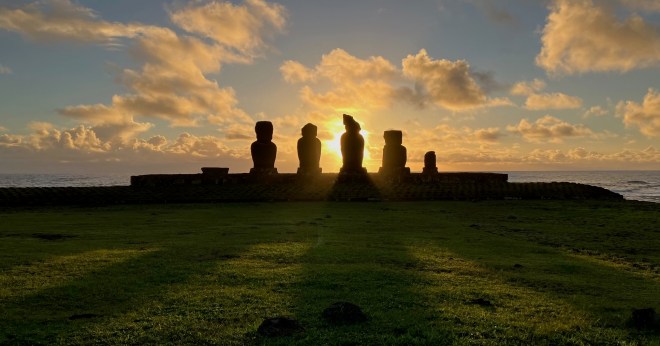
“Iorana, welcome,” a smiling woman said, bearing flower leis and a sign with my name on it as we exited the open air terminal. She ushered us past tropical plants and Hawaiian-shirted islanders greeting their loved ones. What a change from the cool, damp air of mainland central Chile to the humid, warm air of Rapa Nui, also called Easter Island. Looking out the plane’s window on the five-hour flight from Chile’s capital, Santiago, I saw only thousands of miles of water until the little dollop of green appeared in the vast expanse of blue. The single airstrip on Rapa Nui is about a five-minute drive beyond the only town, so the plane basically buzzes the town as it comes in. I got my first hint of the magic awaiting us when we passed right over five moai, those huge stone heads for which the island is famous, standing sentry on a platform near the water’s edge.
Fun fact: The airport of Rapa Nui is the most remote commercial airport in the world. The next closest airport is a whopping 1,617 miles away located in the Gambier Islands of French Polynesia.
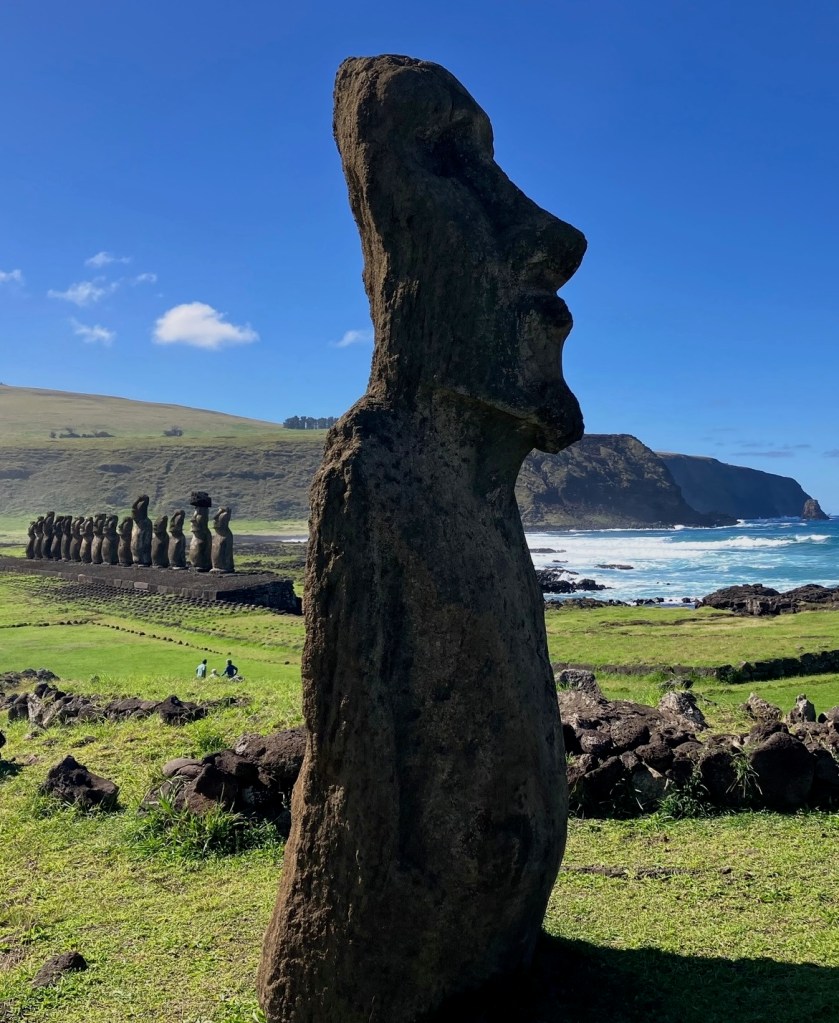
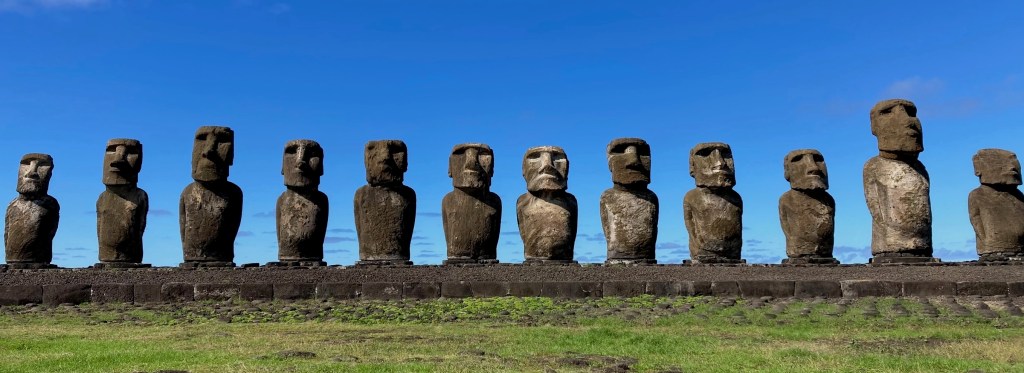
Perhaps, like me, you have a picture of Easter Island in your mind. A place with some weird stone heads sticking up out of the ground, conflicting opinions about their origin, and not much else. It turns out that there are over a thousand moai scattered around the island, not just the dozen or so pictured in old National Geographic magazines. There is also a thriving community of indigenous people who are proud of their history and protective of their culture and heritage.
During the recent pandemic, Rapa Nui was essentially cut off from contact with the rest of the world. The ships and planes they rely on to bring them supplies all but stopped arriving. Tourism, which these days provides the bulk of income and work for islanders, came to an abrupt and total halt.
One woman we spoke with recalled fondly that the islanders quickly reverted to the lifestyle of their ancestors. Locals traded what they had for what they needed. Farming increased to provide native produce (camote, potatoes, sugar cane and taro, among others). The barter system replaced that of money for goods. These days it is back to business as usual with flights disgorging hundreds of tourists each day to the island, filling the hotels, restaurants, and souvenir shops.
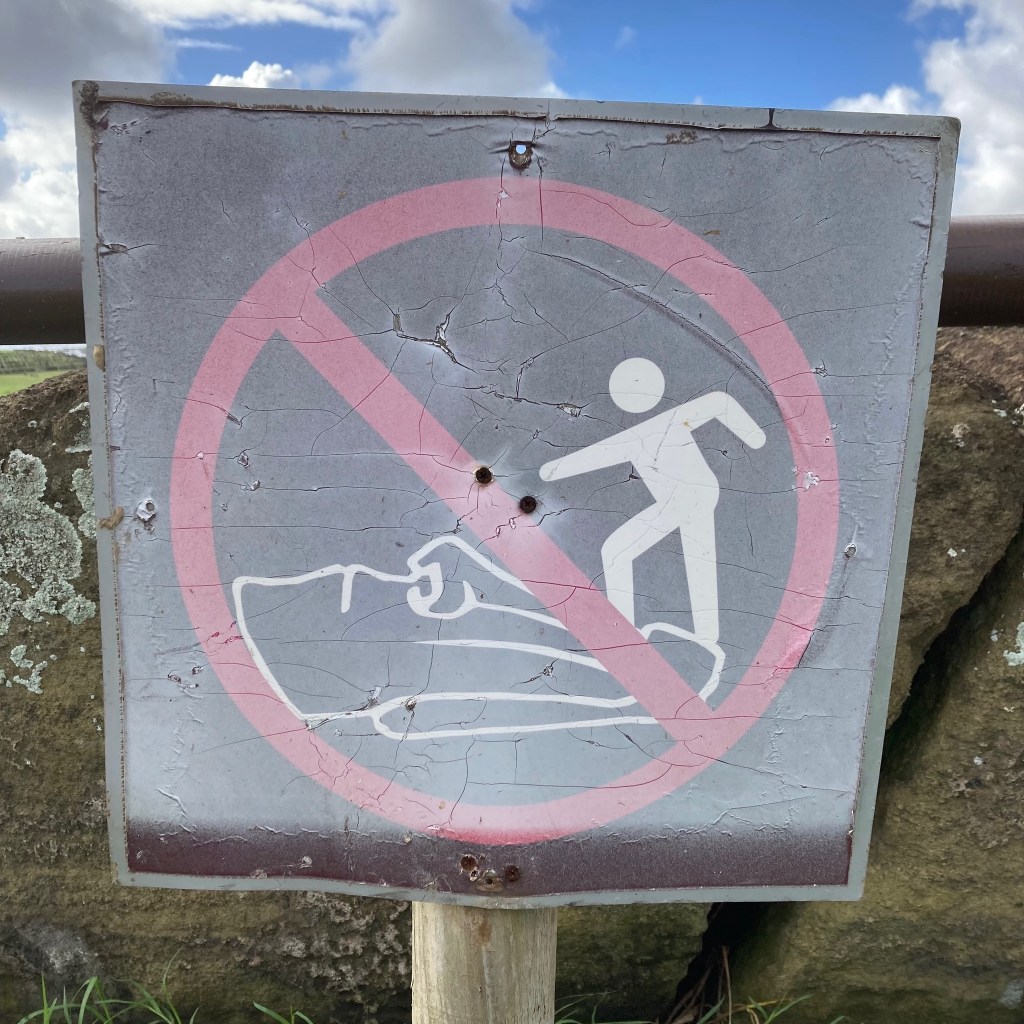
One change as a result of the Covid shutdown is that now in order to see any of the island’s sites you must be accompanied by a licensed guide or native islander. No doubt this was put in place to create new jobs for locals as well as to ensure that the heritage sites are protected from damage and misuse.
Fun fact: Over 40 percent of the island has been designated a UNESCO World Heritage site.
One of the beautiful things we have discovered by being unhurried in our travels is that it provides us the opportunity to allow for serendipity. Rather than planning out every minute to make sure that we get to all the “must-see” places, we can arrive in a place, get a feel for it, talk to locals and other travelers to get their suggestions, and be flexible when something unexpected shows up that catches our interest. The average amount of time a typical tourist spends on Rapa Nui is two to four days. On the advice of a friend, we decided to stay for nine, and we were not disappointed.
Since you now need a guide to see the sites, there is very little that you can do on your own. But we did find one hike around the southwest corner that we could access directly from town and would take us to the top of an extinct volcano. We had a wonderful hike uphill to a scenic overlook and a path around the rim of a crater lake. At the end of the path lies Orongo, site of the ruins of a 500-year-old village, which does require a guide to enter. We thought we could hire a guide once there but found that was not an option. So we turned around to hike back to town. Going back past the overlook, we met a group of tourists and overheard them talking about doing a beach clean-up. I had been hoping to get involved in removing trash from a beach, having read that it was becoming a huge issue on the island. Serendipity! I struck up a conversation with some of the group and they suggested I talk with their guide. It turns out that not only were we more than welcome to join them in beach cleaning, they were on their way to Orongo and we were invited to tag along with them.
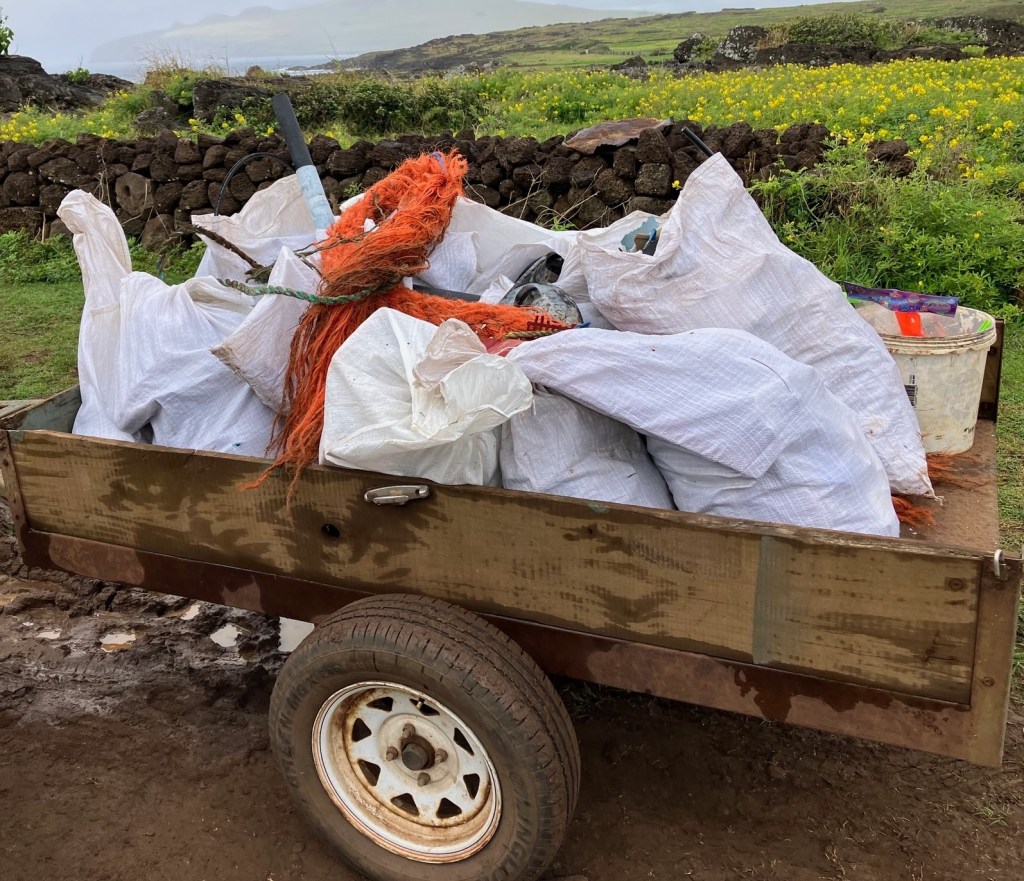
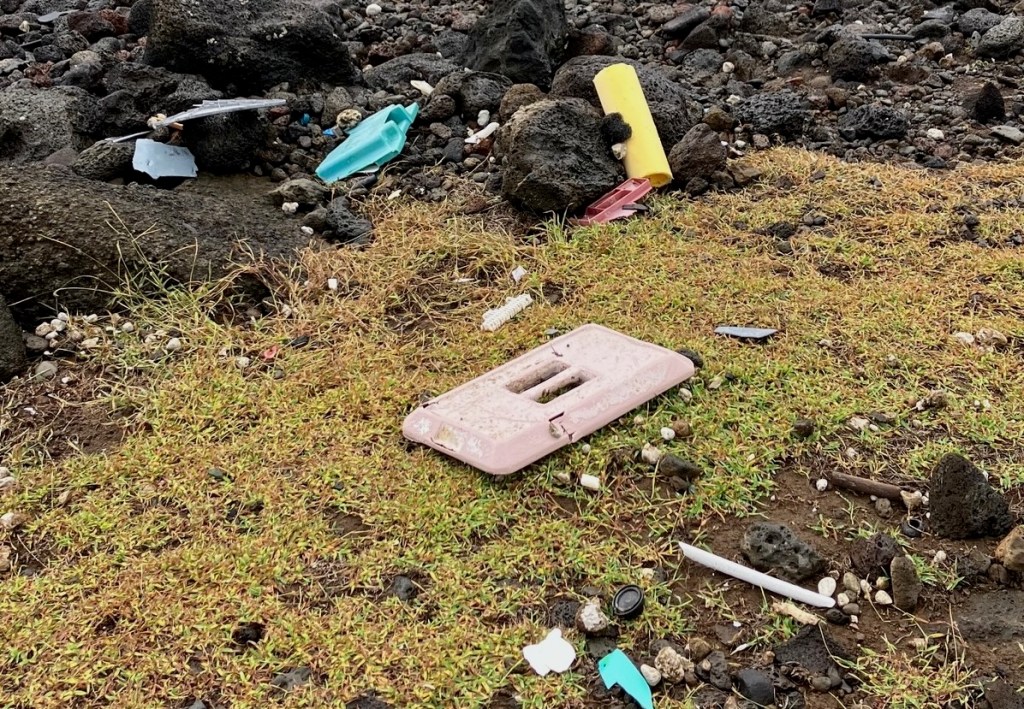
A couple days later our group of hardy trash collectors, reusable 30-gallon bags in hand, climbed over the lava rocks along the shore gathering plastic washed up from the ocean. The clean-up was organized by Te Mau o te Vaikava o Rapa Nui (Youtube video: Cleaning Rapa Nui), a group dedicated to conservation of the ocean water surrounding the island. We found all manner of plastic waste—a hair brush and comb, razor blade handles, toothbrushes, rope, bottles, cooler tops, flip flops, and much that was unrecognizable. After just one hour we had filled more than 20 bags and gathered more than 150 pounds of trash. Unfortunately, Rapa Nui is in the direct path of the planet’s fifth and most-recently formed ocean garbage patch (aka “trash island”), so a lot of plastic washes up on its shore (see PBS Newshour story for more: Trash on Rapa Nui).
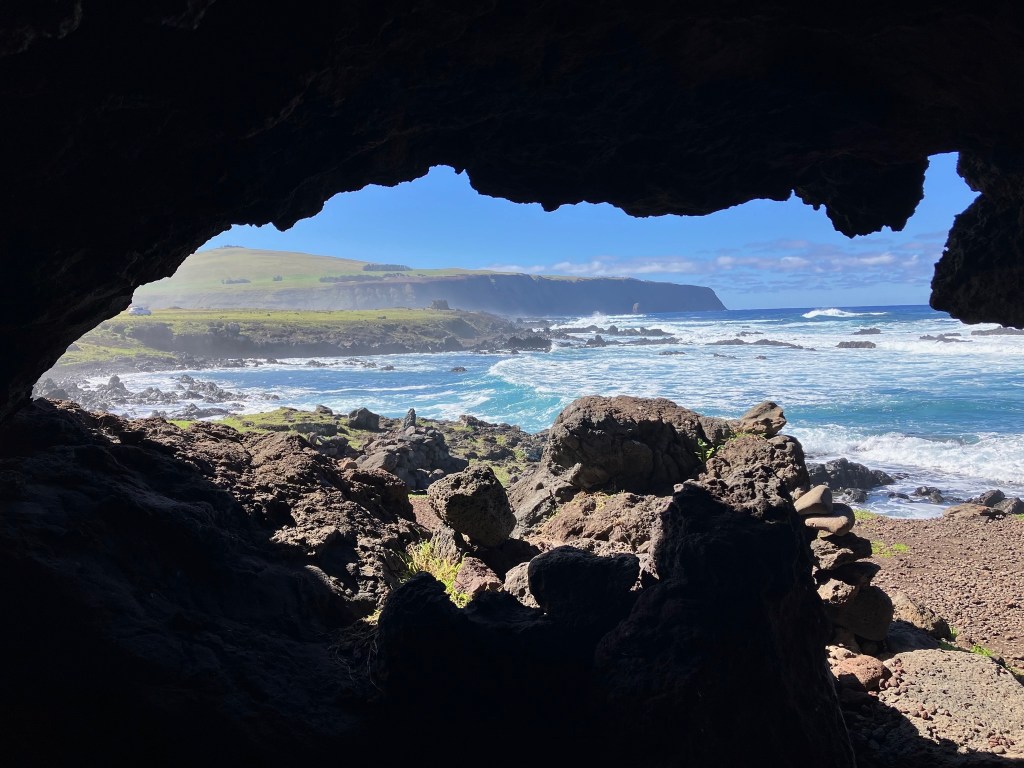
After cleaning up the trash, we were again invited to tag along and visit a heritage site. This time we crouched our way through an ancient cave system created when the island was still being formed by its four volcanoes. The tunnels and caves have been used as housing throughout the ages. Our lodging host told us that she and her family lived in one of the caves for three months when her children were young. I did not learn whether it was out of necessity or just for the novelty of the experience. Though I wouldn’t seek it out, I can think of worse places to hang my hat for a short time than a spacious cave on a tropical island.
Fun fact: There are neither bats, nor snakes, nor sea gulls on the island.
Speaking of animals, in 1903 the island was leased for 25 years to a Scottish sheep farming company named the “Easter Island Exploitation Company.” (You can’t make this stuff up!) About 70,000 sheep had free range of the island while the native people were essentially herded and penned into one small corner of the island. Today there is not one single sheep (nor any goats for that matter) living here. Rats arrived a few hundred years ago on sailing ships when explorers were “discovering” South America and the South Pacific islands. The rats had no natural predators on the island and proceeded to reproduce wildly and overrun it. Later, Chimango CaraCara (small hawk-like birds) were introduced to mitigate the rat problem. Not surprisingly, they also had no natural predators and so have themselves become a bit of a nuisance. These days islanders have cows and horses, which are given free range (where exactly would they run off to?). You often have to wait patiently while they occupy the one road that circles the island.
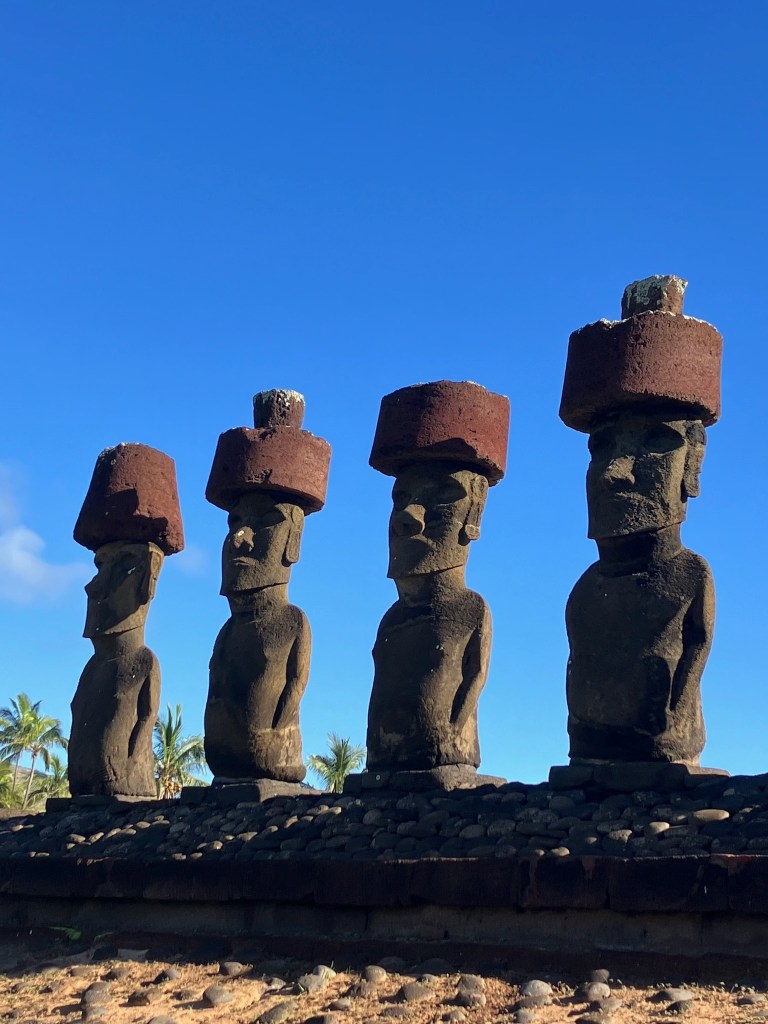
Rapa Nui falls about halfway between Nantucket and Martha’s Vineyard in total area (obviously I am showing my New England-centric roots here). It was formed by a series of volcanoes underneath the water, so it is 50 times larger than what we can see on the surface. Despite being a Polynesian island, it has just one small sand beach; the rest of the coastline is rough volcanic rock. We caught a ride to the beach one morning and enjoyed some body surfing under the watchful eyes of a group of moai standing guard over the buried remains of what is thought to have been the first village on the island. It was easy to imagine the first Polynesian navigators, having traveled thousands of miles in open outrigger canoes with plants and animals, circling the island and seeing this one sandy beach as the most hospitable place to land and settle.
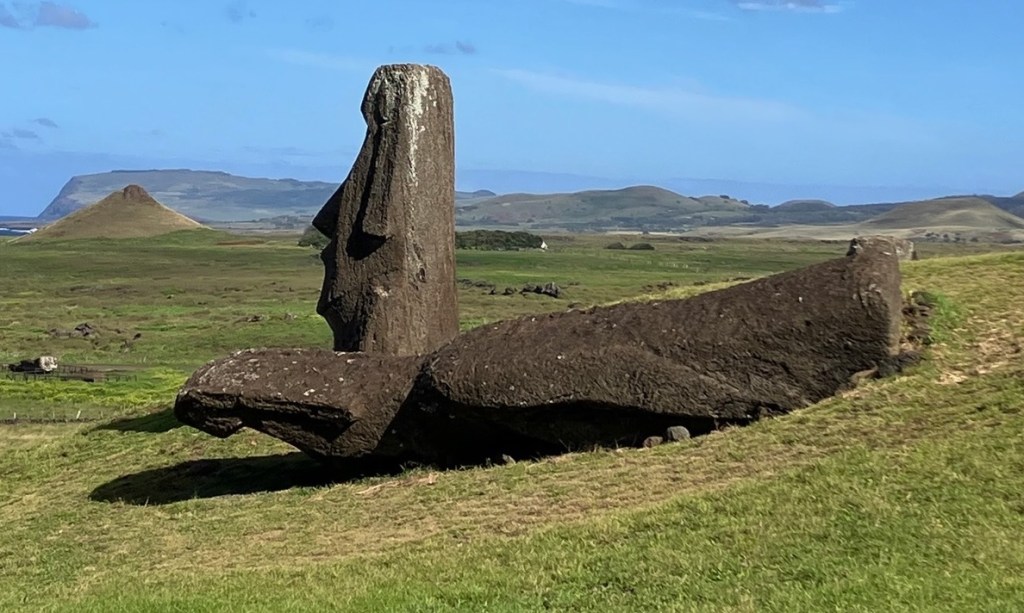
The most popular tourist site on the island is the quarry where all the moai were carved during their heyday. The moai were hewn directly out of the rock and then once cut free they were “walked” using an ingenious though not fail-proof method of ropes and brute strength, to a platform somewhere on the island. Many of the moai never made it out of the rock, others face-planted on the slope of the stone mountain, and still others fell on their way to their platform and were left to suffer the indignity of erosion, facedown on the ground. The age of moai worship lasted about 500 years and was abruptly abandoned, leaving dozens of moai partially carved and anthropologists to wonder why. Once again, we had not made specific tour plans but got lucky when we were introduced to a native Rapa Nui man named Jhony, who offered to spend some time showing us around.
Jhony grew up playing in the shadow of the quarry on his grandfather’s land and now has his own home and farm at the bottom of the mountain’s slope. He took us around the back side of the quarry and showed us the volcano’s crater lake. As we were walking through an opening in the wall of the crater he pointed out a thick black hose coursing down the hill and recounted a memory from his childhood. His grandfather, needing water for his farm animals, blasted an opening in the crater wall with dynamite and ran a hose from the lake to his farm. That gap in the wall became the primary path for people to reach the crater lake. We also learned from him that just a couple of generations ago, children were beaten by their teachers for speaking rapanui (the language of the islanders). Fortunately, these days children are given the option to do first through third grade entirely in their native language and it is flourishing. Among Jhony’s own grown children, one is a rapanui language teacher, one teaches the traditional dance form, and a third organizes the preservation and education of the island’s unique music. Clearly keeping their culture alive is a priority and joy for them all.
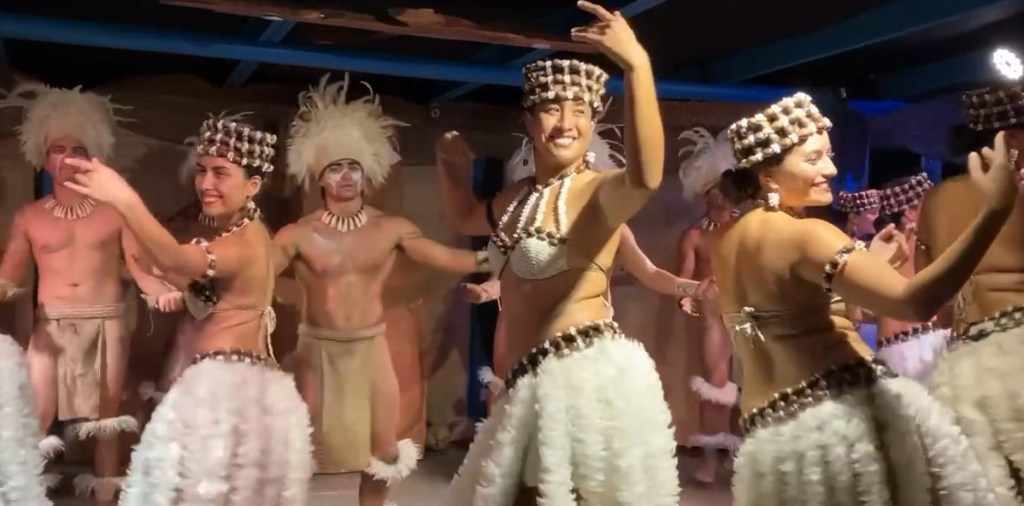
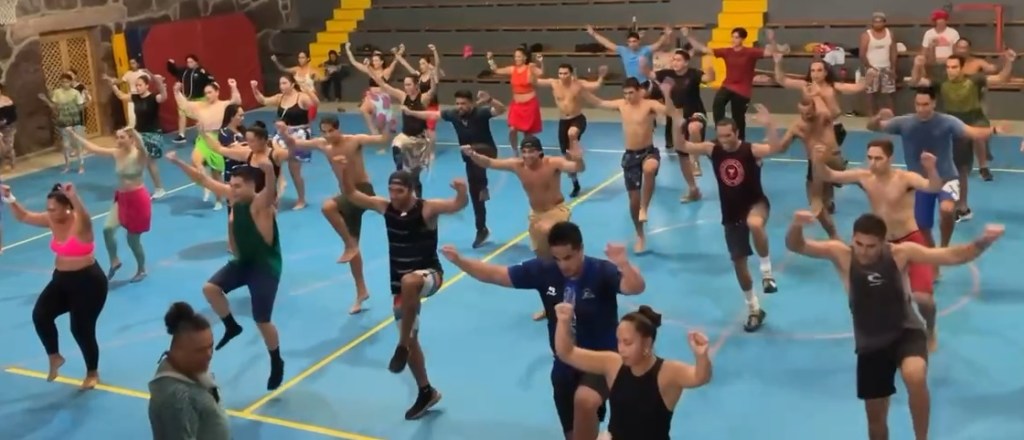
One day, while walking in town we heard music emanating from the community gymnasium. Curious, we stepped inside where we saw about 80 people practicing a traditional dance accompanied by a group of musicians playing all sorts of instruments. We learned that later in the month a group of 200 island dancers, musicians, and artisans would be heading to Hawaii to participate and compete in a pan-Polynesian multi-day event; a competition of sorts but also a sharing of island cultures. One evening early in our stay, we went to see a dance/music show (think: Luau) and wondered if the dancers’ smiles were genuine or a put-on for the performance. When we saw the smiles on the faces of the people dancing in the gym, we knew their joy and enthusiasm for dancing was genuine. They were clearly having a great time.
Fun Fact: Only the first European sailors saw any moai standing on their platforms. By the late 1700s all of these huge stone statues were toppled (or fell) to the ground, face-down.
It wasn’t until Thor Heyerdahl and other archaeologists arrived in the 1950s that a massive effort began to restore and re-stand the moai to their original positions of honor. There are several theories as to why the massive statues were toppled—ranging from earthquakes to a loss of faith in the old ways when finite resources dwindled and inter-tribal warfare erupted on the island. But whether standing upright or lying face-down, whether inside a restored national park site or alongside a hiking trail, the moai we saw are constant reminders of the culture that once thrived and that is once again connecting to its roots.
As Jhony, our guide, laughingly said, weren’t their ancestors foresighted? The moai were carved to house the mana (spirit) of their ancestors, who were placed on the platforms to watch over and protect their people; to help them thrive. After 500 years of exploitation, slavery, and disease brought by foreigners, the Rapa Nui people are again thriving thanks to the moai drawing tourists from all over the world.
 Seeing the World, One Year at a Time
Who needs National Geographic? I never cease to wonder at your ability to so exquisitely relate your observations and experiences. Never knew how much I didn’t know about Rapa Nui, including the name. Enjoyed the fun facts. Grateful I get to go along with you and your enriching journey. XOX Shirley
LikeLike
What a lovely thing to say Shirley. Thanks for commenting (and for being such a consistent reader). We are now with my parents in their new condo and loving having time together. XOXOXO
LikeLike
I’m with Shirley: no matter what you and Al write about, it’s always intriguing and delightful, and I’m glad to have the opportunity to learn from and enjoy reading about your travels. Thank you for sharing your discoveries and your experiences.
LikeLike
Hi Leslie. Thanks for commenting. We loved your mother’s native land and are so glad to have had the chance to get to know it from top to bottom this past year. Take care.
LikeLike
This was wonderful to read. I appreciated learning about this magical place from you.
I hope to see you both soon!
LikeLike
I would love to spend time with you and your family. Let us know if you have plans to travel east this summer.
LikeLike
Amazing! I totally appreciate your way of traveling – taking time and not planning much. So, you felt like you got to see and visit what you wanted without planning any guided tours?
I’ve always wanted to visit Rapanui and almost flew there from Tahiti many years ago, but a little issue got into our way back then. Now, traveling in South America with a dog prevents us from visiting the island out of Santiago. One day…
LikeLike